How to identify it
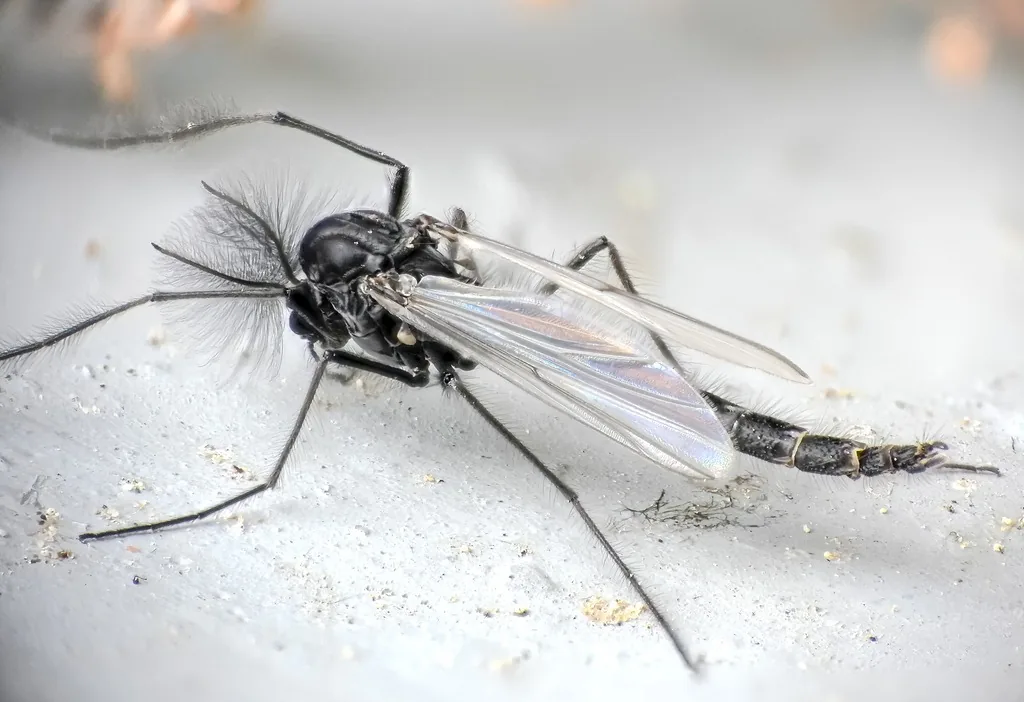
- Adults are about 0.2 to 0.5 inch long, in light green, pale, tan or dark brownish-black, with clear wings that have no markings.[1]
- They often hold their long front legs forward, away from the body.[1]
- Males have bushy, feathery antennae, which gives them the nickname fuzzy bills; females have thin, thread-like antennae.[1][2]
- Swarming adults may make a high-pitched humming sound as they gather to attract mates.[1]
Look-alikes
| Look-alike | How to tell them apart |
|---|---|
| Mosquitoes | Midges resemble mosquitoes closely enough to be called blind mosquitoes, but they don't bite or spread disease and are weak fliers that rest in masses near water.[1][2] |
Where it lives
Found in nearly every kind of fresh or brackish water, from fast streams and slow rivers to ditches, ponds, lakes, reservoirs, sewage ponds and stormwater basins.[1][2]
Biology and life cycle
Midges go through egg, larva, pupa and adult stages; most larvae live in the mud at the bottom of the water.[1]
Larvae are worm-like with a distinct head; some that live in low-oxygen water carry hemoglobin and are bright red, earning the name bloodworms.[1]
Adults emerge in spring, sometimes in huge numbers, with a peak that usually lasts only a few weeks; several generations occur each year.[1]
Adults live only a few days, mating and then dying.[1]
Swarms usually form in late afternoon or evening near water, and adults are drawn to outdoor lights on nearby houses.[1]
Water enriched with nitrogen and phosphorus from lawn, farm and recreational runoff favors the tolerant midge species that reach the highest numbers.[1][2]
Damage and signs
Health risk
Non-biting midges do not bite or transmit diseases. Their larvae are an important food for fish, birds and other wildlife and are used as indicators of water quality.[1][2]
Control
Prevention
Turn off outdoor lights when you can, or switch to lower-intensity, motion-activated fixtures, and lower shades or blinds at night during peak emergence.[1]
Keep them out
Keep doors and windows tightly sealed and screens free of holes to keep midges out of the house.[1]
Sanitation
Reduce fertilizer use and keep wide buffers around ponds and lakes, since nutrient runoff can make midge problems worse.[1][2]
Pesticides
Spraying is not a real option for homeowners: ponds and lakes cannot and should not be treated with insecticides, and fogging for adults is short-lived and kills harmless insects too.[1]
When to call a professional
Some states run midge suppression programs; Maryland's targets larvae by air along the Back River and asks residents to report swarms through its Midge Reporter tool.[2]
Common questions
- Do midges bite?
- No. Non-biting midges cannot bite and do not spread disease, even though they look a lot like mosquitoes.[1][2]
- How long do midge swarms last?
- Each adult lives only a few days, and the spring peak usually lasts a few weeks, though more generations follow during the year.[1]
- Why do midges cover my house at night?
- Adults are attracted to lights near the water where they emerge. Cutting outdoor lighting and closing blinds reduces how many settle on your walls.[1]
Sources
- Virginia Cooperative Extension, Virginia Tech, “Non-biting Midges (ENTO-438NP, published September 8, 2026).” www.pubs.ext.vt.edu/ENTO/ENTO-438/ENTO-438.html (accessed 2026-10-06)
- Maryland Department of Agriculture, “Nuisance Midge Control and Information.” mda.maryland.gov/Pages/Nuisance%20Midge%20Control%20and%20Information.aspx (accessed 2026-10-06)
- iNaturalist, “Chironomidae taxon page (order and family).” www.inaturalist.org/taxa/53275 (accessed 2026-10-06)