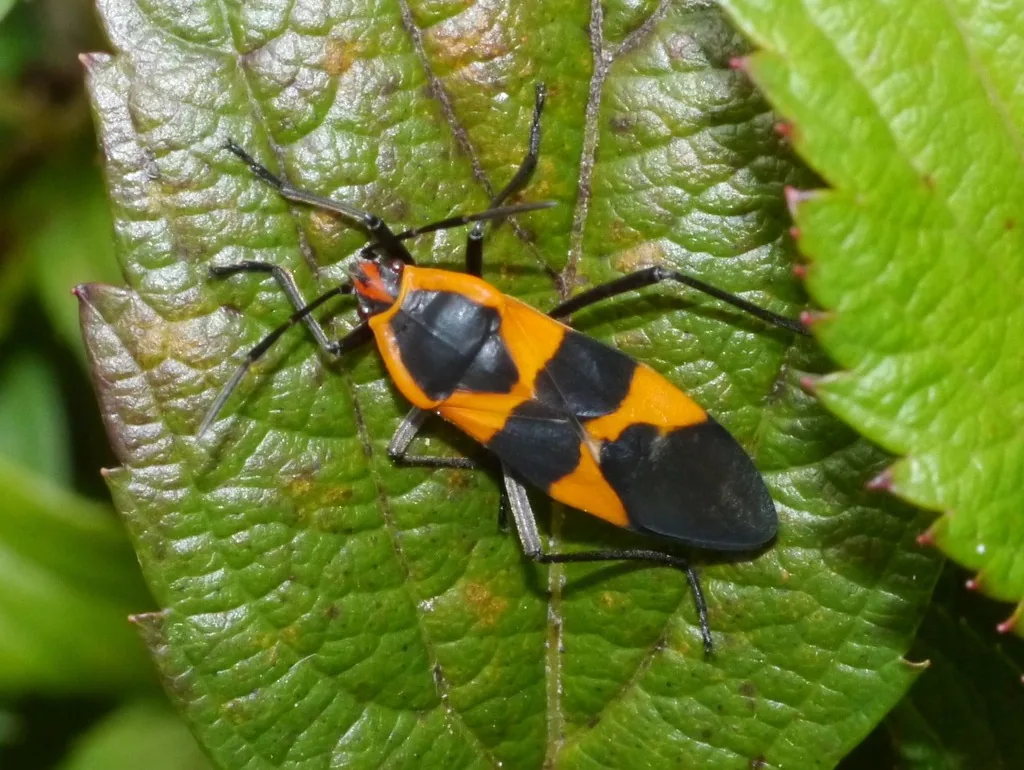
How to identify it
- Adults are 1/2 to 3/4 inch long, reddish orange with a black band across the middle and large diamond-shaped black patches at front and rear.[1]
- Nymphs are red, become more spotted as they grow, and show larger wing buds with each molt.[1]
- Newly molted adults are yellow and black, turning reddish orange as they mature.[1]
Where it lives
It is a southern and eastern species that Iowa State reports has become much more common in Iowa in recent years.[2]
Biology and life cycle
Females lay 25 to 35 eggs a day in small clusters; the eggs hatch in about five days, and nymphs molt five times to become adults.[1]
Bugs usually appear after milkweed forms seed pods, then new adults move to sheltered spots for winter.[1]
Milkweed seeds appear to be their only food, though they have also been reported from oleander.[1]
Their bright colors warn predators: the bugs build up toxins from milkweed.[2]
Damage and signs
Health risk
Iowa State describes milkweed bugs as harmless, and NC State notes they do little damage.[1][2]
Control
Prevention
In a butterfly garden it is usually better to live with the seed damage than to spray.[1][2]
Sanitation
Remove leaf litter and spent milkweed stalks in fall to eliminate overwintering spots.[1]
Pesticides
If no monarch caterpillars are present, insecticidal soap kills the bugs and its dried residue is not especially toxic to caterpillars that hatch later.[1]
Common questions
- Do milkweed bugs hurt monarch caterpillars?
- No. They feed on the seed pods without disturbing monarch caterpillars on other parts of the plant.[2]
- Should I kill milkweed bugs?
- Usually not. They do little damage and last only a month or so; insecticides can harm monarchs and pollinators.[1][2]
- Why are there suddenly so many milkweed bugs?
- They appear after milkweed sets seed pods; in Iowa they have become more abundant in recent years.[1][2]
Sources
- NC State Extension, “Milkweed Bug (PDIC Factsheet).” content.ces.ncsu.edu/milkweed-bug (accessed 2026-10-15)
- Iowa State University Extension and Outreach, “Large Milkweed Bugs (Yard and Garden, August 24, 2018).” yardandgarden.extension.iastate.edu/article/2018/08/large-milkweed-bugs (accessed 2026-10-15)
- iNaturalist, “Oncopeltus fasciatus taxon page (order and family).” www.inaturalist.org/taxa/55556 (accessed 2026-10-06)