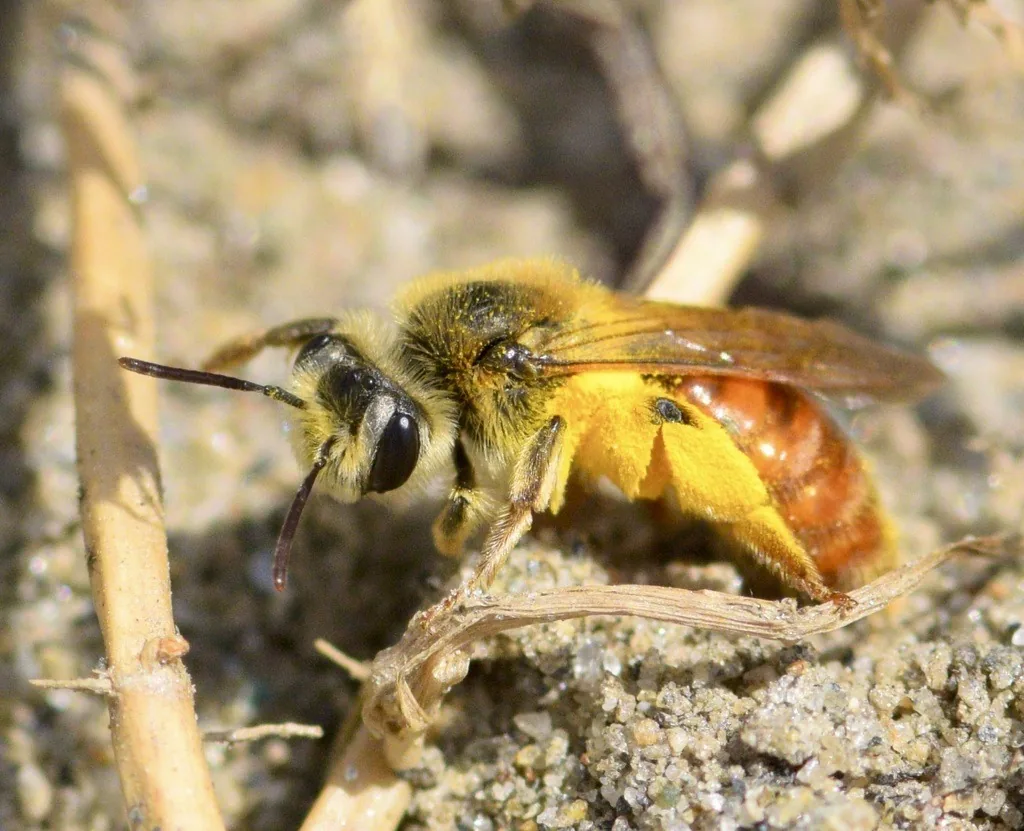
How to identify it
Look-alikes
| Look-alike | How to tell them apart |
|---|---|
| Cellophane bees | Colletes bees also nest in spring ground aggregations, and cuckoo bees appear a few weeks after both emerge.[1] |
Where it lives
Penn State notes mining bees are among the most abundant ground-nesting bees in the northeastern US, and Pennsylvania alone has at least 438 bee species.[1]
Biology and life cycle
Ground-nesting spring bees are active for about 6 to 8 weeks, and about a third of Pennsylvania's bee species emerge in March and April.[1]
Most prefer loose, exposed soil on south-facing slopes, which warm earlier in spring.[1]
They pollinate native plants and crops such as apples, pears, cherries and blueberries.[1]
Damage and signs
- They don't damage lawns or homes; their nests are common in backyard gardens.[1]
Health risk
Females have a stinger but aren't aggressive; they won't try to sting unless handled or stepped on.[1]
Control
Prevention
Penn State strongly recommends avoiding chemicals; if control is absolutely necessary, water the nesting area to encourage the bees to nest elsewhere.[1]
Common questions
Sources
- Penn State Extension, “Spring Bees: Who Are They and Where Do They Live?.” extension.psu.edu/spring-bees-who-are-they-and-where-do-they-live (accessed 2026-10-06)
- iNaturalist, “Andrena taxon page (order and family).” www.inaturalist.org/taxa/57669 (accessed 2026-10-06)