How to identify it
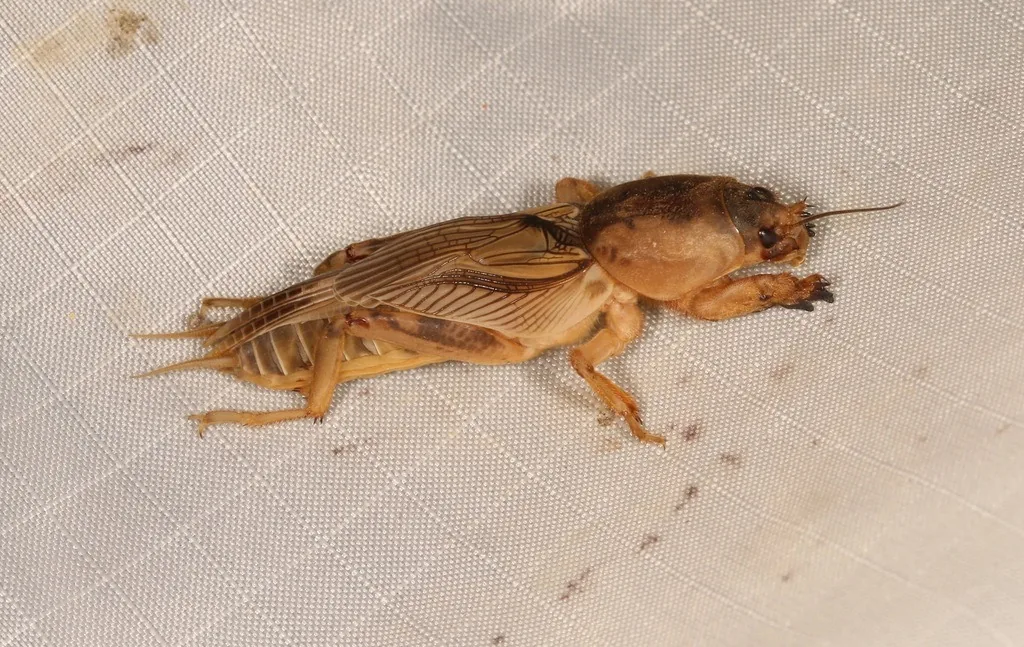
- Adults are cylindrical, dull to yellowish brown and about 1 to 1 1/2 inches long, with enlarged, shovel-like front legs built for digging.[3][1]
- Nymphs look like small adults with undeveloped wing pads.[2][3]
- The southern mole cricket has two pairs of pale spots on the shield behind the head and a wide U-shaped gap between the digging claws.[3]
- The tawny mole cricket lacks those pale spots, and its digging claws nearly touch at the base, forming a narrow V.[3][1]
- The shortwinged mole cricket has wings shorter than the shield behind its head and can't fly.[1]
Look-alikes
Where it lives
The southern mole cricket ranges from North Carolina to central Texas and into Arizona and California. The tawny mole cricket sticks near the Atlantic and Gulf coasts from North Carolina to Texas but occurs throughout Florida.[2][1]
Biology and life cycle
Most have one generation a year, overwintering as large nymphs and adults; southern mole crickets have two in southern Florida.[1][2]
Adults fly at night in spring, are drawn to lights, and burrow into moist soil nearby to mate and lay eggs, so damage often starts around lights and sprinkler heads.[2]
Females lay clusters of about 25 to 60 eggs in a chamber several inches deep, and nymphs develop over the summer.[1][2]
They tunnel just under the surface when soil is warm and moist, go deeper when it dries, and surface to forage after dusk.[1]
The southern mole cricket eats mostly other insects, while the tawny mole cricket feeds mainly on plants.[1][3]
Damage and signs
- Tunneling and root feeding cause thinning, dead patches and grass that looks drought-stressed even after watering.[2]
- Bahiagrass, bermudagrass and seashore paspalum suffer most; St. Augustinegrass, centipedegrass and zoysiagrass are injured less often.[2]
- They also cut off and girdle garden seedlings such as tomato, pepper, cabbage and lettuce at the soil line.[1][2]
- Raccoons, armadillos and birds dig up lawns hunting for mole crickets, adding to the damage.[2]
Health risk
Mole crickets are not harmful to people or animals; they are plant pests.[3]
Control
Prevention
Soap-flush to confirm them: pour soapy water over a few square feet of turf at the edge of damage and count crickets that surface within three minutes. Two or more often justifies action.[2][1]
Keep grass healthy with proper fertilizing, watering and mowing height; scalping adds stress and makes damage worse.[2]
Reduce outdoor lighting that attracts flying adults, and map areas hit before, since they are likely to be reinfested.[2]
Biological control
Introduced natural enemies, including a mole-cricket nematode, a parasitic Larra wasp and a red-eyed fly, have sharply reduced mole crickets in Florida.[1][2]
Pesticides
Use insecticides only where damage thresholds are exceeded, targeting small summer nymphs, which are easier to kill than larger nymphs in late summer and fall.[2]
Watering before treatment brings crickets closer to the surface; baits work best applied in early evening and are washed out by rain or irrigation.[2][1]
Common questions
- How can I tell if mole crickets are damaging my lawn?
- Look for raised tunnels, spongy soil and grass that wilts despite watering, then do a soap flush to bring crickets to the surface.[2][1]
- When is the best time to treat for mole crickets?
- In summer, while nymphs are small. Large nymphs and adults in late summer and fall are much harder to control.[2]
- Why are there so many mole crickets near my porch light?
- Flying adults are attracted to lights at night and often burrow and lay eggs in moist soil nearby.[2]
Sources
- University of Florida IFAS Extension, Featured Creatures, “Shortwinged, Southern and Tawny Mole Crickets, Neoscapteriscus spp. (IN391).” ask.ifas.ufl.edu/publication/IN391 (accessed 2026-10-06)
- University of Florida IFAS Extension, “Mole Cricket IPM Guide for Florida (IN1021).” ask.ifas.ufl.edu/publication/IN1021 (accessed 2026-10-06)
- Texas A&M AgriLife Extension, “Southern Mole Cricket (Field Guide to Common Texas Insects).” texasinsects.tamu.edu/mole-cricket/ (accessed 2026-10-06)
- iNaturalist, “Neoscapteriscus vicinus taxon page (order and family).” www.inaturalist.org/taxa/558126 (accessed 2026-10-06)