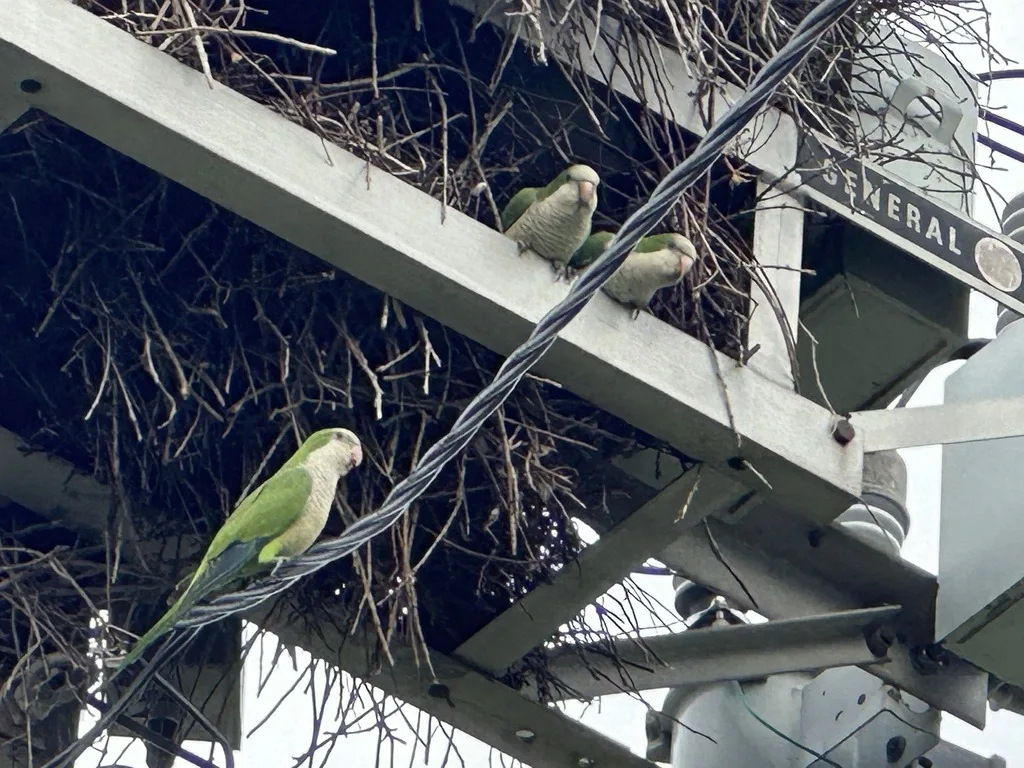
How to identify it
- A medium-sized parrot, about 11 to 13 inches from head to the tip of its long, tapered tail, weighing 3 to 4 ounces.[2][1]
- Mostly green, with a gray face, throat and breast; the gray breast feathers have pale edges that give a scalloped look.[2][3]
- The bill is pale pinkish, and blue flight feathers show on the wings in flight.[2][3]
- The gray head and breast set it apart from other parrots living wild in North America.[1]
- Flocks are loud, and their raucous contact calls can be very annoying to neighbors of a colony.[1][3]
Look-alikes
Where it lives
Native to lowland South America. Established U.S. populations live in New York, Connecticut, Illinois, Texas, Louisiana and Florida, with Florida's largest around Miami, West Palm Beach and Tampa.[1][2]
Biology and life cycle
They live in social flocks and build bulky nests of sticks and twigs, adding to and maintaining them all year.[2][1]
Nests are communal: each pair has its own apartment of at least two chambers, built onto the main structure as the colony grows.[2][1]
Pairs are monogamous and raise one clutch of 4 to 8 eggs a year.[1]
They eat fruit, seeds, buds, flowers and insects, and readily visit backyard feeders for sunflower seeds.[1][2]
Monk parakeets don't shy away from people and are found in towns, suburbs, farms and orchards.[2][3]
Damage and signs
- The main U.S. conflict is with electric utilities. In one south Florida study, 60 percent of nests were on energized utility equipment.[1]
- Nesting material can complete a circuit between energized parts or to a grounded part, causing power outages and fires that damage transformers.[1]
- Monk parakeets and other birds damage tropical fruit crops such as longans and mangos, and they may also feed on citrus, corn and sorghum.[1][2]
- Their nonstop calling near a colony is a common neighborhood complaint.[1]
Health risk
The main safety concern is nests on energized utility equipment, which can short circuit and start fires.[1]
Control
Keep them out
Hard plastic anti-perching cones can be somewhat effective on transmission towers, but there is no practical way to exclude them from distribution poles or substations.[1]
Traps and physical control
Nest removal gives only short-term relief, because the birds tend to rebuild immediately.[1]
Red laser light made monk parakeets leave a nest colony in tests, but the effect didn't last.[1]
Pesticides
No toxicants are registered for monk parakeets. The contraceptive diazacon cut eggs and chicks by 68 percent in trials but remains experimental and unregistered with the EPA.[1]
When to call a professional
Where removal is legal, trapping at the nest with a long-handled net works best after dark, when birds are less likely to scatter.[1]
Legal status
Monk parakeets are non-native and not protected by the federal Migratory Bird Treaty Act.[1]
The U.S. Fish and Wildlife Service's list of birds outside the Act includes the parrot family, Psittacidae.[4]
State rules vary considerably, from no regulation at all to complete protection, so check with your state wildlife agency before taking any action.[1]
In Florida they are regulated as Class III wildlife: a permit is needed to keep them for exhibition or sale, but not as personal pets.[2]
Why shooting is rarely an option
Most U.S. monk parakeets nest, feed and fly in populated areas, which severely limits the use of firearms.[1]
Common questions
- Are monk parakeets protected?
- Not federally, since the Migratory Bird Treaty Act doesn't cover them, but state protection ranges from none to complete.[1][4]
- Why do monk parakeets build nests on power poles?
- They build big stick nests on human structures, and utility equipment is a favorite; in one Florida study most nests were on energized equipment.[3][1]
- Will knocking down the nest make them leave?
- Usually not for long. Monk parakeets tend to rebuild right away, so nest removal gives only short-term relief.[1]
Sources
- USDA APHIS Wildlife Services, “Monk Parakeets, Wildlife Damage Management Technical Series (Avery and Lindsay, November 2016).” aphis.prod.usda.gov/sites/default/files/Monk-Parakeet.pdf (accessed 2026-10-06)
- Florida Fish and Wildlife Conservation Commission, “Monk Parakeet (Myiopsitta monachus) species profile.” myfwc.com/wildlifehabitats/profiles/birds/monk-parakeet/ (accessed 2026-10-06)
- Cornell Lab of Ornithology, All About Birds, “Monk Parakeet Identification.” www.allaboutbirds.org/guide/Monk_Parakeet/id (accessed 2026-10-06)
- U.S. Fish and Wildlife Service (Federal Register), “List of Bird Species To Which the Migratory Bird Treaty Act Does Not Apply, 85 FR 21262 (April 16, 2020).” www.govinfo.gov/content/pkg/FR-2020-04-16/html/2020-06782.htm (accessed 2026-10-06). Lists Psittacidae (parrots) among families the MBTA does not cover.
- iNaturalist, “Myiopsitta monachus taxon page (order and family).” www.inaturalist.org/taxa/19349 (accessed 2026-10-06)