How to identify it
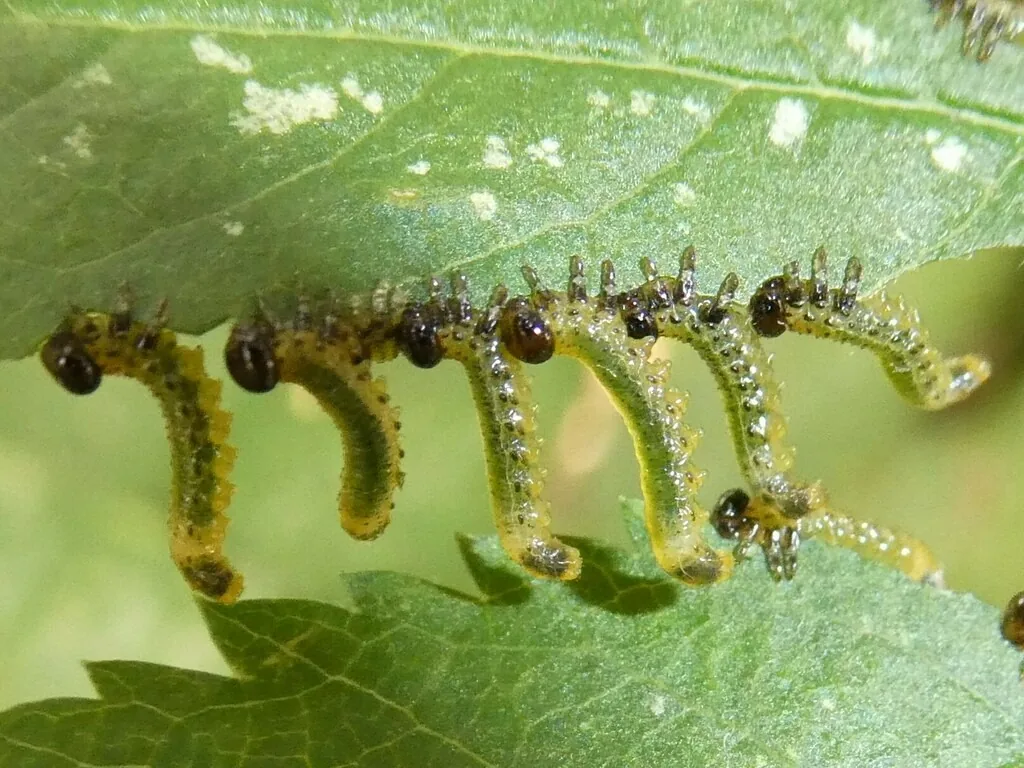
- Young larvae are yellowish and somewhat translucent; older ones are orange-yellow with distinct black spots and grow to 0.6 to 0.75 inch.[1]
- Larvae line up nearly head to head along a leaflet edge and swing their tail ends away from the leaf.[1]
- Adults look like small dark flies but have four wings; they're sawflies, related to bees, ants and wasps.[1]
Where it lives
It arrived in the US from Europe in the 1920s, was found north of Seattle in 2009 and has since spread to several counties.[1]
Biology and life cycle
It overwinters in a brownish-tan cocoon in the soil; adults emerge in late spring and insert eggs into slits in the leaves.[1]
There are two and possibly three generations a year, and pupae can reportedly delay emergence for two or three years.[1]
Damage and signs
- Larvae eat all but the midribs and stalks of the leaflets, and the second generation can defoliate trees in midsummer.[1]
Health risk
It feeds on plants; the PNW Insect Management Handbook mentions no risk to people.[1]
Control
Prevention
Scout every year, since a heavily infested tree one year may be free of larvae the next; sticky traps can show when adults emerge.[1]
If a tree is defoliated, water it and give it light fertilizer to push new growth.[1]
Traps and physical control
Prune off sawfly clusters as soon as you notice them; early removal limits midsummer defoliation by the second generation.[1]
Common questions
Sources
- Pacific Northwest Pest Management Handbooks (OSU, WSU, University of Idaho), “Emerging Insect Pests in the Pacific Northwest: Mountain ash sawfly (2009).” pnwhandbooks.org/insect/emerging-insect-pests/emerging-insect/mountain-ash-sawfly-2009 (accessed 2026-10-06)
- iNaturalist, “Pristiphora geniculata taxon page (order and family).” www.inaturalist.org/taxa/228729 (accessed 2026-10-06)