How to identify it
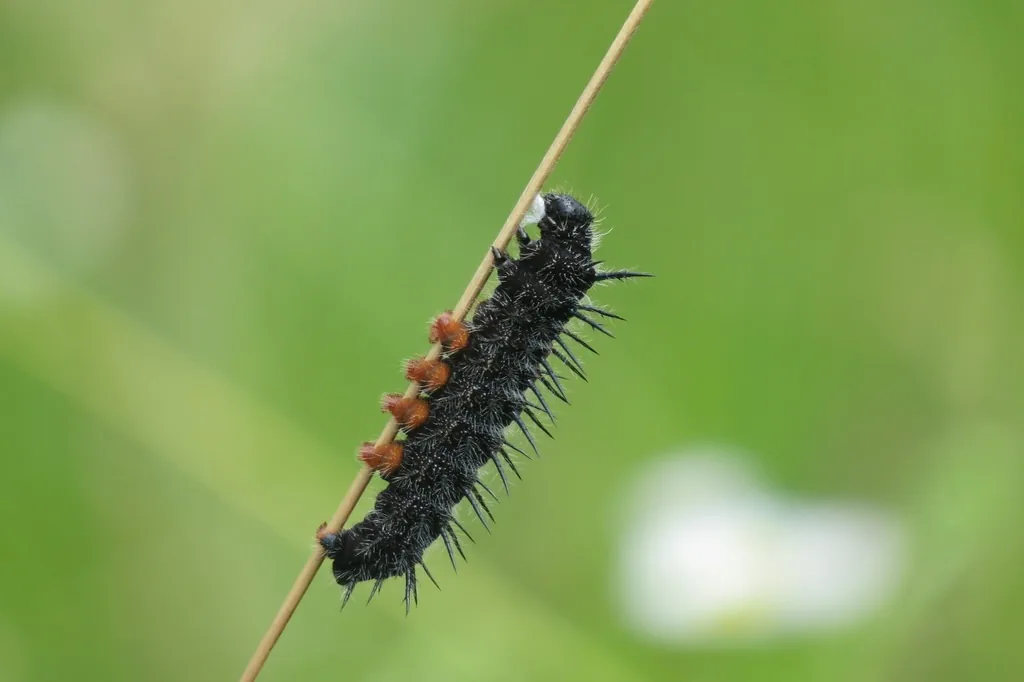
- Caterpillars are purplish black with white specks and a row of orange to red spots along the back, nearly 2 inches long when grown.[1]
- They're covered in long, forked spines and have brownish prolegs.[1]
- The butterfly is about 2.5 inches across, purplish brown to black with a creamy yellow border and a row of blue spots.[1]
Where it lives
The PNW Insect Management Handbook covers it on willow, elm and poplar in Pacific Northwest landscapes.[1]
Biology and life cycle
Adults overwinter in protected places and fly on warm spring days around budbreak.[1]
Females lay egg masses on twigs; larvae feed in large groups, then each pupates in a chrysalis hanging from a leaf.[1]
A second generation, when there is one, emerges in August.[1]
Damage and signs
- Groups eat every leaf on a branch before moving on, leaving ragged, chewed leaves.[1]
Health risk
It feeds on plants; the PNW Insect Management Handbook mentions no risk to people.[1]
Control
Traps and physical control
Hand-pick larvae or remove heavily infested branches.[1]
Biological control
Several parasitic wasps attack the larvae, and birds chase and eat the adult butterflies.[1]
Common questions
Sources
- Pacific Northwest Pest Management Handbooks (OSU, WSU, University of Idaho), “Willow (Salix): Spiny elm caterpillar (mourning cloak butterfly) (Insect Management Handbook).” pnwhandbooks.org/insect/hort/landscape/hosts-pests-landscape-plants/willow-salix-spiny-elm-caterpillar-mourning-cloak-butterfly (accessed 2026-10-06)
- iNaturalist, “Nymphalis antiopa taxon page (order and family).” www.inaturalist.org/taxa/56832 (accessed 2026-10-06)