How to identify it
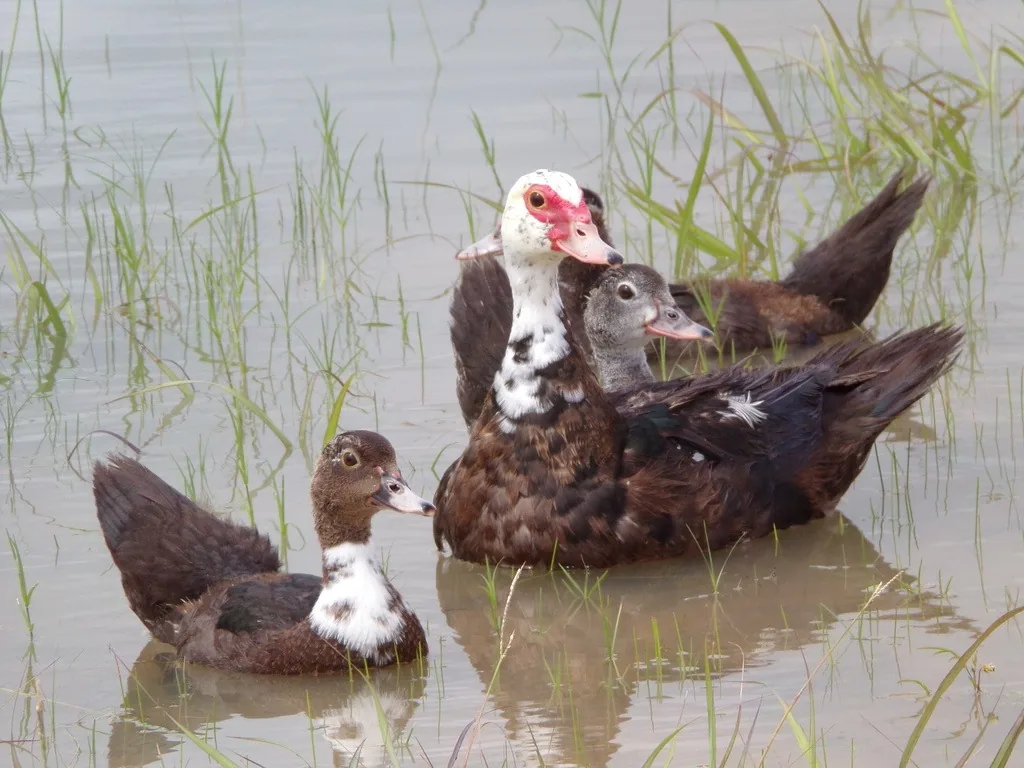
- Males have fleshy red caruncles, or warty bumps, on the face over the eyes and at the base of the bill; females have smaller caruncles or none.[5][3]
- Wild-type plumage is brownish-black with an iridescent green and purple sheen and white wing patches, but feral birds may be solid white, solid black or mottled.[2][5]
- They are big ducks, averaging about 9 pounds with a wingspan of 54 to 61 inches; males are larger, roughly 10 to 15 pounds.[2][5]
- Compared with other ducks they have long, flattened tails and large claws.[5]
- Muscovies do not quack: the male gives a loud, dry hiss and the female a quiet coo.[5]
- Ducklings are yellow with buff-brown on the tail and wings.[5]
Look-alikes
| Look-alike | How to tell them apart |
|---|---|
| Other ducks | Muscovies can resemble other ducks, but the stocky black-and-white body and red facial bumps set them apart.[5] |
Where it lives
Native to Mexico, Central and South America and extreme southern Texas. Feral flocks live around urban centers from New York southwest to Texas and in Washington and California, and in nearly all 67 Florida counties.[5][2]
Biology and life cycle
Feral Muscovies dig shallow nests on the ground, while wild birds nest in tree cavities.[5]
A female lays 8 to 16 cream-colored eggs and incubates them for about 5 weeks; males often guard the ducklings while they forage.[5]
They eat roots, stems, leaves and seeds of water and land plants, plus small fish, insects, crustaceans and human handouts.[2][5]
Muscovies do not migrate and are active during the day. Dominant males hold territories and mate with the females nesting there.[2]
They breed prolifically, so a local flock can grow dramatically in a short time.[3][5]
Damage and signs
- Large flocks leave heavy droppings on sidewalks, driveways, docks and patios.[2][5]
- Droppings add excess nutrients to small ponds and can seriously degrade water quality.[2][5]
- Ducks used to being fed can turn aggressive and may chase or try to bite children.[5][3]
- Feral Muscovies compete with native waterfowl, can spread disease to them and may interbreed with native ducks.[2][5]
Health risk
Muscovy droppings contaminate water and are a health hazard to people and pets, and crowded flocks can spread disease among birds.[5][3]
Control
Prevention
Never feed Muscovy ducks, either by hand or by leaving feed where they can reach it. Feeding leads to overcrowding, mess and disease.[3][5]
Traps and physical control
Make your yard unwelcome by spraying the ducks with a garden hose or letting a dog chase them off without catching them.[3]
Ducks used to handouts can often be caught with a net, or in welded-wire funnel traps baited with corn; check traps at least once every 24 hours.[2]
To cut nesting success, shake eggs vigorously and return them to the nest, or swap in plastic eggs. Simply removing eggs prompts the female to lay a new clutch.[5]
When to call a professional
In Florida the FWC does not remove nuisance Muscovies; landowners can act under the federal control order or hire a licensed nuisance wildlife trapper.[2][4]
The federal control order
Muscovy ducks are covered by the Migratory Bird Treaty Act, but a U.S. Fish and Wildlife Service control order lets people remove them without a federal permit in most of the country.[2][1]
Under 50 CFR 21.174, landowners, wildlife agencies and their tenants, employees or agents may remove or destroy Muscovies, including hybrids, and their nests or eggs at any time.[1]
The order covers the contiguous United States except Hidalgo, Starr and Zapata Counties in Texas, where a depredation permit is needed. It does not cover Alaska, Hawaii or U.S. territories.[1]
Removed ducks may not be released elsewhere, kept, eaten or sold. They must be buried, incinerated, or donated to a public museum or institution for science or education.[1]
Anyone using a firearm under the order must use nontoxic shot or bullets, and no action may harm other migratory birds or endangered or threatened species.[1]
The order also requires following state, tribal and local laws, so what is allowed still varies by state. Check with your state wildlife agency first.[1]
Florida rules
Florida treats Muscovies as a nonnative, domesticated or feral species. No FWC permit is needed to keep them, but state law and federal rules forbid releasing them.[2][3]
No permit is needed to remove them with humane live capture such as nets or cage traps. Traps must be checked every 24 hours, and other animals caught must be released on site.[2][3]
Muscovies may be shot on private property in daylight with landowner permission, using nontoxic shot or bullets; check local firearm ordinances first.[2][3]
Captured birds must be humanely euthanized or donated to a scientific or educational institution that keeps them from escaping, and euthanized birds must be buried or incinerated.[3][2]
Common questions
- Can I get rid of Muscovy ducks on my property without a permit?
- In most of the lower 48 states, yes: the federal control order lets landowners remove Muscovies, nests and eggs without a federal permit. State and local rules still apply.[1][4]
- Can I catch Muscovy ducks and take them to a park or lake?
- No. Releasing captured Muscovies anywhere else is illegal under federal rules and Florida law, because they spread disease, interbreed with native ducks and multiply quickly.[1][2]
- Why are the Muscovy ducks in my neighborhood so aggressive?
- Muscovies that are used to being fed often become pushy and may chase or try to bite children. Stopping all feeding is the first step.[5][3]
Sources
- Electronic Code of Federal Regulations (U.S. Fish and Wildlife Service), “50 CFR 21.174, Control order for Muscovy ducks in the United States.” www.ecfr.gov/current/title-50/chapter-I/subchapter-B/part-21/subpart-D/section-21.174 (accessed 2026-10-06). Issued 2010 (75 FR 9321); redesignated from 50 CFR 21.54 in 2022 (87 FR 882).
- Florida Fish and Wildlife Conservation Commission, “Muscovy Ducks (Cairina moschata) species profile.” myfwc.com/wildlifehabitats/profiles/birds/waterfowl/muscovy-ducks/ (accessed 2026-10-06)
- Florida Fish and Wildlife Conservation Commission, “Nonnative Species: Muscovy Ducks (flyer).” myfwc.com/media/arzj5c2y/muscovy-duck.pdf (accessed 2026-10-06). Cites the control order under its former number, 50 CFR 21.54.
- Florida Fish and Wildlife Conservation Commission, “FAQs: Nuisance Wildlife.” myfwc.com/conservation/you-conserve/wildlife/faqs-nuisance-wildlife/ (accessed 2026-10-06)
- University of Florida IFAS Extension (EDIS), “Florida's Introduced Birds: Muscovy Duck (Cairina moschata), WEC 254.” journals.flvc.org/edis/article/view/117879 (accessed 2026-10-06). First published March 2009; archival EDIS copy.
- iNaturalist, “Cairina moschata taxon page (order and family).” www.inaturalist.org/taxa/7120 (accessed 2026-10-06)