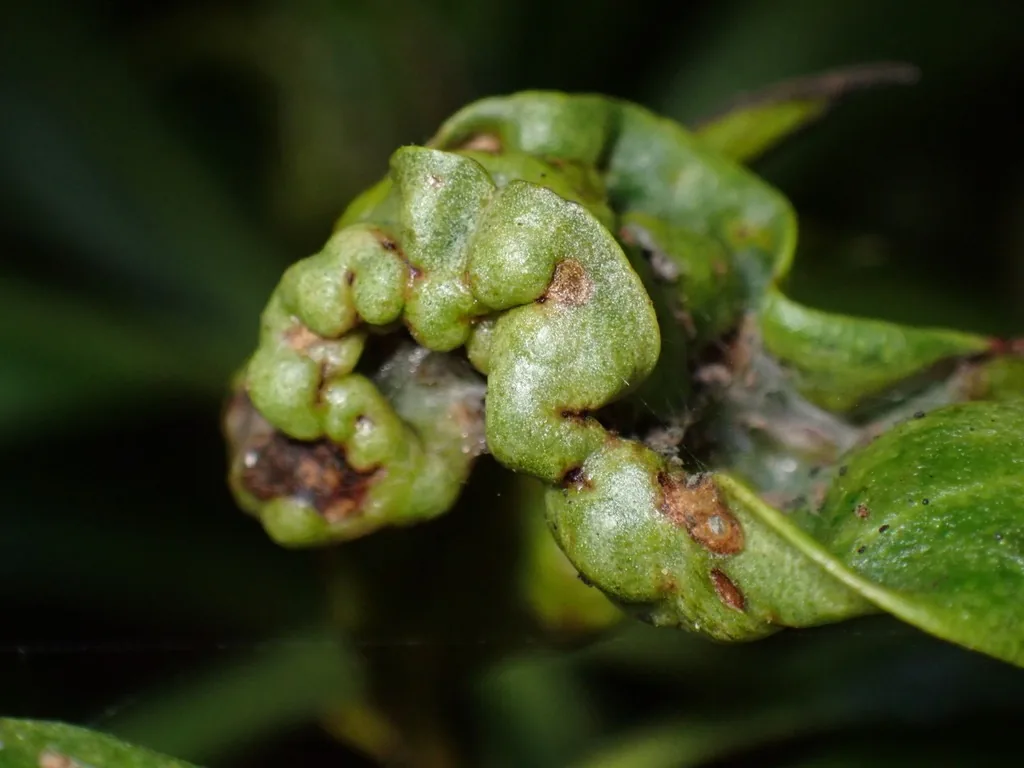
How to identify it
Look-alikes
Where it lives
It damages Myoporum along the California coast from San Diego to San Francisco and has attacked naio in Hawaii.[1]
Biology and life cycle
At 86 degrees F a generation takes about 38 days, and in warm areas it breeds year-round.[1]
In California it has been seen on Myoporum laetum and M. pacificum, but not M. parvifolium.[1]
Damage and signs
- One female on new growth can cause noticeable distortion within four hours; persistent damage stunts tips and can kill plants.[1]
Health risk
It feeds on plants; UC IPM mentions no risk to people.[1]
Control
Prevention
Avoid planting susceptible Myoporum; choose resistant species or other plants.[1]
Sanitation
Prune, bag and dispose of infested tips and dead plants, without over-pruning, which can stress or kill Myoporum.[1]
Traps and physical control
Tap shoot tips over white paper early in the season to find females before they hide in leaf folds.[1]
Pesticides
Contact sprays fail because thrips hide in folds; systemic insecticides are most effective, never during bloom or with bees present.[1]
Common questions
Sources
- University of California Statewide IPM Program, “Myoporum Thrips (Pest Notes).” ipm.ucanr.edu/home-and-landscape/myoporum-thrips/ (accessed 2026-10-06)
- iNaturalist, “Klambothrips myopori taxon page (order and family).” www.inaturalist.org/taxa/354247 (accessed 2026-10-06)