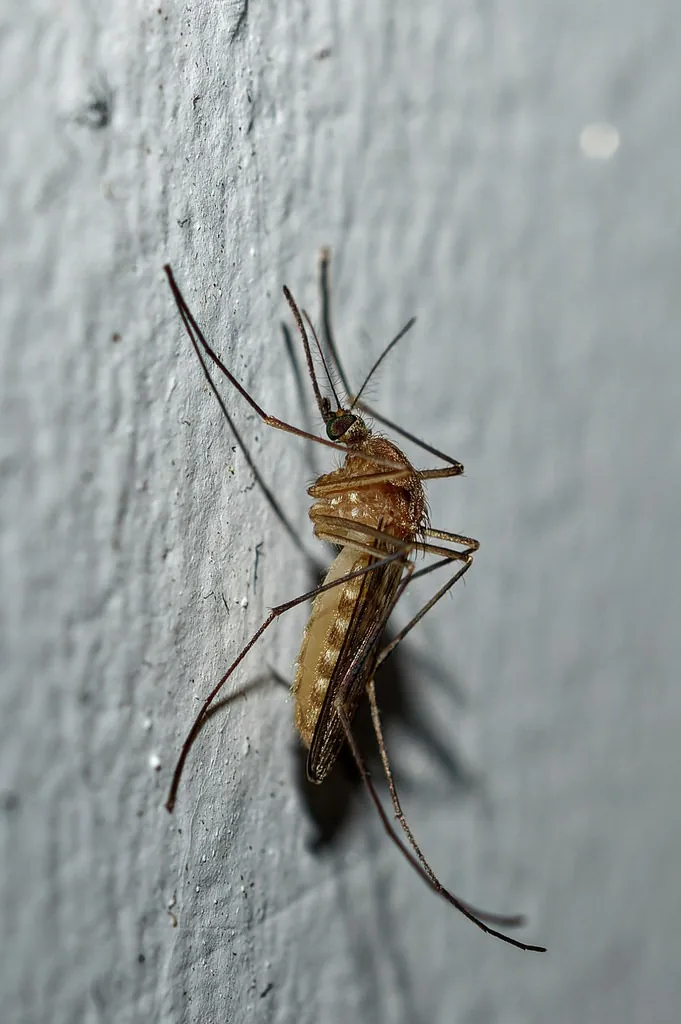
How to identify it
- It is a small to medium mosquito with a light brown body, scattered patches of pale scales and a dark proboscis.[1]
- Each abdominal segment has a pale band across its base, and the tip of the abdomen is bluntly rounded.[1]
- Eggs are laid together as a floating raft of about 150 to 300 eggs on the surface of standing water.[1][3]
- Adults are most active from dusk to dawn and rest in cool, dark, humid vegetation by day.[3]
Look-alikes
| Look-alike | How to tell them apart |
|---|---|
| Southern house mosquito (Culex quinquefasciatus) | A close relative found south of about 36 degrees north latitude; between roughly 32 and 40 degrees north, the two species and their hybrids overlap.[1] |
| Asian tiger mosquito | An Aedes mosquito that glues its eggs to container walls just above the waterline, while house mosquitoes lay floating egg rafts on the water.[4][3] |
| Other mosquitoes | Several Culex species in the U.S., including the southern house mosquito and Culex tarsalis, spread West Nile, St. Louis encephalitis and eastern equine encephalitis viruses.[3] |
Where it lives
Found in urban, suburban and rural areas across the northern United States and southern Canada, generally above about 39 degrees north latitude; the southern house mosquito replaces it farther south.[1]
Biology and life cycle
Larvae tolerate water rich in organic matter, living in ponds, buckets, rain barrels, cans, roadside ditches and sewage seepage.[1]
Around homes and cities, it breeds in tires, clogged gutters, untended birdbaths, wading pools, storm drains and catch basins.[2]
Eggs hatch in 2 to 3 days, and an egg becomes an adult in about 7 to 10 days.[1][3]
Mated females spend winter in basements, culverts and other sheltered places that stay above freezing, then bite and lay eggs in spring.[2][1]
Females feed mainly on birds but also bite mammals, including people; adults can fly up to 2 miles.[1][2][3]
Damage and signs
Health risk
West Nile virus is the leading mosquito-borne disease in the contiguous U.S., and Culex mosquitoes are its main vectors. Culex pipiens also spreads St. Louis encephalitis virus.[5][1][3]
Control
Prevention
Use an EPA-registered repellent with DEET, picaridin, IR3535, oil of lemon eucalyptus, PMD or 2-undecanone, especially from dusk to dawn.[7][3]
Wear loose, long-sleeved shirts and pants, and consider permethrin-treated clothing and gear.[7]
Keep them out
Repair cracks in septic tanks, screen open vent and plumbing pipes, and tightly cover water storage containers.[6]
Install and repair window and door screens, and keep doors, including garage doors, closed.[6]
Sanitation
Each week, dump and scrub, tip over, cover or discard water-holding items like old tires, buckets, planters, toys and birdbaths.[6]
Pesticides
Larvicides can treat larger standing water that won't be used for drinking, and adulticides can treat shady resting spots; always follow the label.[6]
Common questions
- Which mosquito spreads West Nile virus?
- Mainly Culex mosquitoes. In the northern U.S., the northern house mosquito is considered the primary vector; it picks up the virus from infected birds.[1][5]
- Can I catch West Nile virus from another person?
- No. People don't spread it through coughing, sneezing or touching, and they don't carry enough virus to infect mosquitoes.[5]
- Where do house mosquitoes go in winter?
- Mated females shelter in basements, culverts and other protected spots that stay above freezing, then emerge in spring to feed and lay eggs.[2][1]
Sources
- University of Florida IFAS Extension, Featured Creatures, “Northern House Mosquito, Culex pipiens Linnaeus (IN1324).” ask.ifas.ufl.edu/publication/IN1324 (accessed 2026-10-06)
- Rutgers University, Center for Vector Biology (Mosquito Research and Control), “Culex pipiens: The Northern House Mosquito.” vectorbio.rutgers.edu/outreach/species/cxpip.htm (accessed 2026-10-06)
- U.S. Centers for Disease Control and Prevention, “Life Cycle of Culex Mosquitoes.” www.cdc.gov/mosquitoes/about/life-cycle-of-culex-mosquitoes.html (accessed 2026-10-06)
- U.S. Centers for Disease Control and Prevention, “Life Cycle of Aedes Mosquitoes (reviewed April 16, 2024).” www.cdc.gov/mosquitoes/about/life-cycle-of-aedes-mosquitoes.html (accessed 2026-10-06)
- U.S. Centers for Disease Control and Prevention, “West Nile: Causes and How It Spreads (reviewed July 15, 2026).” www.cdc.gov/west-nile-virus/causes/index.html (accessed 2026-10-06)
- U.S. Centers for Disease Control and Prevention, “Mosquito Control at Home (reviewed April 16, 2024).” www.cdc.gov/mosquitoes/mosquito-control/mosquito-control-at-home.html (accessed 2026-10-06)
- U.S. Centers for Disease Control and Prevention, “Preventing Mosquito Bites (reviewed August 28, 2024).” www.cdc.gov/mosquitoes/prevention/index.html (accessed 2026-10-06)
- iNaturalist, “Culex pipiens taxon page (order and family).” www.inaturalist.org/taxa/1096295 (accessed 2026-10-06)