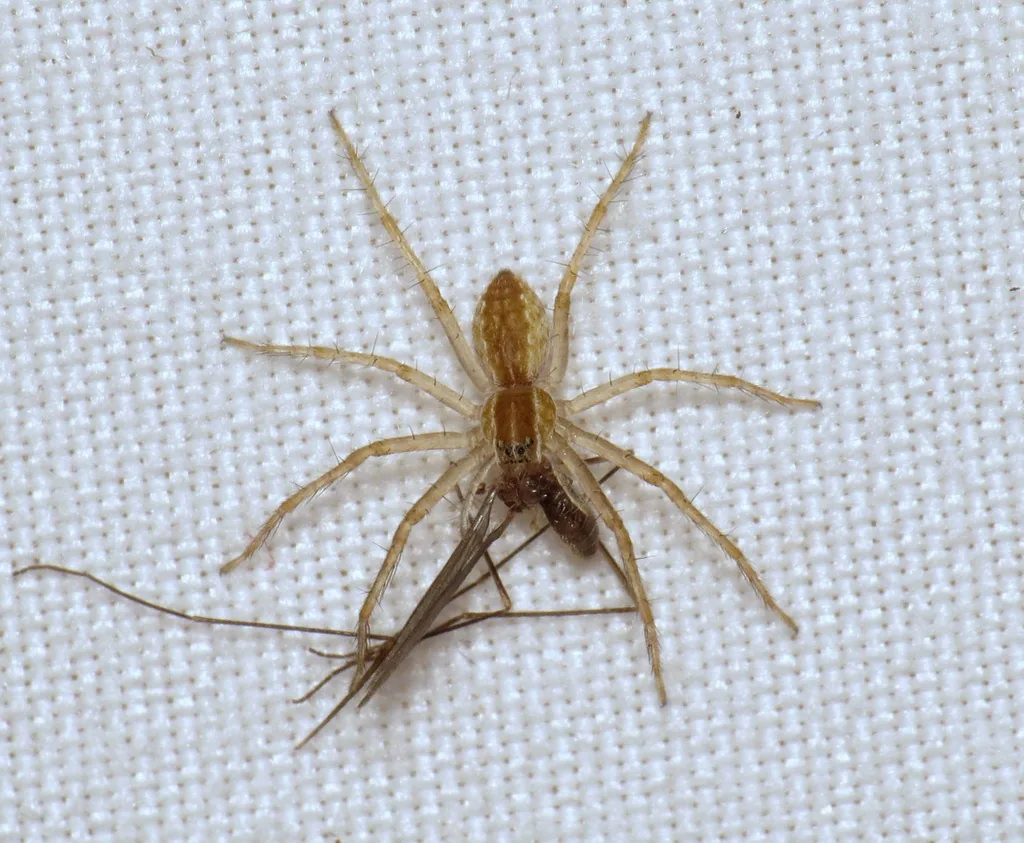
How to identify it
Look-alikes
| Look-alike | How to tell them apart |
|---|---|
| Wolf spiders | Nursery web spiders have a single dark stripe down the back and unbanded legs, and females carry the egg sac in their mouthparts.[1] |
Where it lives
Minnesota Extension describes it in fields and the understory plants of wooded areas.[1]
Biology and life cycle
When the eggs are ready to hatch, the female folds a leaf over and fills the space with silk, building the 'nursery' the spider is named for.[1]
It hunts insects rather than catching them in a web.[1]
Damage and signs
- It does no damage; it's beneficial as a predator of insects.[1]
Health risk
Minnesota Extension says it doesn't harm people.[1]
Control
Prevention
Trim plants back from the house so spiders don't settle against it and then move indoors.[2]
Traps and physical control
No control is needed outdoors; if one wanders inside, sweep or vacuum it up or move it out, since spiders feed mostly on small insects.[2]
Common questions
Sources
- University of Minnesota Extension, “Nursery web spider (What insect is this?).” apps.extension.umn.edu/garden/diagnose/insect/general-curiosity-insects/relatives/medium/nurserywebspider.html (accessed 2026-10-06)
- University of California Statewide IPM Program, “Spiders (Pest Notes, Home and Landscape).” ipm.ucanr.edu/home-and-landscape/spiders/ (accessed 2026-10-06)
- iNaturalist, “Pisaurina mira taxon page (order and family).” www.inaturalist.org/taxa/84109 (accessed 2026-10-06)