How to identify it
- The mite itself is about 0.2 mm long, roughly 1/125 inch, and is barely visible to the naked eye.[1][2]
- Under magnification it is elongated, reddish tan and shiny; females swollen with developing offspring are much larger than newly mated ones.[1]
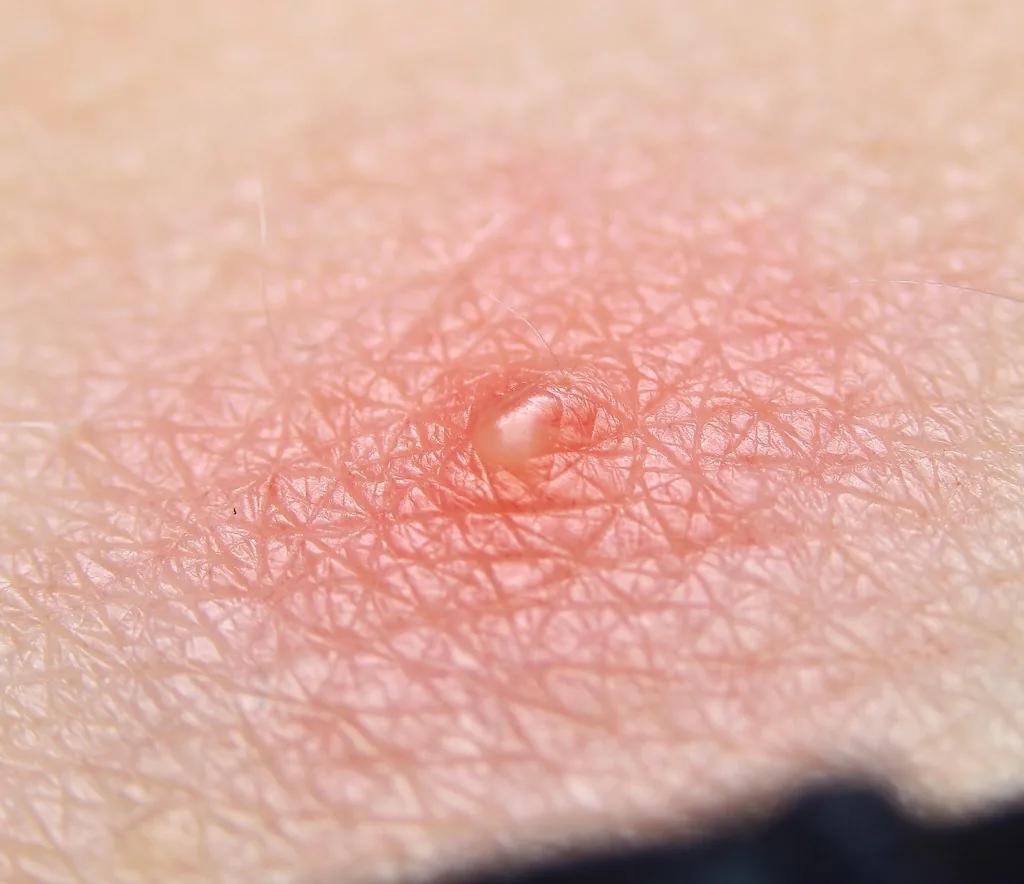
- You usually notice the bites, not the mite: raised red bumps with a small blister in the center that start itching 10 to 16 hours after exposure.[2][3]
- Bites cluster on the upper body, around the neck, shoulders and chest, because the mites drop from tree canopies.[2][3]
Look-alikes
| Look-alike | How to tell them apart |
|---|---|
| Chiggers | Chigger bites gather where clothing is tight, such as the waistband, underwear and socks, while itch mite bites show up where clothing is loose on the upper body.[2][3] |
| Bird and rodent mites | Bird mites and scabies cause bites with different clinical signs on different parts of the body, and they are usually localized rather than striking a whole community at once.[2] |
Where it lives
Thought to come from Europe; first recognized in the U.S. in Kansas in 2004 and since reported from Illinois, Nebraska, Ohio, Oklahoma, Missouri, Tennessee, Texas, Pennsylvania and the Washington, D.C., area.[1][3]
Biology and life cycle
Mated females slip into the marginal leaf-fold galls made by a midge on pin oaks and other red oaks, paralyze the midge larva with venom, and feed on it.[1][3]
Offspring develop inside the mother's swollen abdomen, up to about 250 of them, and males mate with emerging females, then die without ever feeding.[1]
A generation can take as little as one week, so populations build very fast; up to 84 percent of galls on sampled pin oak leaves held mites.[1]
Mites can fall from trees at up to 370,000 per day, drift long distances on the wind, and may even pass through window screens.[1][3]
It also feeds on other insects, including periodical cicada eggs in twig egg nests, which has been linked to bite outbreaks in cicada years.[3]
Damage and signs
Health risk
Bites cause an intensely itchy red rash that can be painful if scratched, and scratching can lead to secondary bacterial infection; see a doctor if symptoms are severe or a bite looks infected.[1][2][3]
Control
Prevention
Limit time spent under oaks or other trees known to be infested, especially while raking or blowing leaves in late summer and fall.[1][2][3]
Wear long sleeves, a hat and gloves for yard work near infested trees, then promptly change, wash the clothes and shower.[3][1][2]
Don't count on repellents: DEET has given mixed results, and mosquito and tick repellents haven't reliably stopped itch mite bites.[1][2][3]
Pesticides
Tree sprays aren't effective, because the mites are protected inside leaf galls or cicada egg nests.[1][2][3]
Easing the itch
Physicians suggest calamine lotion and other anti-itch creams, and some remedies, such as cortisone creams and antihistamines, may need a doctor's advice.[1][2]
Try not to scratch, since broken skin can become infected.[1][3]
Common questions
- Why did I get itchy bites after raking leaves when I never saw a bug?
- Oak leaf itch mites are nearly invisible, and most bites happen to people handling infested pin oak leaves in fall; the itching doesn't start until 10 to 16 hours later.[1][2]
- Can I spray my oak tree to stop itch mites?
- No. Sprays don't reach mites hidden inside galls; avoiding the trees and washing up after exposure works better.[1][2]
- When do oak leaf itch mites go away?
- Bites peak from late July into fall, and populations fall off once their food source, such as gall midge larvae or cicada eggs, is used up.[2][3]
Sources
- Penn State Extension, “Oak Leaf Itch Mite.” extension.psu.edu/oak-leaf-itch-mite (accessed 2026-10-06)
- K-State Research and Extension, Johnson County, “Oak Leaf Itch Mites (agent article).” www.johnson.k-state.edu/programs/natural-resources/agent-articles/home-insect-control/oak-leaf-itch-mites.html (accessed 2026-10-06)
- University of Maryland Extension, “Oak Leaf Itch Mites and Periodical Cicada Eggs (updated August 13, 2021).” extension.umd.edu/resource/oak-leaf-itch-mites-and-periodical-cicada-eggs/ (accessed 2026-10-06)
- iNaturalist, “Pyemotes herfsi taxon page (order and family).” www.inaturalist.org/taxa/505686 (accessed 2026-10-06)