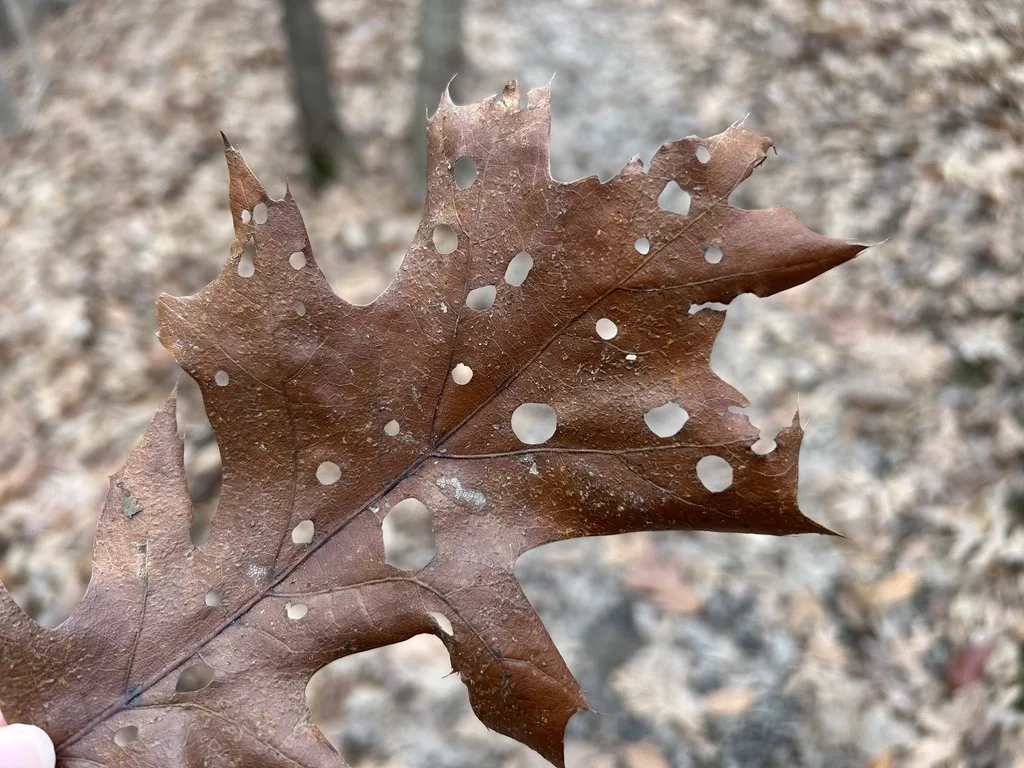
How to identify it
- The first sign is round holes, often symmetrical on both halves of a new oak leaf, growing up to about 3/8 inch as the leaf expands.[1][2]
- Blotch mines are light green to tan while active and darken once the maggots leave; the dead tissue later drops out, leaving ragged holes.[1]
- The adults are very small flies that are rarely noticed.[1][2]
Where it lives
It is considered native and is reported throughout the eastern United States from Maine to Georgia; NC State reports it on most oak species in North Carolina.[1][2]
Biology and life cycle
Females emerge as oak buds open and pierce buds and young leaves with their egg-laying tube to drink the sap, laying an occasional egg.[1][2]
Maggots mine the leaves and, usually by the end of May in North Carolina, drop to the soil to pupate and spend the summer and winter; there is one generation a year.[1][2]
Damage and signs
Health risk
Control
Biological control
Numerous parasites attack it, and the next year's infestation may not even be noticeable.[1]
Pesticides
Spraying during the growing season won't improve the tree's appearance, since the maggots have usually left by the time damage is noticed; pesticides are probably best avoided.[1]
Common questions
- Why do my new oak leaves have round holes in them?
- Oak shothole leafminer females puncture the buds in spring, and the punctures enlarge into holes as leaves expand.[1][2]
- Should I spray for oak shothole leafminer?
- No. By the time damage shows, the maggots are gone, and spraying won't improve the look of the tree.[1]
- Will it happen again next year?
- Maybe not; parasites often keep the next year's infestation from being noticeable.[1]
Sources
- NC State Extension, “Oak Shothole Leafminer (PDIC Factsheet).” content.ces.ncsu.edu/oak-shothole-leafminer (accessed 2026-10-15)
- UMass Extension Landscape, Nursery and Urban Forestry Program (Landscape Insect & Mite Guide), “Japanagromyza viridula (Oak Shothole Leafminer).” www.umass.edu/agriculture-food-environment/landscape/publications-resources/insect-mite-guide/japanagromyza-viridula-formerly-agromyza-viridula (accessed 2026-10-15)
- iNaturalist, “Japanagromyza viridula taxon page (order and family).” www.inaturalist.org/taxa/501206 (accessed 2026-10-06)