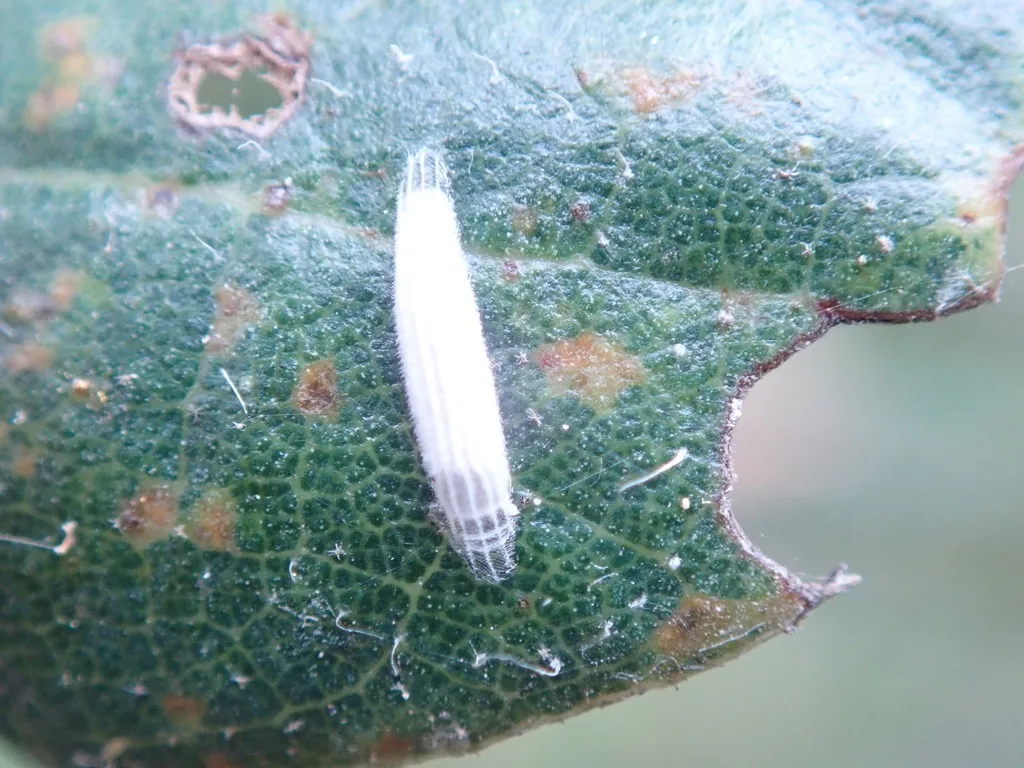
How to identify it
Where it lives
It's reported on California valley oak and coast live oak, and the PNW Insect Management Handbook covers it as an oak pest.[1]
Biology and life cycle
Young larvae mine inside leaves; older larvae feed on the undersides, leaving only the upper surface and veins.[1]
It appears to overwinter inside its cocoon; young larvae make flat, white, round cocoons to hibernate.[1]
Moths appear in spring and lay eggs under leaves, and there are two generations a year.[1]
Damage and signs
- Skeletonized leaves turn brown, and badly damaged ones can be almost transparent.[1]
Health risk
It feeds on plants; the PNW Insect Management Handbook mentions no risk to people.[1]
Control
Prevention
Cocoons are easily carried from place to place on infested plant material.[1]
Sanitation
Rake up fallen leaves to remove cocoons, and destroy them by deep composting.[1]
Biological control
Natural enemies probably help keep it in check; avoid broad-spectrum insecticides that kill them.[1]
Common questions
- What are the tiny ribbed white cocoons on my oak leaves?
- Likely oak skeletonizer (oak ribbed casemaker) cocoons, which are oblong and white with lengthwise ribs.[1]
- Why are my oak leaves turning see-through?
- Older oak skeletonizer larvae eat the leaf undersides, leaving only the upper surface and veins.[1]
Sources
- Pacific Northwest Pest Management Handbooks (OSU, WSU, University of Idaho), “Oak (Quercus): Oak skeletonizer (Insect Management Handbook).” pnwhandbooks.org/insect/hort/landscape/hosts-pests-landscape-plants/oak-quercus-oak-skeletonizer (accessed 2026-10-06)
- iNaturalist, “Bucculatrix albertiella taxon page (order and family).” www.inaturalist.org/taxa/469759 (accessed 2026-10-06)