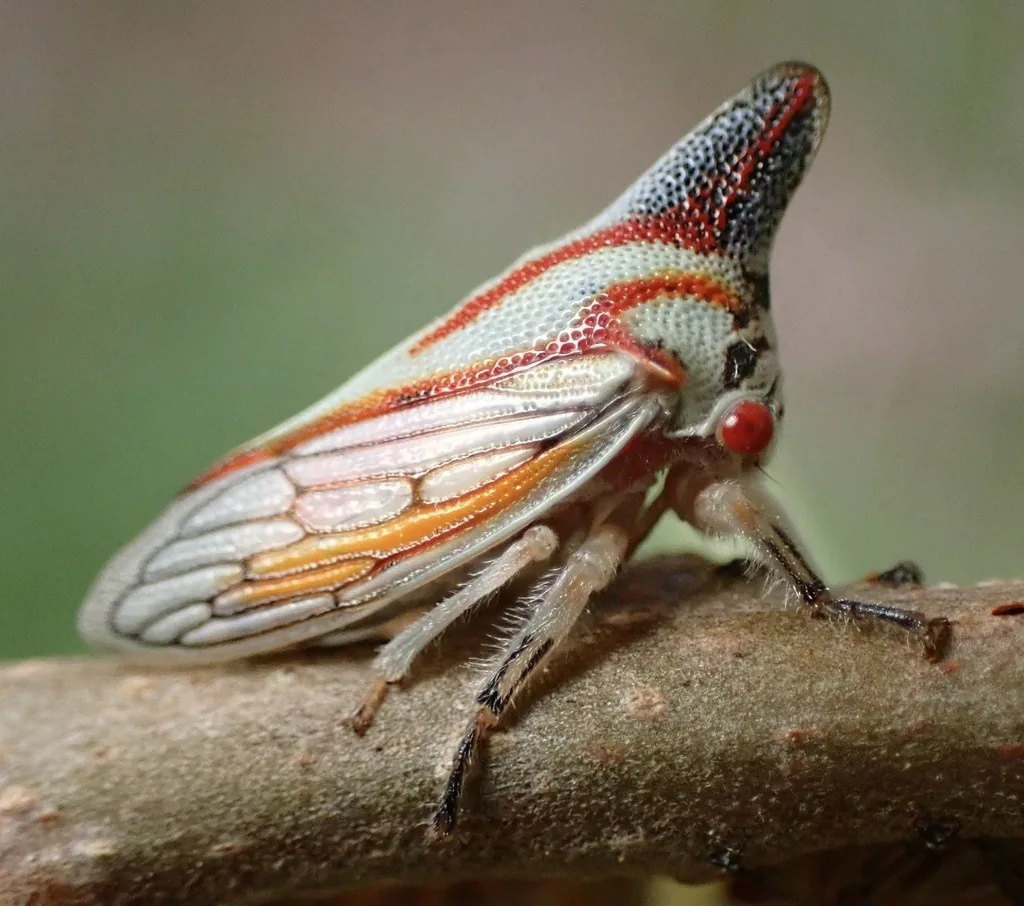
How to identify it
- Treehoppers are related to leafhoppers but larger, with the front of the thorax modified into bumps or spines; some oak treehoppers have a conspicuous horn projecting over the head.[1][2]
- Young adults may be white with red and black markings, while older adults are dull brown or green.[1]
- Nymphs cluster around slits in the bark where the female laid eggs.[1]
Where it lives
It feeds on oaks throughout the eastern United States, with records in a broad band from Pennsylvania and New Jersey south to Florida and west to Texas and Arizona, and in California.[1][2]
Biology and life cycle
Females overwinter in leaf litter, emerge and lay about 40 eggs in a slit in a twig the following spring; the main hatch in Florida peaks from late March through early May.[1][2]
Females have been seen standing guard over their nymphs and driving off small wasps.[1][2]
Damage and signs
Health risk
Control
Prevention
It ordinarily doesn't do enough damage to justify control.[2]
Pesticides
If numbers get out of hand, NC State notes most contact insecticides such as pyrethroids give adequate control.[1]
Common questions
- What are the horned bugs clustered on my oak twigs?
- Likely oak treehoppers, which feed in groups on oak twigs.[1][2]
- Do oak treehoppers harm oaks?
- Rarely; damage is mostly small egg-laying scars in twigs.[2]
- Why is one adult standing over the nymphs?
- Female oak treehoppers guard their young from predators.[1][2]
Sources
- NC State Extension, “Oak Treehopper.” content.ces.ncsu.edu/oak-treehopper-1 (accessed 2026-10-15)
- University of Florida IFAS Extension (Featured Creatures), “Oak Treehopper, Platycotis vittata (EENY-328).” ask.ifas.ufl.edu/publication/IN519 (accessed 2026-10-15)
- iNaturalist, “Platycotis vittata taxon page (order and family).” www.inaturalist.org/taxa/48679 (accessed 2026-10-06)