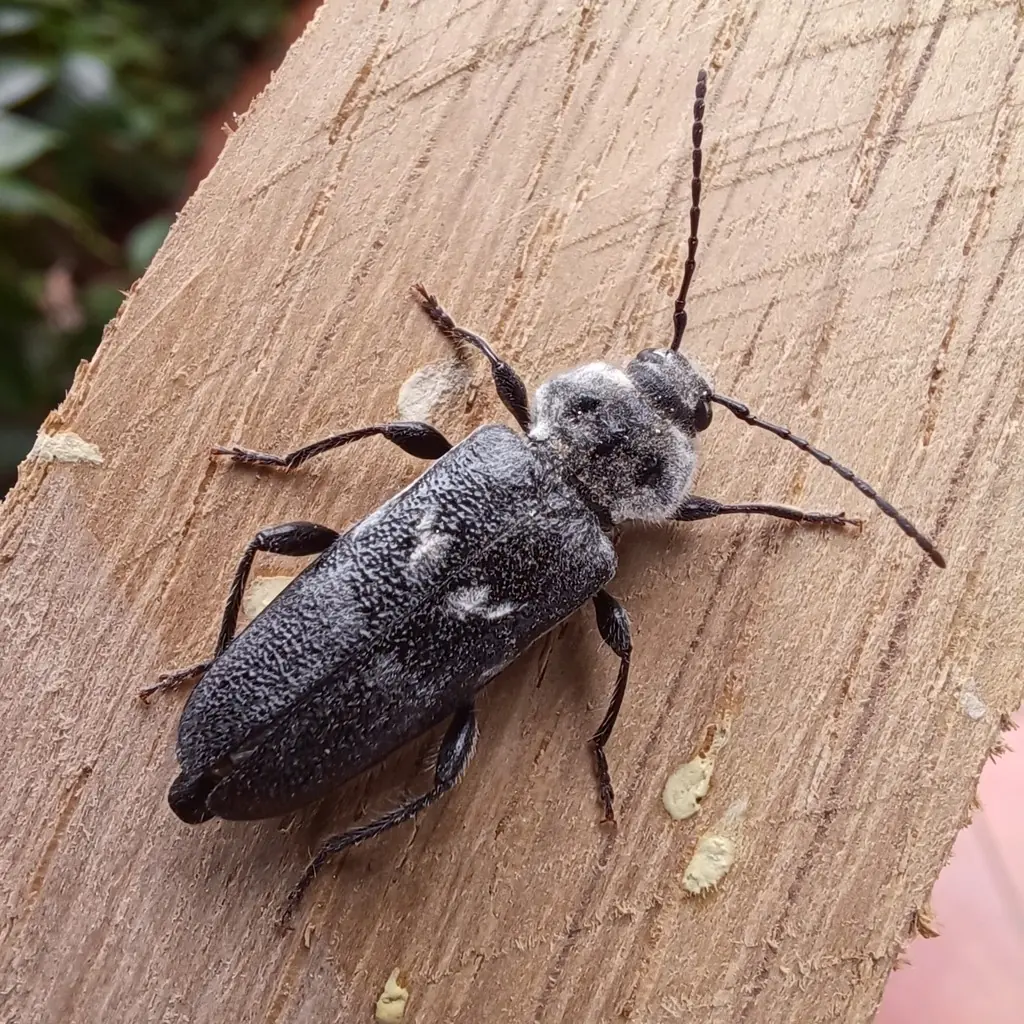
How to identify it
- Adults are brownish to black beetles 5/8 to 1 inch long, with two shiny, raised black knobs on the section just behind the head.[1][2]
- Fine gray hairs cover the thorax, and irregular patches of gray hair form bands across the wing covers; antennae are about one-third the body length.[2][1]
- Exit holes are oval, about 1/4 to 3/8 inch across, and sometimes have ragged edges.[1][2]
- Larvae are cream-colored grubs up to about 1-1/4 inches long, with three tiny dark eyespots in a row on each side of the head; a hand lens is needed to see them.[2][1]
- Larval tunnels hold loose powder with tiny barrel-shaped pellets, and the tunnel walls have a rippled look, like sand after water washes over it.[1][2]
Look-alikes
| Look-alike | How to tell them apart |
|---|---|
| Powderpost beetle | Old house borers attack only softwoods such as pine, fir and spruce, so hardwood flooring, cabinets and furniture are generally immune; powderpost beetles attack hardwoods and leave tiny round exit holes rather than oval ones.[1][3] |
Where it lives
Native to North Africa and believed to have reached North America around 1875; in the U.S. it ranges from Maine to Florida and west to Michigan and Texas, and is especially common along the Atlantic Seaboard.[2][1]
Biology and life cycle
Females lay about 50 to 200 eggs in cracks, crevices and joints between wood members; the eggs hatch in a few weeks and the larvae bore in.[1]
Larvae usually take about 3 to 6 years to mature, but development can stretch to 10 years or longer in cool or unfavorable wood.[1]
Larvae thrive at 15 to 25 percent wood moisture and are unlikely to survive below about 10 percent.[1]
Adults emerge in spring and summer, mostly June through August, and often try to reinfest wood near where they came out.[1][2]
In the U.S. it infests buildings and lumber only, not living trees, stumps or firewood; infestations usually start in lumber that already held larvae before construction.[1]
Damage and signs
- Larvae prefer protein-rich sapwood of younger wood, so infestations are most common in structures less than about 10 years old.[1]
- Dry, climate-controlled buildings often see damage to only a few boards, but in damp crawlspaces, attics and outbuildings studs and joists can be reduced to powder over time.[1]
- Log homes are particularly vulnerable, and exit holes in logs can let water in and lead to decay.[1]
- Fully grown larvae make a rasping, clicking sound while chewing that can often be heard through walls, floors and ceilings.[1][2]
Health risk
The old house borer threatens structural softwood, not people; the larvae do the harm while hidden inside framing and timbers.[1][2]
Control
Prevention
Use kiln-dried lumber, since kiln heat kills all stages, and never build with wood that shows exit holes or powder, such as repurposed barn boards.[1][2]
Bring wood moisture down, ideally below about 10 percent, with vapor barriers, better ventilation and improved drainage in crawlspaces, basements and attics.[1]
Traps and physical control
When activity is limited to a few boards, remove and replace them and consider replacing adjacent pieces; seal old holes and clean away powder so old damage isn't mistaken for new.[1]
Pesticides
Borate sprays on bare, unfinished wood can kill newly hatched larvae before they tunnel deep; they won't penetrate varnished or sealed surfaces and must stay dry to last.[1][2]
When to call a professional
Whole-structure fumigation is a costly last resort for hard-to-reach infestations; current sulfuryl fluoride fumigants are less effective on these beetles and leave no lasting protection.[1][2]
Common questions
- Why do I have old house borers in a fairly new house?
- The larvae usually arrive in lumber infested before construction, and they favor the sapwood of younger wood, so most cases are in homes under about 10 years old.[1]
- How can I tell if an old house borer infestation is still active?
- Look for fresh powder the color of newly sawn wood sifting from holes, or listen for gnawing; powder covered with dust or cobwebs suggests the activity has stopped.[1]
- Do I need to fumigate my house right away?
- No. These beetles damage wood slowly, so there's time to confirm the identification and weigh options; fumigation is seldom necessary.[1]
Sources
- University of Kentucky Entomology, “ENTFACT-653: Old House Borer (revised March 2026).” entomology.mgcafe.uky.edu/ef653 (accessed 2026-10-06)
- Penn State Extension, “Old House Borer (updated May 12, 2026).” extension.psu.edu/old-house-borer (accessed 2026-10-06)
- University of California Statewide IPM Program, “Pest Notes: Wood-Boring Beetles in Homes, Publication 7418.” ipm.ucanr.edu/home-and-landscape/wood-boring-beetles-in-homes/ (accessed 2026-10-06)
- iNaturalist, “Hylotrupes bajulus taxon page (order and family).” www.inaturalist.org/taxa/221942 (accessed 2026-10-06)