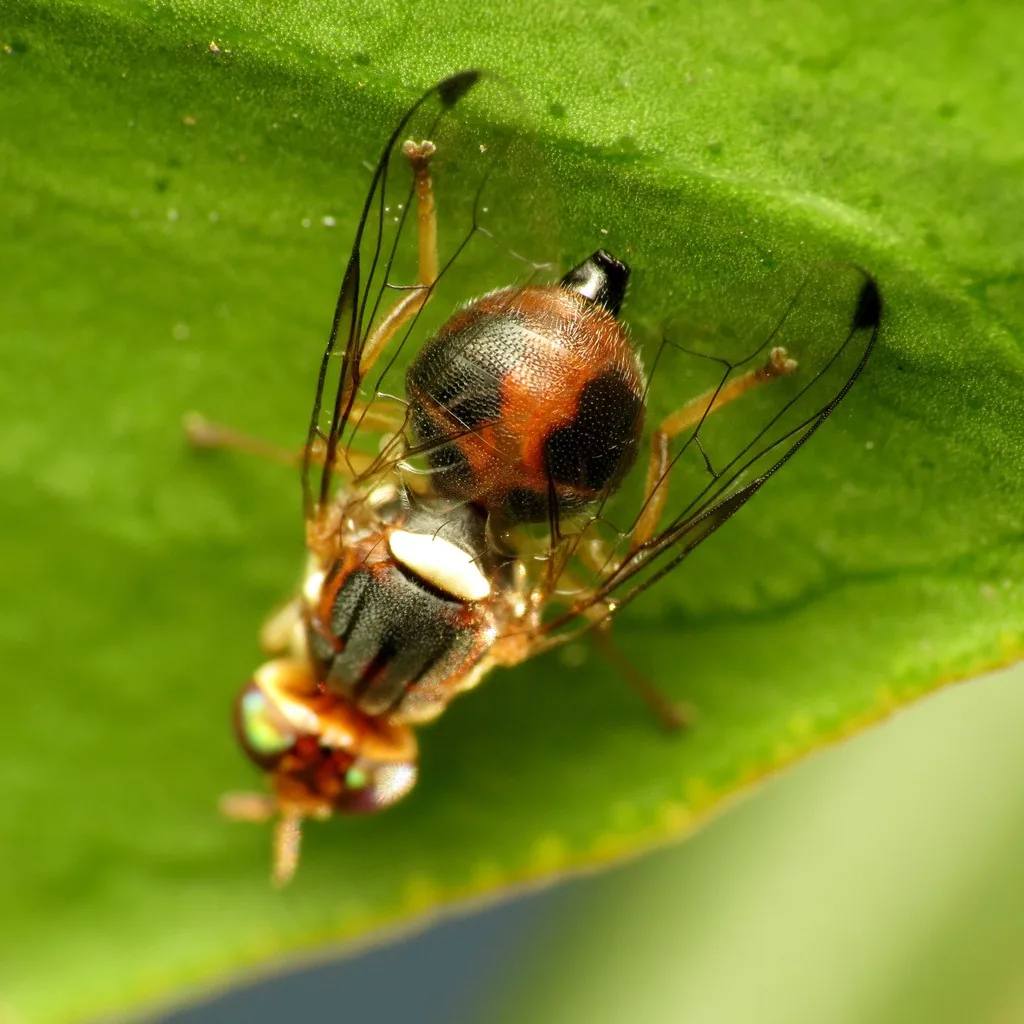
How to identify it
Look-alikes
| Look-alike | How to tell them apart |
|---|---|
| Walnut husk fly and apple maggot | These related fruit flies have banded wings; the olive fruit fly has only dark wing tips.[1] |
Where it lives
First found in California in west Los Angeles in 1998, it now occurs in all of the state's olive-growing areas.[1]
Biology and life cycle
On the mild coast, adults are active year round; inland they emerge March to May and attack leftover olives.[1]
Females lay eggs in the new crop from about late June or July, usually one per fruit.[1]
Damage and signs
Health risk
It feeds on olives; UC IPM mentions no risk to people.[1]
Control
Prevention
Harvest early and press infested fruit quickly to limit off flavors.[1]
Sanitation
Pick up fallen fruit, harvest promptly, and knock remaining fruit off trees after harvest; mulch, mow or bury it at least 4 inches deep.[1]
Pesticides
A spinosad bait spray, started when traps catch flies or 2 to 3 weeks before pit hardening, kills adults that feed on it; follow the label.[1]
Common questions
Sources
- University of California Statewide IPM Program, “Pest Notes: Olive Fruit Fly (Publication 74112).” ipm.ucanr.edu/PMG/PESTNOTES/pn74112.html (accessed 2026-10-06)
- iNaturalist, “Bactrocera oleae taxon page (order and family).” www.inaturalist.org/taxa/326609 (accessed 2026-10-06)