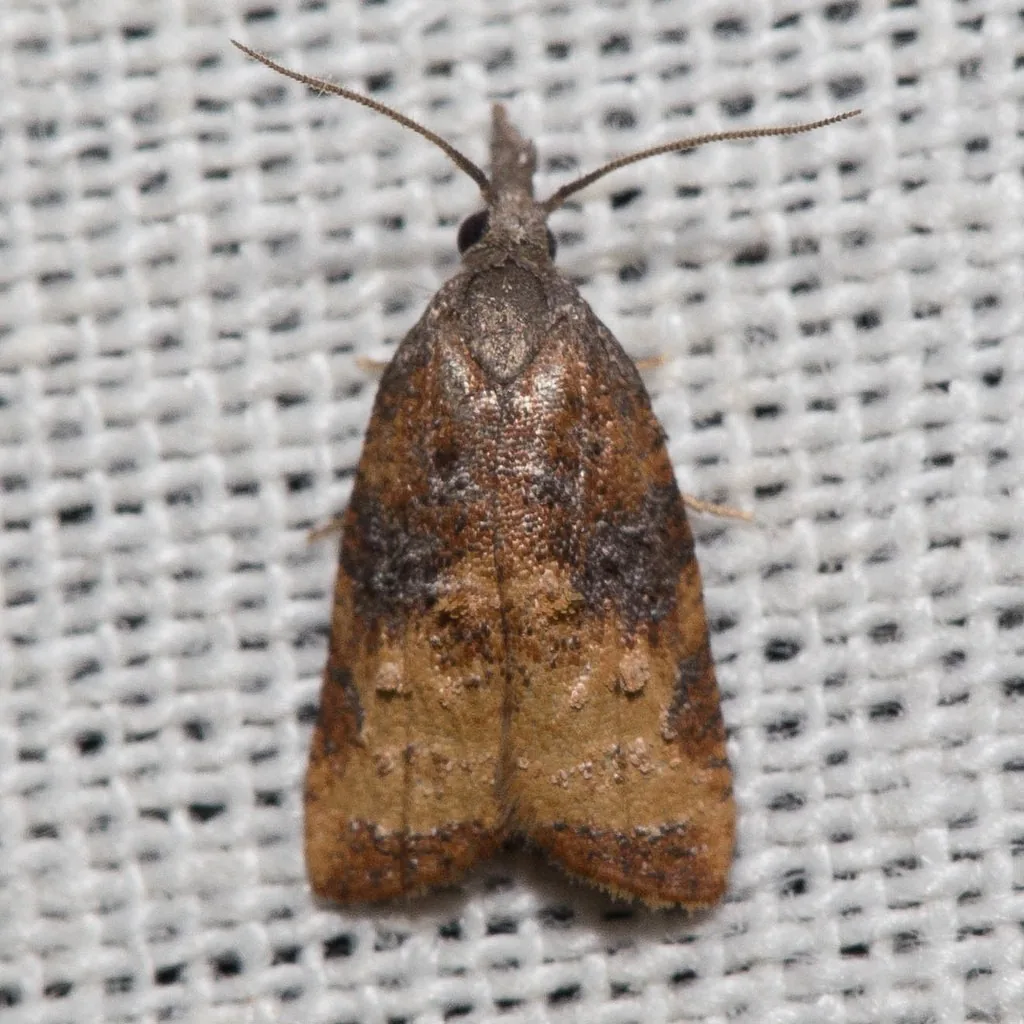
How to identify it
- Larvae are brown to cream or greenish brown, up to 3/5 inch, with a black or brown head and shield behind it.[1]
- A faint dark stripe often shows down the back, and the bumps at the base of bristles are chalky white.[1]
- Adults are small dark brown moths up to 1/2 inch with a dark wing band and a snout, bell-shaped at rest.[1]
Where it lives
It feeds on many hosts, including caneberries, fruit and nut trees, grapes, ornamentals and weeds.[1]
Biology and life cycle
Each caterpillar may build several nests and pupates in a nest or on bark in a thin cocoon.[1]
Females lay overlapping egg masses like fish scales on leaves or bark.[1]
There are up to five or six generations a year in warm interior valleys.[1]
Damage and signs
- Larvae chew foliage inside their nests, and feeding between leaves and fruit causes substantial fruit scarring.[1]
Health risk
It feeds on plants; UC IPM mentions no risk to people.[1]
Control
Sanitation
Remove alternate-host weeds and plant debris that harbor pupae.[1]
Traps and physical control
Hand-pick webbed leaves and larvae on small plants.[1]
Biological control
Parasitic wasps, tachinid flies, Trichogramma, lacewings, assassin bugs and spiders often keep numbers low.[1]
Pesticides
Only if numbers are high, a well-timed Bt or spinosad spray works; repeat Bt in 7 to 10 days and keep spinosad off flowering plants.[1]
Common questions
Sources
- University of California Statewide IPM Program, “Omnivorous Leafroller (Pests in Gardens and Landscapes).” ipm.ucanr.edu/PMG/GARDEN/VEGES/PESTS/omnileafroller.html (accessed 2026-10-06)
- iNaturalist, “Platynota stultana taxon page (order and family).” www.inaturalist.org/taxa/258623 (accessed 2026-10-06)