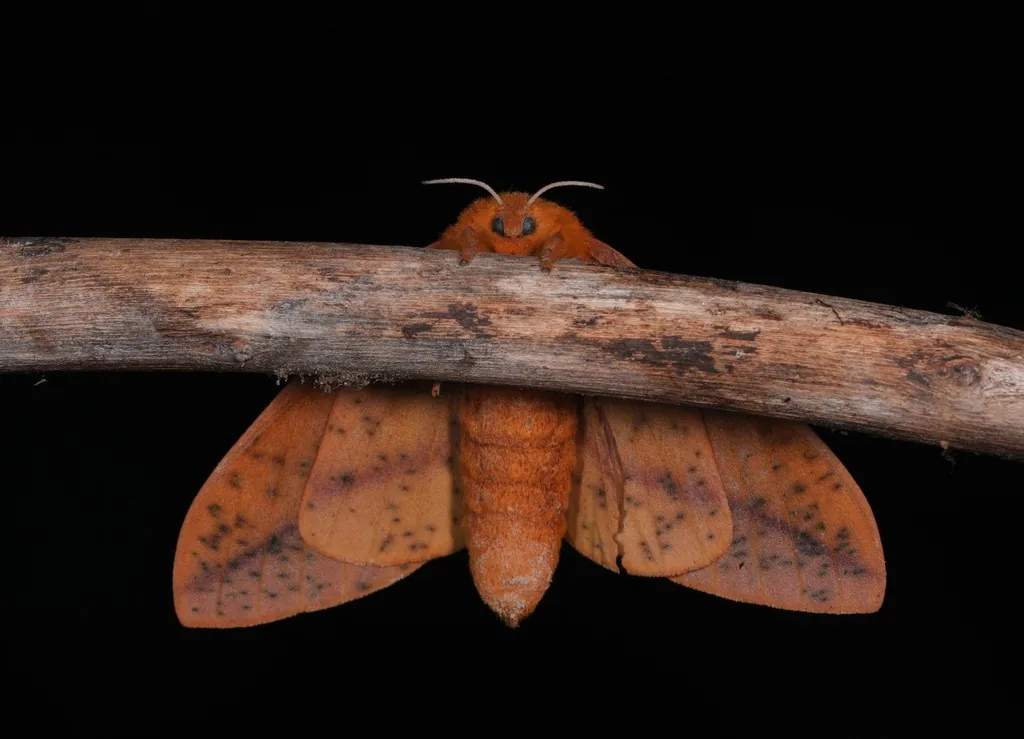
How to identify it
- Mature caterpillars are over 2 inches long, black with lengthwise yellow to orange stripes.[1][2]
- A pair of slender spines or horns sticks up behind the head; young caterpillars are greenish.[1][2]
- Moths are orange to rusty brown, with a single white spot on each forewing; males are smaller and darker.[1][2]
Where it lives
It is a native insect of the eastern United States.[2]
Biology and life cycle
Moths emerge in June and July; females lay up to 500 eggs in clusters of several hundred on the undersides of oak leaves.[1][2]
Young caterpillars feed in groups and skeletonize leaves; older ones eat all but the midvein, and thousands may be on one tree in late August and September.[1][2]
Mature caterpillars crawl down and burrow a few inches into the soil to pupate and spend the winter; there is usually one generation a year.[1][2]
Damage and signs
- Oaks are preferred (especially white and scrub oak), with birch, hazelnut, hickory and maple also recorded.[1][2]
- Small and young landscape trees can be completely defoliated; late-summer defoliation is much less harmful to tree health than spring defoliation.[1]
- Large, dry frass pellets rain down from infested trees.[1]
Health risk
Control
Traps and physical control
Caterpillars can be knocked off small trees and destroyed.[1]
Biological control
On large trees in mid to late summer it is probably better to rely on birds, paper wasps, diseases and parasites to reduce next year's population.[1]
Pesticides
On trees small enough to treat, Bacillus thuringiensis or neem products work only on young caterpillars; older caterpillars on the ground are very resistant to pesticides.[1]
Common questions
- What are the black and orange striped caterpillars crawling on my driveway?
- In late summer they are often orangestriped oakworms leaving oak trees to dig into the soil and pupate.[1][2]
- Will oakworms kill my oak?
- Late-summer defoliation does much less harm than spring defoliation, though small young trees suffer most.[1]
- Is it worth spraying a big oak?
- Usually not; sprays can't reach high in shade trees, and late caterpillars resist pesticides, so natural enemies are the better bet.[1]
Sources
- NC State Extension, “Orangestriped Oakworm (PDIC Factsheet).” content.ces.ncsu.edu/orangestriped-oakworm-1 (accessed 2026-10-15)
- UMass Extension Landscape, Nursery and Urban Forestry Program (Landscape Insect & Mite Guide), “Anisota senatoria (Orangestriped Oakworm).” www.umass.edu/agriculture-food-environment/landscape/publications-resources/insect-mite-guide/anisota-senatoria (accessed 2026-10-15)
- iNaturalist, “Anisota senatoria taxon page (order and family).” www.inaturalist.org/taxa/1354096 (accessed 2026-10-06)