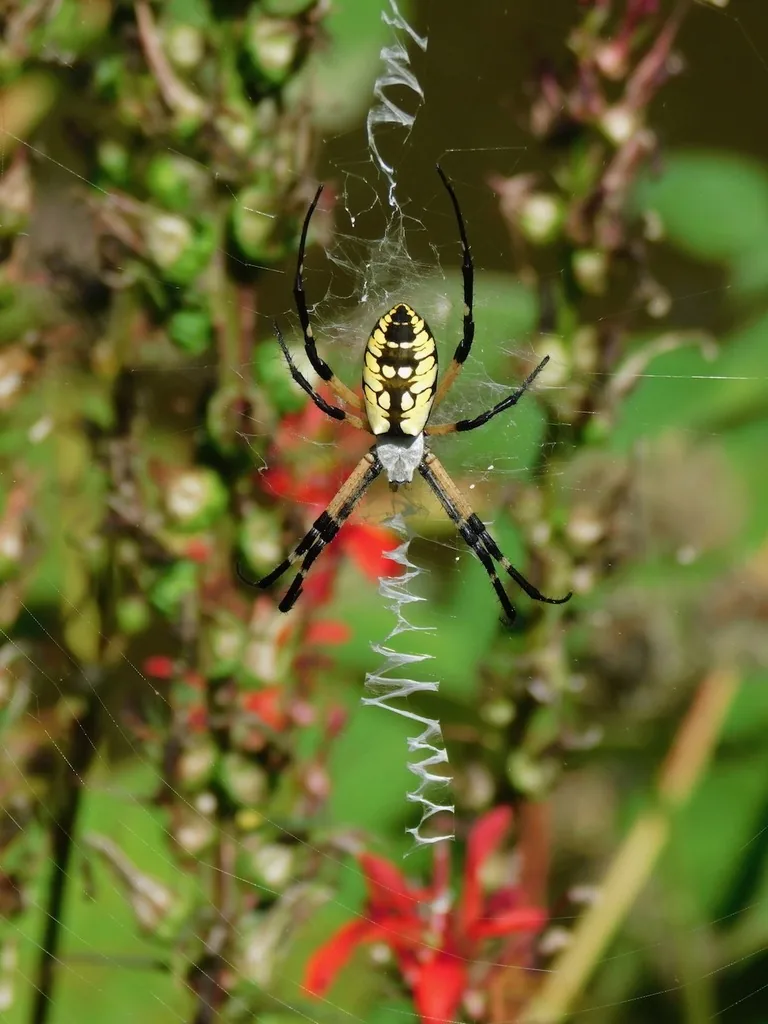
How to identify it
- Orb weavers spin round webs of spokes and spirals and usually rest at the center or in a retreat at the edge, sensing prey by vibration.[5][6]
- Female yellow garden spiders have an egg-shaped abdomen boldly patterned black and yellow, a body about 1 inch long, and silvery hairs on the front body section.[2][1][4]
- Their webs are large and vertical, often in sunny open spots, with a thick white zigzag band of silk called a stabilimentum down the center.[1][2][4]
- Males are much smaller, rarely more than 1/4 inch, and duller; juveniles have banded legs.[4][3][1]
Look-alikes
| Look-alike | How to tell them apart |
|---|---|
| Banded garden spider (Argiope trifasciata) | A close relative with thin yellow, white and black bands across the abdomen and black-striped yellow legs.[4] |
| Golden silk orbweaver (Trichonephila clavipes) | Larger, with a white front body section, a yellow abdomen, hairy bottlebrush tufts on its legs and golden-colored silk.[4] |
| Joro spider (Trichonephila clavata) | An invasive Asian orb weaver with golden webs and horizontal silver stripes on the abdomen; it lays egg sacs outside the web, unlike garden spiders.[4] |
Where it lives
The yellow garden spider occurs across most of the United States and is most common in the East; about 200 orb weaver species live in North America.[1][3][6]
Biology and life cycle
There is one generation a year; adults are seen mostly from July to October.[2][4]
After mating in late summer or early fall, females lay several hundred to a thousand or more eggs in a brown, papery sac hung in the web.[2][1][4]
Spiderlings hatch but stay in the sac over winter and emerge in spring; many are lost to cannibalism, birds and mud dauber wasps.[2][1]
Females often eat the sticky web at night and spin a new one.[2]
They catch flying insects such as dragonflies, wasps, bees and grasshoppers, wrapping larger prey in silk.[3][4]
Damage and signs
- None. Because they feed on insects, their presence helps rather than harms garden and landscape plants.[2]
Health risk
Not considered medically important; they run rather than bite. A bite usually requires careless handling and would feel like a bee or wasp sting.[1][2][4]
Control
Prevention
Because these spiders are beneficial, no control is necessary.[2]
Outdoor lights attract the insects spiders hunt, so keep fixtures off walls and away from doors and windows where possible.[6]
Traps and physical control
If webs on the house are a nuisance, sweep or hose them off regularly, and trim plants back from the walls.[6]
Pesticides
Insecticides won't give long-term control and generally shouldn't be used against spiders outdoors.[6]
Common questions
- Why is it called a writing spider?
- Because of the white zigzag band of silk it weaves down the middle of its web, which looks like writing.[3][4]
- Should I kill the big yellow spider in my garden?
- There's no need. Garden spiders aren't aggressive, eat insects that include pests, and are considered beneficial.[2][4]
- Do orb weavers come into the house?
- Rarely. They often live on or near outside walls but have poor eyesight and have trouble walking anywhere but webs.[5]
Sources
- Penn State Extension, “Yellow Garden Spider (updated June 24, 2026).” extension.psu.edu/yellow-garden-spider (accessed 2026-10-06)
- NC State Extension, “Black and Yellow Garden Spider (reviewed May 8, 2023).” content.ces.ncsu.edu/black-and-yellow-garden-spider (accessed 2026-10-06)
- University of Florida IFAS Extension, “Yellow Garden Spider, Writing Spider, Argiope aurantia (Featured Creatures, IN1273).” edis.ifas.ufl.edu/publication/IN1273 (accessed 2026-10-06)
- Clemson Cooperative Extension Home and Garden Information Center, “Big Yellow Spiders in South Carolina (HGIC 2503, revised November 20, 2024).” hgic.clemson.edu/factsheet/big-yellow-spiders-in-south-carolina/ (accessed 2026-10-06)
- University of Kentucky Entomology, “ENTFACT-622: Common Spiders Found Around Homes and Buildings.” entomology.mgcafe.uky.edu/ef622 (accessed 2026-10-06)
- University of California Statewide IPM Program, “Spiders (Pest Notes, Home and Landscape).” ipm.ucanr.edu/home-and-landscape/spiders/ (accessed 2026-10-06)
- iNaturalist, “Argiope aurantia taxon page (order and family).” www.inaturalist.org/taxa/67707 (accessed 2026-10-06)