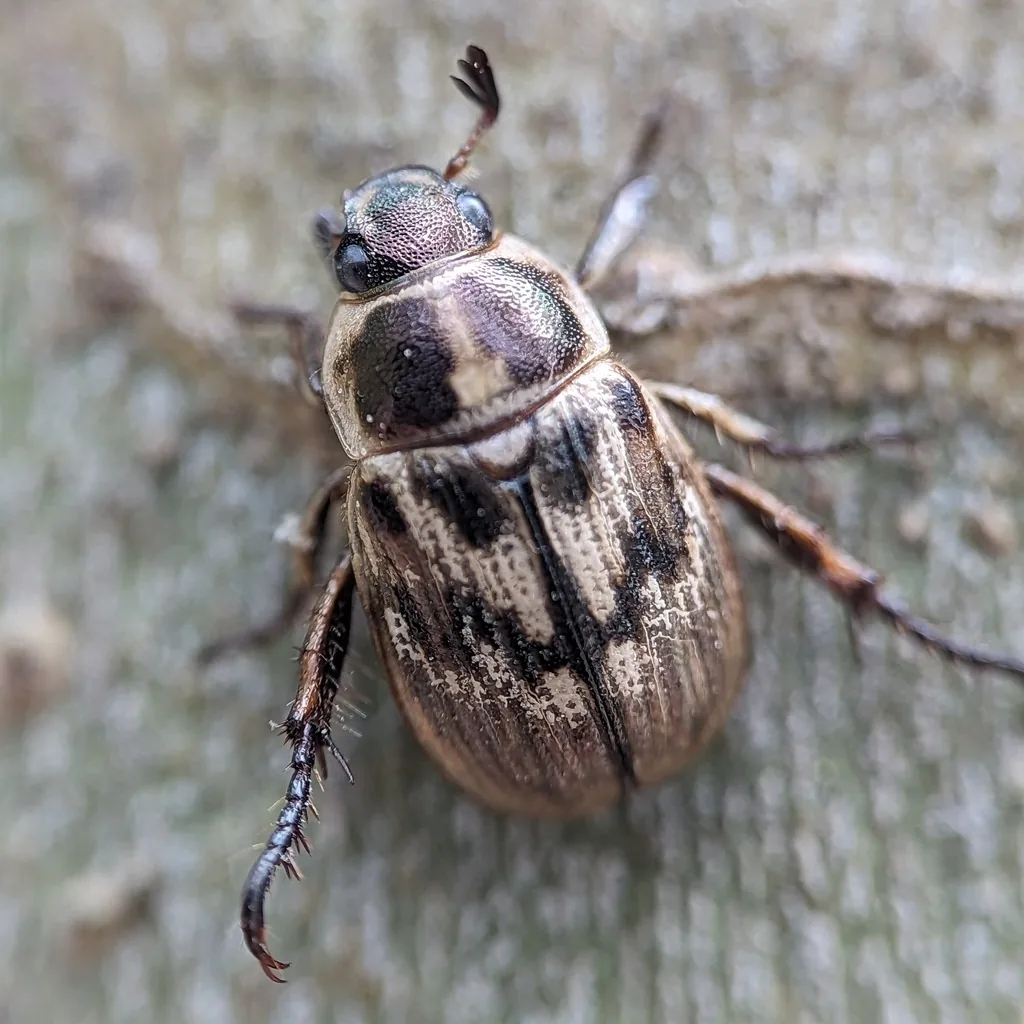
How to identify it
- Adults are stout, oval beetles about 3/8 inch long, mostly straw-colored with variable black markings on the thorax and wing covers.[1]
- Color varies a lot: some adults are nearly all straw-colored and others almost entirely brownish black.[1]
- Grubs are cream-colored and C-shaped with a brown head and six short legs, and grow to about 1 inch long.[1][3]
- Under a hand lens, the grub's raster, the hair pattern under the tip of the abdomen, shows parallel rows of dark hairs, though some related grubs have similar patterns.[3][1]
Look-alikes
| Look-alike | How to tell them apart |
|---|---|
| Japanese beetle | Japanese beetle adults have a shiny metallic green head and body and coppery wing covers with white hair tufts; oriental beetles are tan to straw-colored with brown or black markings.[1][2] |
| Other white grubs | Grubs of oriental beetle, Japanese beetle and masked chafers look alike and reach similar sizes; only the raster pattern under the tail tells them apart.[1][2] |
| Asiatic garden beetle | Asiatic garden beetle adults are a dull, velvety chestnut brown with a faint iridescent sheen, and their grubs grow only to about 3/4 inch.[1] |
Where it lives
First found in the United States in Connecticut in 1920, the oriental beetle now occurs through the Northeast, mid-Atlantic and parts of the Midwest and is slowly spreading south and west.[3][2]
Biology and life cycle
Adults emerge in June through August and are active mainly in the evening; they feed little, though some are seen on flower petals in June.[1][3][2]
After mating, females burrow back into the soil and lay 20 to 60 eggs in batches, usually 1 to 4 inches deep.[1]
Grubs feed on roots through late summer and fall, move deeper to overwinter, then feed again for 4 to 6 weeks in spring before pupating.[1]
Females also lay eggs in nursery container mixes, where grubs can badly damage the roots of potted trees and shrubs.[3]
Damage and signs
- Grubs chew roots near the soil surface; the large late-summer grubs, combined with heat and drought, can kill turf quickly from late August to mid-October.[1]
- Early signs are thinning, yellowing and wilting despite watering, followed by dead patches where turf feels spongy and peels up like a carpet.[1]
- Skunks, raccoons, crows and moles tearing up turf to eat grubs often cause worse damage than the grubs themselves.[1][2]
- Root damage done in fall often isn't noticed until the following spring.[2]
Health risk
Oriental beetle grubs harm the roots of turf and ornamental plants, and the adults feed very little.[1][3]
Control
Prevention
Keep turf vigorous with proper watering, fertilizing and mowing; tall fescue tolerates grub feeding best among cool-season grasses, and perennial ryegrass least.[1]
Traps and physical control
In mid-August, cut soil plugs or square-foot samples in a grid and count grubs; treatment is usually justified only above about 6 to 10 oriental beetle grubs per square foot.[1][3]
Biological control
Commercial Heterorhabditis nematodes work well on Japanese beetle grubs but are less effective on oriental beetle grubs, and milky spore products don't affect oriental beetles at all.[1][2]
Pesticides
Preventive grub insecticides work best applied in June or July while females are laying eggs; Tennessee State recommends granular imidacloprid in late summer or early fall for young grubs.[1][3]
For curative control, treat while grubs are still small, from mid-August to early September, and water in about 1/4 inch afterward.[1]
Why some grub products disappoint
Halofenozide gives only about 50 percent control of oriental beetle grubs, so the choice of active ingredient matters.[1]
Pyrethroid insecticides bind to organic matter as they move into soil and don't control grubs; check that the label lists grubs, not just surface insects.[2]
Adult male oriental beetles can be lured to traps baited with a commercial sex pheromone.[3]
Common questions
- Are the grubs in my lawn Japanese beetles?
- Not necessarily. In much of the Northeast most lawn grubs are oriental beetles, which you can confirm by checking the raster pattern with a hand lens.[2][1]
- Will milky spore work on oriental beetle grubs?
- No. The commercial milky disease strain is effective only against Japanese beetle grubs.[1][2]
Sources
- Rutgers Cooperative Extension, New Jersey Agricultural Experiment Station, “An Integrated Approach to Insect Management in Turfgrass: White Grubs (Fact Sheet FS1009).” njaes.rutgers.edu/fs1009/ (accessed 2026-10-06)
- Penn State Extension, “Not All Grubs Are Alike (updated March 17, 2025).” extension.psu.edu/not-all-grubs-are-alike (accessed 2026-10-06)
- Tennessee State University Cooperative Extension, “Oriental Beetle (Disaster Education Resource Team, February 2016).” www.tnstate.edu/extension/documents/DERT_Oriental%20beetle%20with%20Figures.pdf (accessed 2026-10-06)
- iNaturalist, “Exomala orientalis taxon page (order and family).” www.inaturalist.org/taxa/359401 (accessed 2026-10-06)