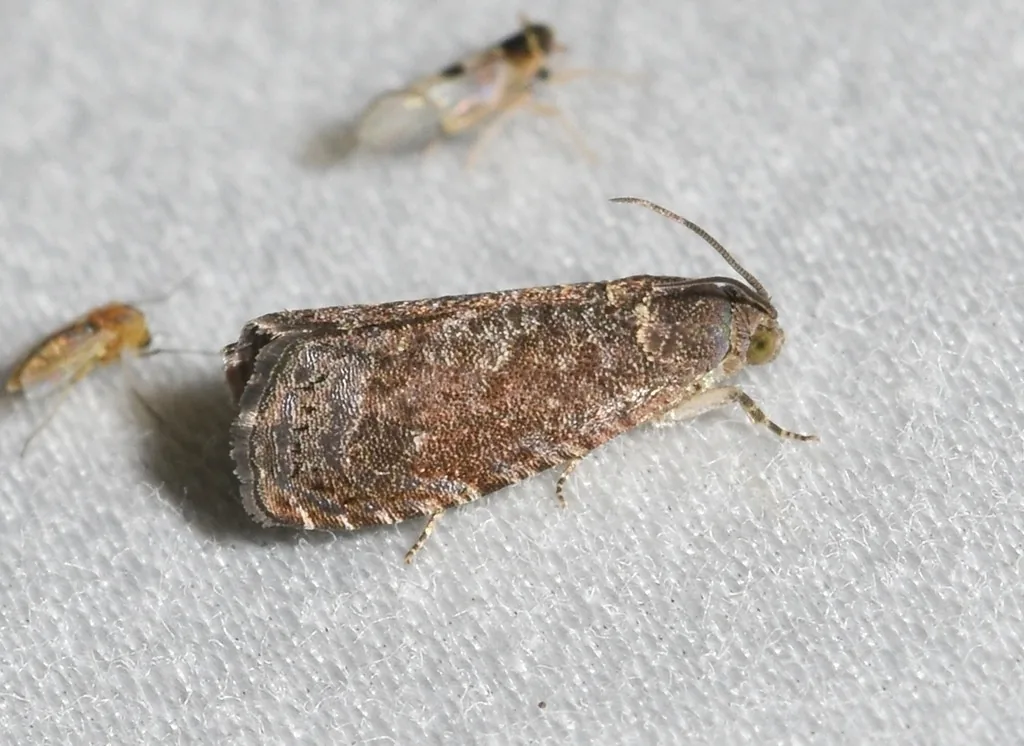
How to identify it
- Larvae are orangish, pale yellow, pink or whitish with a brown head and grow to about 2/3 inch.[1]
- Under a hand lens, a comb of short stiff bristles on the underside of the last segment sets it apart from other fruit-boring larvae.[1]
- Adults are about 1/2 inch long, dark brown or gray with whitish mottling, and fly around twilight.[1]
Look-alikes
| Look-alike | How to tell them apart |
|---|---|
| Peach twig borer | Its shoot damage looks identical; check the larva for the anal comb.[1] |
| Codling moth | Damage to fruit and nuts looks the same; only oriental fruit moth larvae have the anal comb.[1] |
Where it lives
It attacks almonds and stone fruits; nectarines and peaches are especially susceptible.[1]
Biology and life cycle
Mature larvae overwinter in cocoons on the tree or in litter at its base.[1]
Adults emerge in February or early March; early larvae tunnel in shoot tips, later ones in fruit and nuts.[1]
There are five or six generations a year in California.[1]
Damage and signs
Health risk
It feeds on fruit trees only; UC IPM mentions no risk to people.[1]
Control
Prevention
Avoid persistent broad-spectrum insecticides; effective sprays are for professionals, and mating disruption rarely works on one or a few trees.[1]
Biological control
The wasp Macrocentrus ancylivorus commonly parasitizes 80 to 90 percent of larvae by late summer on unsprayed trees.[1]
A small, unharvested sunflower patch planted in April and late May gives that wasp an overwintering host.[1]
Common questions
Sources
- University of California Statewide IPM Program, “Oriental Fruit Moth (Pests in Gardens and Landscapes).” ipm.ucanr.edu/PMG/GARDEN/FRUIT/PESTS/orientfrmoth.html (accessed 2026-10-06)
- iNaturalist, “Aspila molesta taxon page (order and family).” www.inaturalist.org/taxa/1507298 (accessed 2026-10-06)