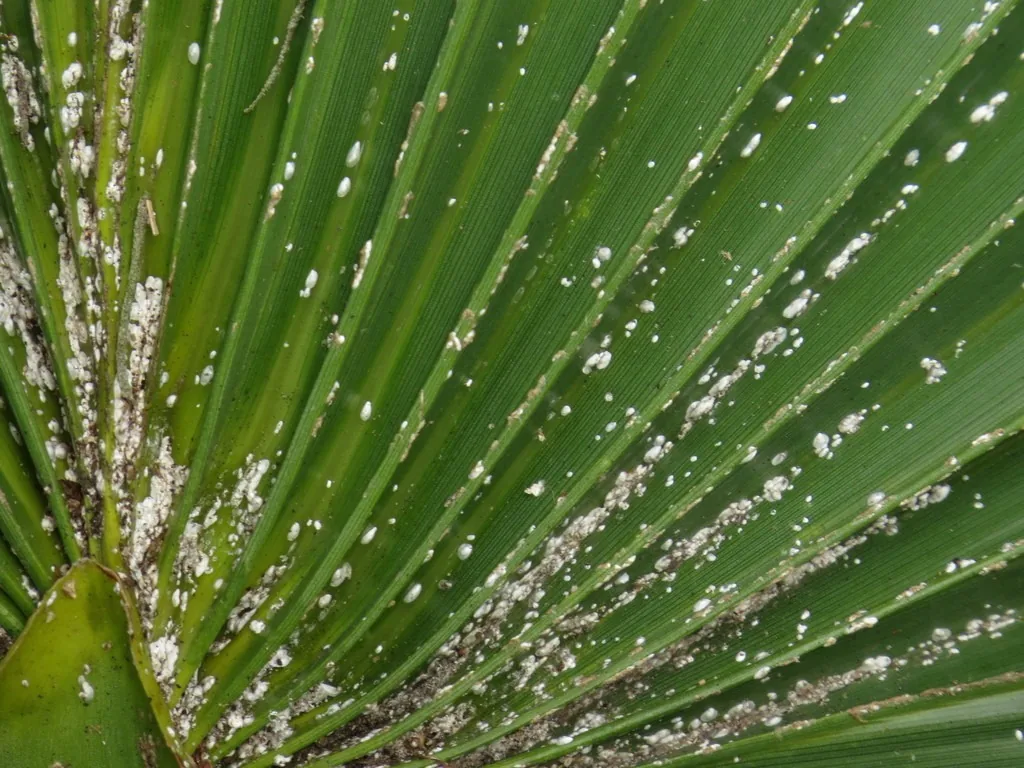
How to identify it
- Females are about 1 to 1.5 mm across, light pink to reddish brown, nearly round but irregular, with an off-center white shed skin covered with yellow wax.[2]
- Males are similar but smaller and more elongated, light pink or cream.[2]
- Feeding shows as yellow splotches or general yellowing on the leaves; heavy infestations can spread to the trunk and fruit.[2]
Where it lives
It is probably native to the southern United States and occurs across the South, in Mexico and the Caribbean, and in greenhouses farther north.[2]
Biology and life cycle
Details of its life cycle are not well known.[2]
A tiny parasitic wasp, Coccobius donatellae, is its primary parasitoid.[2]
Damage and signs
Health risk
Control
Biological control
Parasitoid wasps normally keep it at acceptable levels.[1][2]
Pesticides
Horticultural oil works; NC State advises no more than a 2 percent rate to avoid frond damage, watering the palm well first and keeping it out of direct sun until the spray dries.[1]
Common questions
- What are the tiny pinkish specks on my palm fronds?
- Possibly palmetto scale, an armored scale about 1 to 1.5 mm across.[1][2]
- Is palmetto scale harmful to palms?
- Not usually, as long as its parasites are present.[1][2]
- Can I spray oil on palms?
- Yes, at no more than a 2 percent rate, on a well-watered palm kept out of direct sun until dry.[1]
Sources
- NC State Extension, “Palmetto Scale.” content.ces.ncsu.edu/palmetto-scale (accessed 2026-10-15)
- University of Florida IFAS Extension (Featured Creatures), “Palmetto Scale, Comstockiella sabalis (EENY-465).” ask.ifas.ufl.edu/publication/IN835 (accessed 2026-10-15)
- iNaturalist, “Comstockiella sabalis taxon page (order and family).” www.inaturalist.org/taxa/890484 (accessed 2026-10-06)