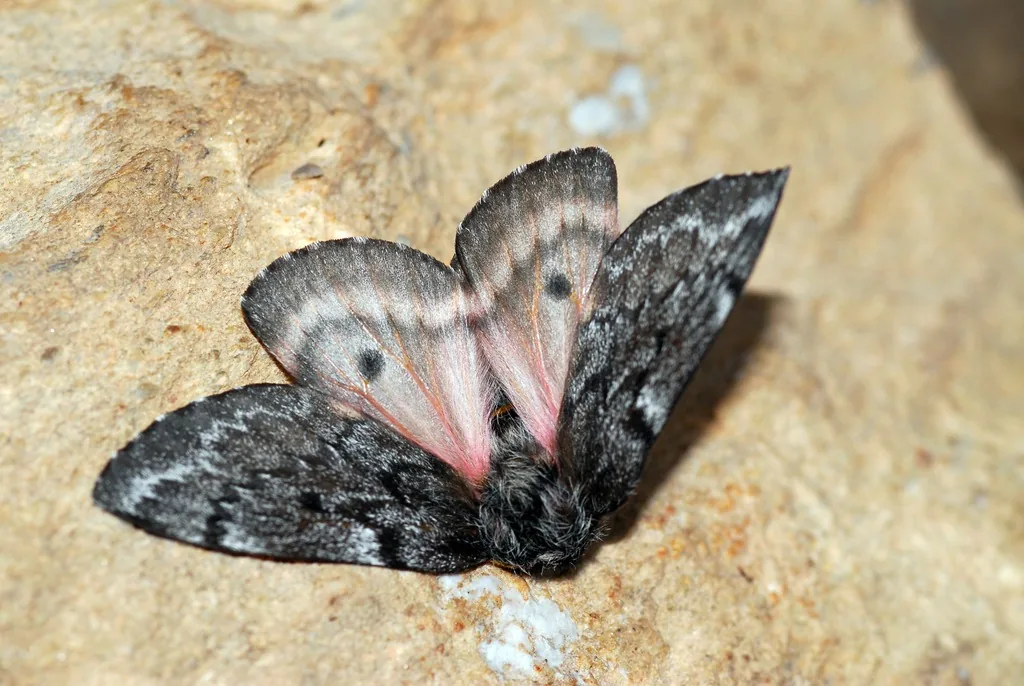
How to identify it
- Adults are large, heavy-bodied, brown-gray moths with a wingspan of 2.7 to 4 inches and black wing markings.[1]
- Caterpillars are brownish to yellowish green, spiny and about 1 inch long when grown.[1]
- Caterpillars travel in single file to new feeding spots, and eaten needles leave stubs on the twigs.[1]
Where it lives
The PNW Insect Management Handbook calls it a sporadic pest of forest and landscape pines.[1]
Biology and life cycle
Moths emerge in midsummer and lay eggs on pine needles or bark; larvae feed on new foliage through summer.[1]
Larvae overwinter in clusters on the tree, feed again in spring, then drop to the soil to pupate, a stage that lasts at least a year.[1]
The larvae are considered a delicacy among tribes in areas where they occur.[1]
Damage and signs
- Crowns of infested trees thin out, and large outbreaks can severely defoliate them.[1]
Health risk
It feeds on plants; the PNW Insect Management Handbook mentions no risk to people.[1]
Control
Prevention
Control isn't needed except in outbreak years; watch for increasing defoliation or clusters of larvae in winter.[1]
Traps and physical control
Hand-pick larvae you find, and prune out severely defoliated sections.[1]
Common questions
Sources
- Pacific Northwest Pest Management Handbooks (OSU, WSU, University of Idaho), “Pine (Pinus): Pandora moth (Insect Management Handbook).” pnwhandbooks.org/insect/hort/landscape/hosts-pests-landscape-plants/pine-pinus-pandora-moth (accessed 2026-10-06)
- iNaturalist, “Coloradia pandora taxon page (order and family).” www.inaturalist.org/taxa/179711 (accessed 2026-10-06)