How to identify it
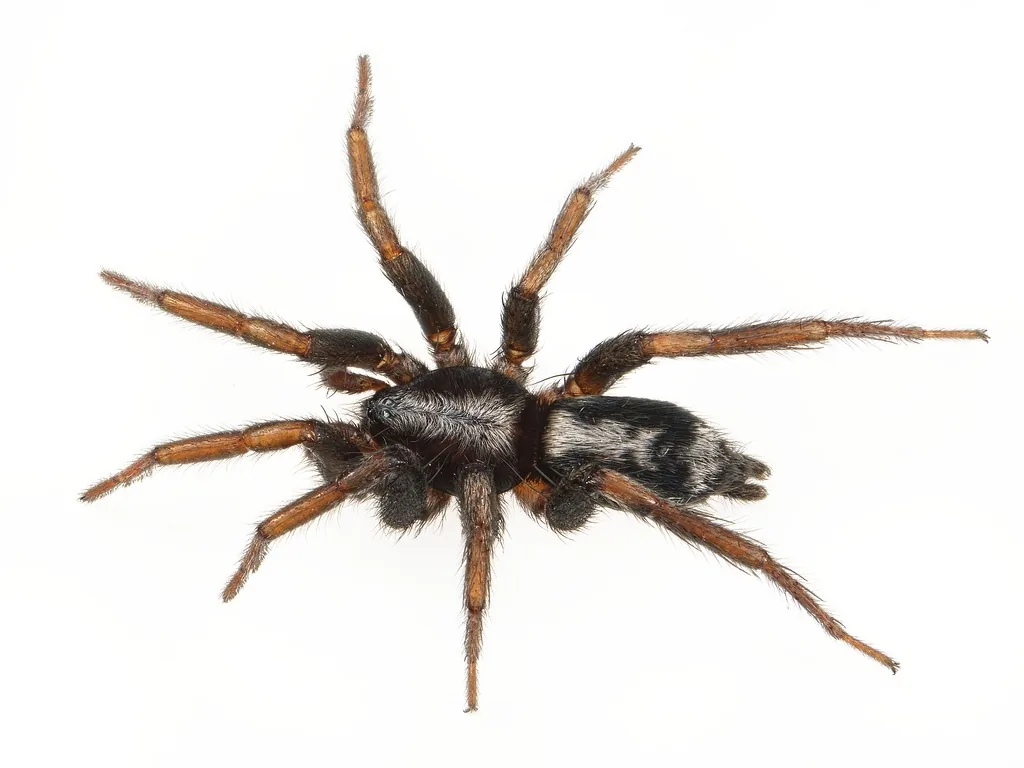
- A rather hairy spider with flat-lying black hairs on the front body section, gray hairs on the abdomen and chestnut brown legs.[1]
- The name comes from a white pattern on top of the abdomen that resembles an old-fashioned clerical collar, plus a small white spot just above the spinnerets.[1]
- Minnesota Extension describes it as dark with a light stripe on the front body section and a white, somewhat arrow-shaped band on the abdomen.[2]
- Females are 8 to 13 millimeters long and males average about 6 millimeters, roughly 1/2 inch or less not counting the legs.[1][2]
Where it lives
Penn State calls it the most commonly encountered of the ground spiders in the United States, and Minnesota Extension lists it among spiders found in and around homes there.[1][2]
Biology and life cycle
By day it hides in a silken retreat in rolled leaves, under bark, stones or debris, mostly in wooded areas; at night it hunts and can move very fast.[1]
It runs in a zigzag to escape predators, which is why it can be hard to catch indoors.[1]
Females lay a white egg sac in fall under the bark of trees and logs, then hibernate there and guard it.[1]
Indoors it turns up in fall as it seeks a winter shelter, and Minnesota Extension reports it in and around homes in spring and summer.[1][2]
Damage and signs
Health risk
The bite is painful and some people may have an allergic reaction, but it isn't considered medically important. Most bites happen when the spider is trapped against skin in clothing or bedding.[1]
Control
Keep them out
Seal cracks in the foundation and gaps around windows and doors, and keep screens tight, before fall when it looks for winter shelter.[3][1]
Sanitation
Keep leaf litter, trash, heavy vegetation and other debris away from the foundation, and reduce clutter in garages, sheds and basements.[3]
Traps and physical control
Vacuum spiders found indoors, or trap one under a jar with a sheet of paper and release it outside; sticky traps placed out of reach of children and pets also catch wanderers.[3]
Pesticides
Insecticides don't give long-term spider control and generally shouldn't be used against spiders outdoors; spraying works only briefly without regular cleaning.[3]
Common questions
Sources
- Penn State Extension, “Parson Spider (updated September 8, 2025).” extension.psu.edu/parson-spider (accessed 2026-10-06)
- University of Minnesota Extension, “Parson spider (What insect is this? Insects found indoors).” apps.extension.umn.edu/garden/diagnose/insect/indoor/relatives/medium/parson-spider.html (accessed 2026-10-06)
- University of California Statewide IPM Program, “Spiders (Pest Notes, Home and Landscape).” ipm.ucanr.edu/home-and-landscape/spiders/ (accessed 2026-10-06)
- iNaturalist, “Herpyllus ecclesiasticus taxon page (order and family).” www.inaturalist.org/taxa/130880 (accessed 2026-10-06)