How to identify it
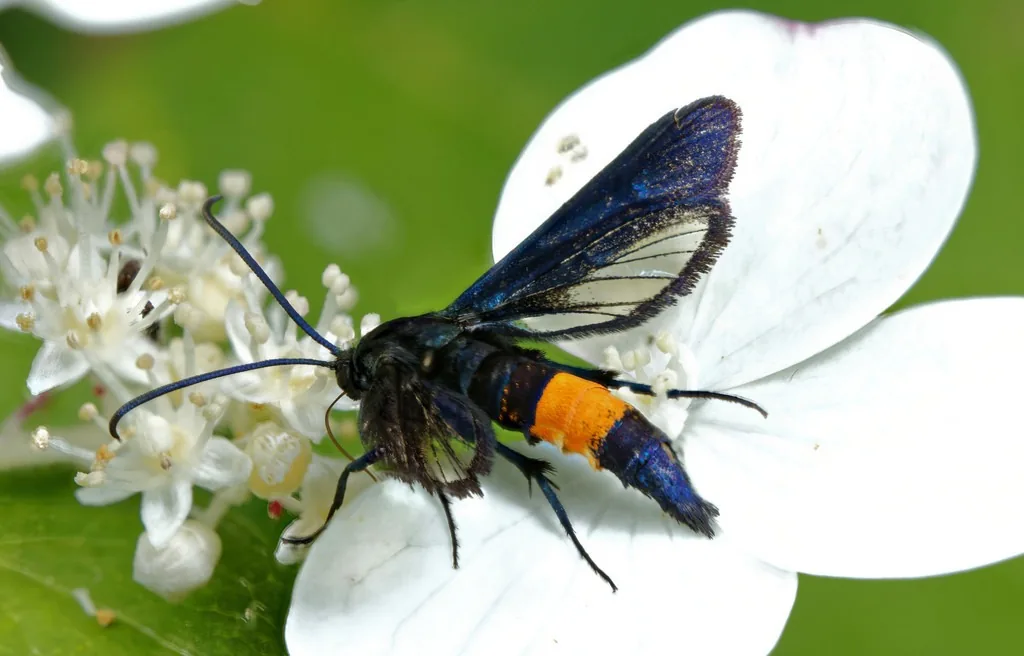
- Adult females are dark metallic blue with a broad reddish-orange band around the abdomen.[1][2]
- Males are smaller and look like small wasps, with clear wings and narrow yellow bands on the abdomen.[2][1]
- Mature larvae are about 1 1/4 to 1 1/2 inches long, white to cream, with a dark brown head.[1][2]
- Empty light brown pupal skins are often seen sticking out of the trunk or lying around the base of damaged trees.[1][2]
Look-alikes
Where it lives
Native to North America, mainly east of the Rocky Mountains; in California it is found mostly in coastal areas and the northern San Joaquin Valley.[1][3]
Biology and life cycle
Larvae of different sizes spend the winter under the bark and resume feeding in spring.[1][2]
Adults fly during the day, mostly from late morning to early afternoon; in Pennsylvania the flight runs from late June to early September.[1][2]
Each female lays 200 to 800 eggs on the lower trunk, in bark crevices or on nearby soil, and the eggs hatch in about 7 to 10 days.[1][2]
Young larvae enter the bark, often through wounds, and feed on the growing layer beneath it.[2][1]
Damage and signs
- Gum oozes from the trunk from about 3 inches below to 12 inches above the soil line, often mixed with sawdust and droppings.[1][2]
- Heavy feeding in the trunk can girdle and kill a tree; root feeding reduces vigor and fruit production, and young trees are especially vulnerable.[2][3]
- Stressed trees, such as new transplants, drought-stressed trees and trunks nicked by mowers or trimmers, are more likely to be attacked.[1]
Health risk
It is a tree pest only; the wasp-like adults are clearwing moths, and the adult stage doesn't feed.[1]
Control
Prevention
Don't pile mulch around the base of Prunus trunks, which attracts egg-laying females, and avoid wounding the bark at the base of the tree.[1]
Traps and physical control
Remove and destroy severely infested trees.[1]
Biological control
Several parasitic wasps and predators attack the eggs, larvae and pupae.[1]
Pesticides
Control works best in the short window between adult emergence and egg hatch; pheromone traps show when the first males are flying.[2][1]
Extension sources advise a registered trunk spray about 1 to 2 weeks after the first male is trapped, wetting the lower trunk thoroughly, following label directions.[1][2]
Trunk sprays are unlikely to kill larvae already inside the tree but protect against new egg-laying, so results may not show until the next season.[3]
Common questions
- Why is gum oozing from the base of my peach tree?
- Gum mixed with sawdust near the soil line is one of the first signs of peachtree borer larvae tunneling under the bark.[1][2]
- When should I treat for peachtree borer?
- Time any treatment to the brief period after adults emerge and before eggs hatch; pheromone traps tell you when the moths are flying.[2][1]
Sources
- Penn State Extension, “Peachtree Borer (updated April 10, 2026).” extension.psu.edu/peachtree-borer (accessed 2026-10-06)
- NC State Extension, “Peachtree Borer (published February 23, 2015).” content.ces.ncsu.edu/peachtree-borer (accessed 2026-10-06)
- University of California Statewide IPM Program, “Peachtree Borer, UC IPM Pest Management Guidelines: Peach (UC ANR Publication 3454).” ipm.ucanr.edu/agriculture/peach/peachtree-borer/ (accessed 2026-10-06)
- iNaturalist, “Synanthedon exitiosa taxon page (order and family).” www.inaturalist.org/taxa/143277 (accessed 2026-10-06)