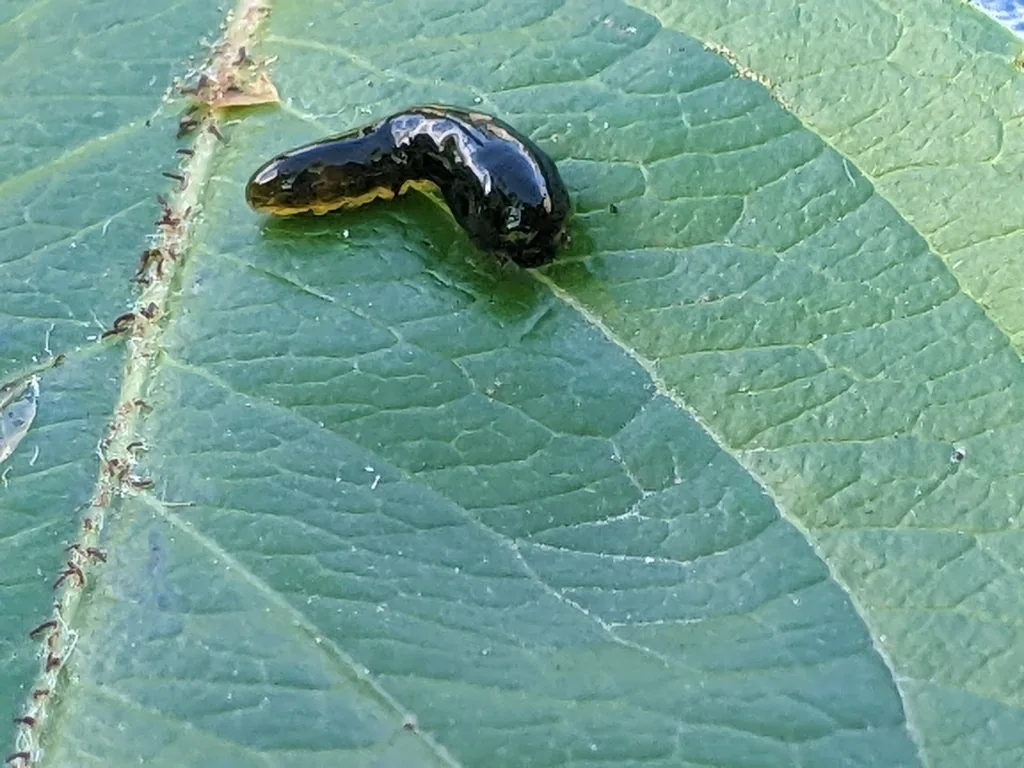
How to identify it
- Larvae grow to about 3/8 inch and are covered with a gelatinous, olive-green coating that makes them look like small slugs.[1]
- The thorax behind the head is wider than the rest of the body.[1]
- Larvae have seven pairs of prolegs, more than the five or fewer of most caterpillars.[1]
- Adults are glossy black and yellow sawflies about 1/5 inch long with a broad waist.[1]
Look-alikes
| Look-alike | How to tell them apart |
|---|---|
| California pear sawfly | Its larvae are bright green and lack the olive-green slimy coat.[1] |
Where it lives
It feeds on cherry and pear and also cotoneaster, hawthorn, mountain ash, plum and quince; in California damage is mostly in coastal and northern areas.[1]
Biology and life cycle
Mature larvae overwinter in cells in topsoil and emerge as adults in early spring.[1]
Females insert eggs in the undersides of leaves, and larvae pass through five instars.[1]
There are generally two generations a year, with larvae most common in mid to late spring and mid to late summer.[1]
Damage and signs
Health risk
It feeds on leaves; UC IPM describes no risk to people.[1]
Control
Traps and physical control
When numbers are low, pick them off or wash them off with a strong stream of water.[1]
Pesticides
Thorough sprays of horticultural oil, neem oil, insecticidal soap or spinosad control them; don't spray spinosad on flowering plants.[1]
Bt does not work on sawfly larvae, because they aren't caterpillars.[1]
Common questions
Sources
- University of California Statewide IPM Program, “Pear Sawfly (Pearslug) (Pests in Gardens and Landscapes).” ipm.ucanr.edu/PMG/GARDEN/FRUIT/PESTS/pearslug.html (accessed 2026-10-06)
- iNaturalist, “Caliroa cerasi taxon page (order and family).” www.inaturalist.org/taxa/386969 (accessed 2026-10-06)