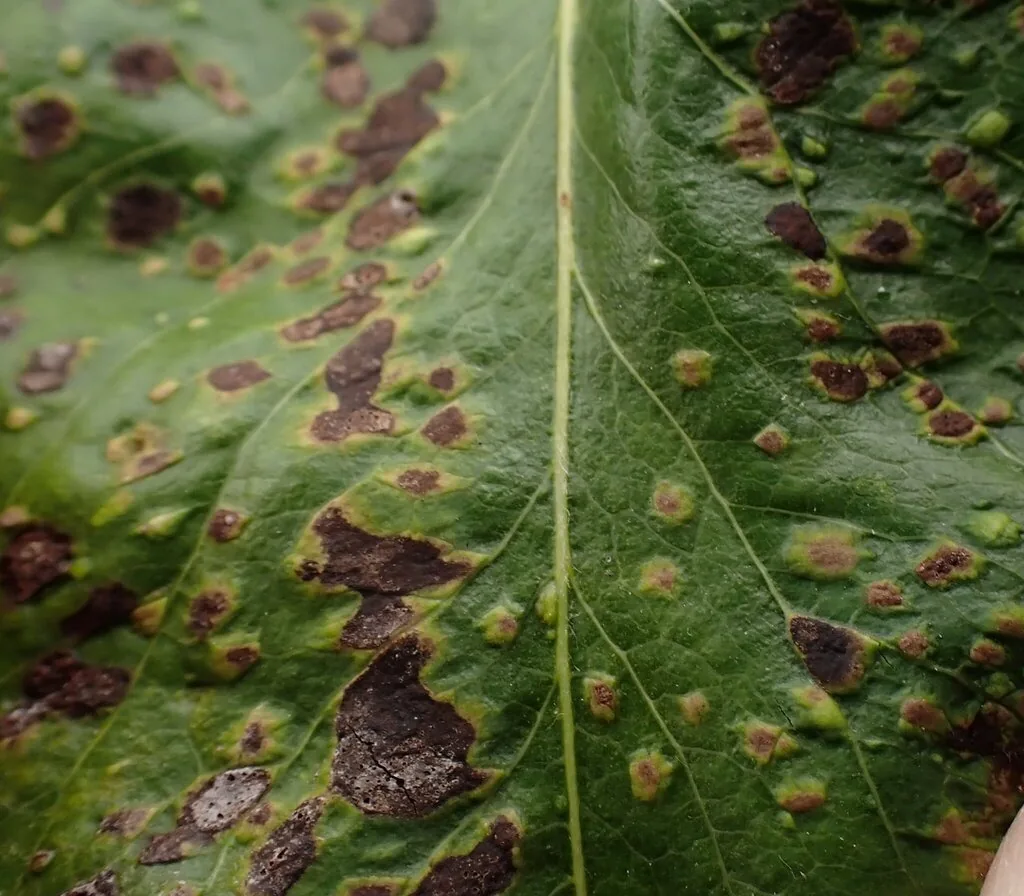
How to identify it
Where it lives
The PNW Insect Management Handbook covers it on flowering pears in Pacific Northwest landscapes.[1]
Biology and life cycle
Mature females overwinter under outer bud scales and burrow into swelling buds in spring, so blisters are already there as leaves unfold.[1]
At petal fall they move to more leaves or fruit; several generations develop inside the blisters each year.[1]
Mites spread from tree to tree on the wind or carried by birds and insects.[1]
Damage and signs
- Leaves may drop early, and losing foliage weakens trees and cuts shoot growth and flowering.[1]
Health risk
It feeds on plants; the PNW Insect Management Handbook mentions no risk to people.[1]
Control
Prevention
Scouting doesn't help in the current season, since mites are already inside when blisters show; plan any action for the following fall or winter.[1]
Water trees properly, since drought-stressed trees are more susceptible, and avoid excess nitrogen.[1]
Traps and physical control
Wash mites from the tree with a strong stream of water.[1]
Biological control
Phytoseiid predatory mites almost always keep it under control if broad-spectrum insecticides are avoided; heavy rain and cold also suppress it.[1]
Common questions
Sources
- Pacific Northwest Pest Management Handbooks (OSU, WSU, University of Idaho), “Pear, flowering (Pyrus): Pearleaf blister mite (Insect Management Handbook).” pnwhandbooks.org/insect/hort/landscape/hosts-pests-landscape-plants/pear-flowering-pyrus-pearleaf-blister-mite (accessed 2026-10-06)
- iNaturalist, “Eriophyes pyri taxon page (order and family).” www.inaturalist.org/taxa/389186 (accessed 2026-10-06)