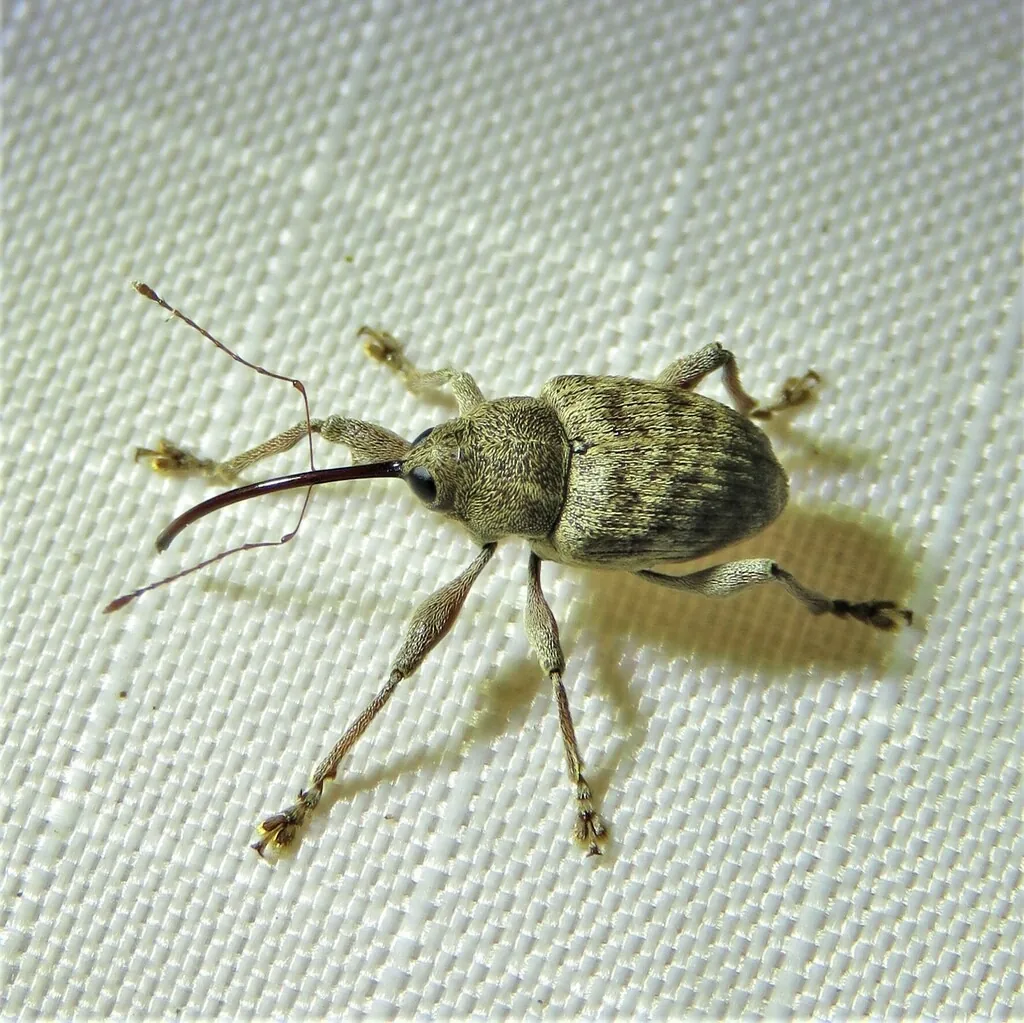
How to identify it
Where it lives
It's a serious late-season pest of hickory and pecan.[1]
Biology and life cycle
Adults emerge in late August through September, often after heavy rains, as nuts begin to harden.[1]
Grubs exit through a round 1/8-inch hole and spend one to two years in the soil; the cycle takes 2 to 3 years.[1]
Damage and signs
- Adult feeding causes early nut drop, and grubs destroy kernels; grubs sometimes turn up where nuts are stored.[1]
Health risk
It feeds on plants; UK Extension mentions no risk to people.[1]
Control
Traps and physical control
Starting in mid-August, jar limbs over a large sheet to see when weevils are active and time any treatment.[1]
Common questions
Sources
- University of Kentucky Entomology (ENTFACT), “Nut Weevils (ENTFACT-206).” entomology.mgcafe.uky.edu/ef206 (accessed 2026-10-06)
- iNaturalist, “Curculio caryae taxon page (order and family).” www.inaturalist.org/taxa/217926 (accessed 2026-10-06)