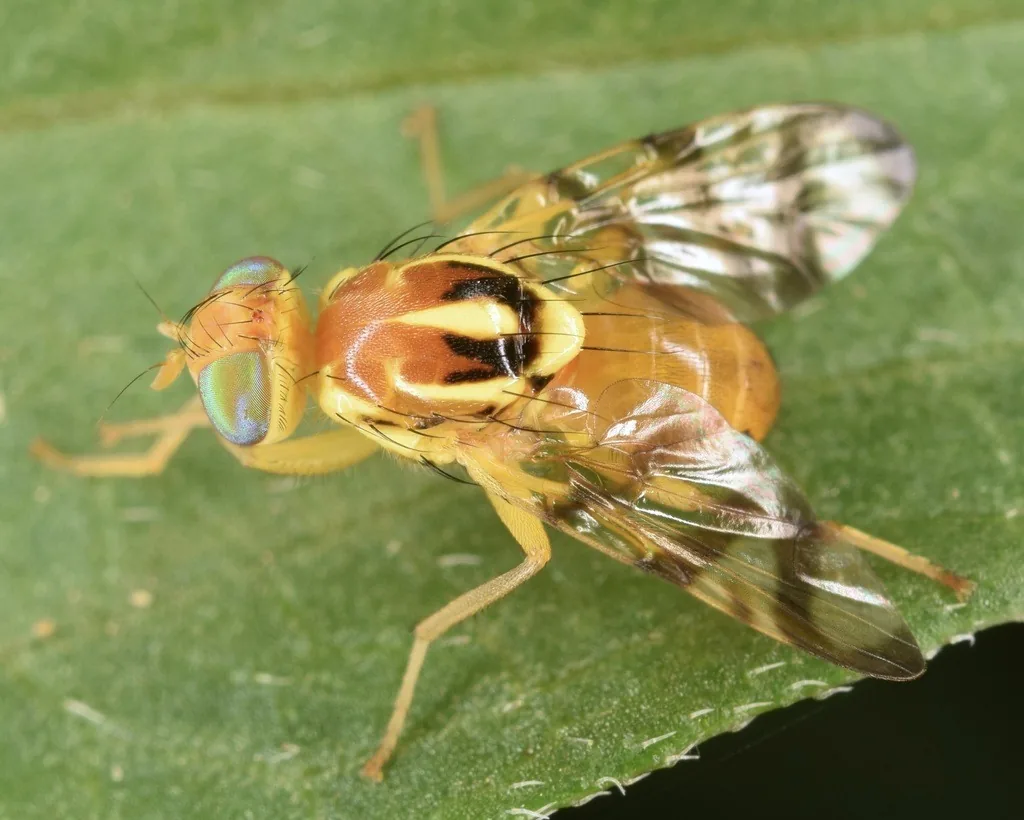
How to identify it
Look-alikes
| Look-alike | How to tell them apart |
|---|---|
| European corn borer | Corn borers leave some outside evidence on peppers; pepper maggots leave almost none.[1] |
Where it lives
It's a sporadic pest of peppers along the Atlantic coast, Indiana and Missouri, first recorded in Kentucky in 2002.[1]
Biology and life cycle
Larvae feed two to three weeks, then drop to the soil and pupate two to four inches deep.[1]
There's one generation a year, with adults emerging from early summer through mid-August.[1]
Damage and signs
- Infested fruit shows internal tunneling and discoloration, often turns color early, and the cap may separate at harvest.[1]
Health risk
It feeds on plants; UK Extension mentions no risk to people.[1]
Control
Prevention
Rotate: avoid planting peppers in or near fields with a history of pepper maggot.[1]
Sanitation
Remove rotting fruit, destroy infested fruit and cull piles, and destroy nearby horsenettle, an alternate host.[1]
Common questions
Sources
- University of Kentucky Entomology (ENTFACT), “Pepper Maggot in Kentucky (ENTFACT-316).” entomology.mgcafe.uky.edu/ef316 (accessed 2026-10-06)
- iNaturalist, “Zonosemata electa taxon page (order and family).” www.inaturalist.org/taxa/554218 (accessed 2026-10-06)