How to identify it
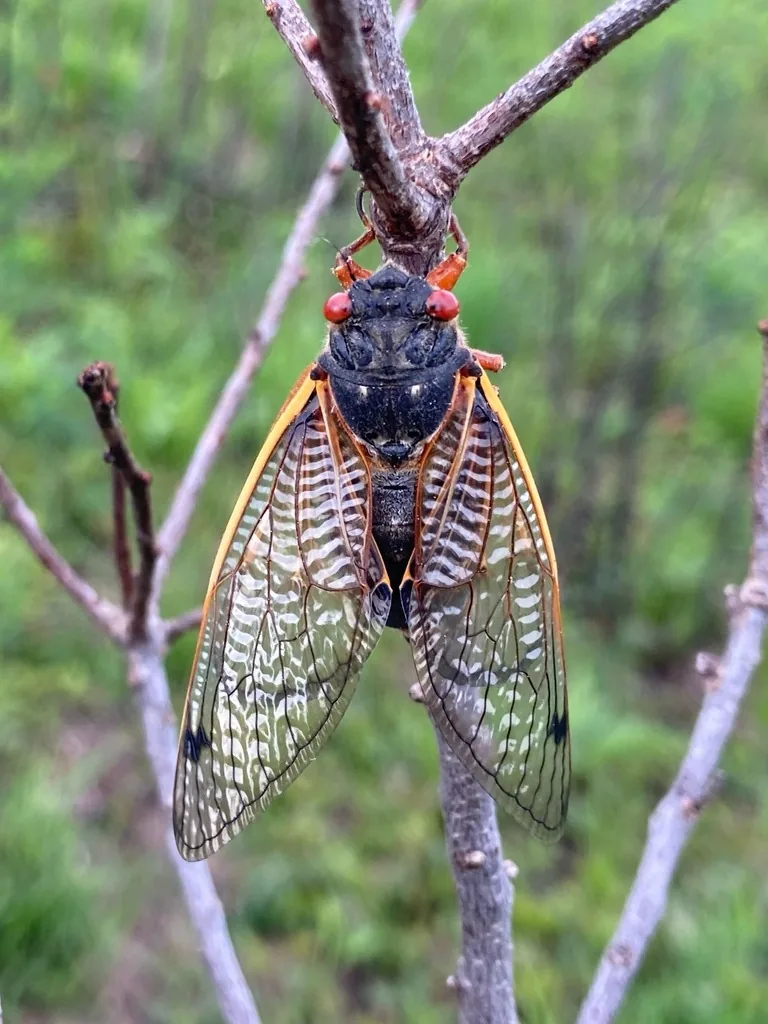
- Adults are about 1.5 inches long, with a black body, red eyes and orange legs.[1]
- The clear wings have orange veins and are held tented over the body; the front wings carry a black W-shaped mark.[1][2]
- Empty brown nymph skins are left clinging to tree trunks, fence posts and leaves where the adults molted.[1][2]
- Before emerging, some nymphs build mud chimneys 2 to 3 inches high over their exit holes, and dime-sized holes may dot the lawn.[2]
Look-alikes
Where it lives
Periodical cicadas live in eastern North America. Each brood emerges in its own area and year, and some areas host more than one brood.[2][1]
Biology and life cycle
Nymphs feed on root sap underground for 13 or 17 years, depending on the species, then tunnel to the surface and molt into winged adults.[1][2]
Emergence is tightly synchronized, often over a few nights, and densities can reach as high as 1 million cicadas per acre.[1][2]
Adults live only a few weeks. In Virginia they appear in early May, peak in early June and are mostly gone by July.[1]
Each brood gets a Roman numeral. For example, Brood X emerged in Maryland in 2021 and is expected again in 2038.[2]
Males sing by vibrating drum-like membranes on the sides of the body; females are silent.[1][2]
Females cut slits into pencil-sized twigs and lay up to 400 eggs in 40 to 50 spots. Eggs hatch in about six weeks, and nymphs drop to the ground.[1][2]
Damage and signs
- Egg-laying splits small twigs, which die and turn brown, a condition called flagging.[1][2]
- Flagging is natural pruning for mature trees, but extensive flagging can stunt or kill young or newly planted trees.[2]
- Newly planted fruit and ornamental trees such as apple, dogwood, peach, cherry and pear are the most seriously damaged; oaks are commonly used.[1]
- Root feeding by nymphs is considered very minor, and emergence holes don't permanently harm lawns or established plants.[1][2]
Health risk
Cicadas aren't poisonous and can't bite or sting, though male choruses can be very loud. Discourage pets from eating large numbers, which can upset their stomachs.[1][2]
Control
Prevention
In a known emergence year, delay planting new trees and shrubs until early autumn, after the cicadas are gone.[2][1]
Keep them out
Cover young trees and shrubs with insect netting of 1/4 to 3/8 inch mesh, secured at the trunk or ground. Bird netting openings are too large.[2][1]
Keep netting on from emergence until the adults die off, then remove it; left on too long, it can distort new growth, cut air circulation and shade leaves.[2][1]
Traps and physical control
Prune out and destroy flagged twigs within about six weeks of egg-laying, before nymphs hatch and drop to the roots.[1]
Pesticides
Backyard insecticides give limited control, can harm pollinators and natural enemies, and may trigger spider mite outbreaks. Control isn't needed for established trees.[1][2]
What doesn't need protecting
Annuals, perennials, vegetables and herbs don't need covering, because cicadas don't feed on them or lay eggs in them.[2]
Cover small fish ponds with screening during an emergence, since many decaying cicadas can deplete oxygen in the water.[2]
Common questions
- Do periodical cicadas bite or sting?
- No. The female's ovipositor looks like a stinger but is only used to lay eggs in twigs, and adults can't bite.[2][1]
- Should I spray my trees during a cicada emergence?
- Generally no. Sprays give limited control because cicadas keep flying in, and they kill beneficial insects; netting young trees works better.[1][2]
- Why do they only come out every 13 or 17 years?
- Scientists aren't sure, but emerging all at once in huge numbers overwhelms birds and other predators so enough cicadas survive to breed.[2][1]
Sources
- Virginia Cooperative Extension, Virginia Tech, “Periodical Cicada, Publication 444-276 (ENTO-455NP), revised June 2021.” www.pubs.ext.vt.edu/444/444-276/444-276.html (accessed 2026-10-06)
- University of Maryland Extension, “Cicadas (updated September 23, 2026).” extension.umd.edu/resource/cicadas (accessed 2026-10-06)
- iNaturalist, “Magicicada septendecim taxon page (order and family).” www.inaturalist.org/taxa/1248681 (accessed 2026-10-06)