How to identify it
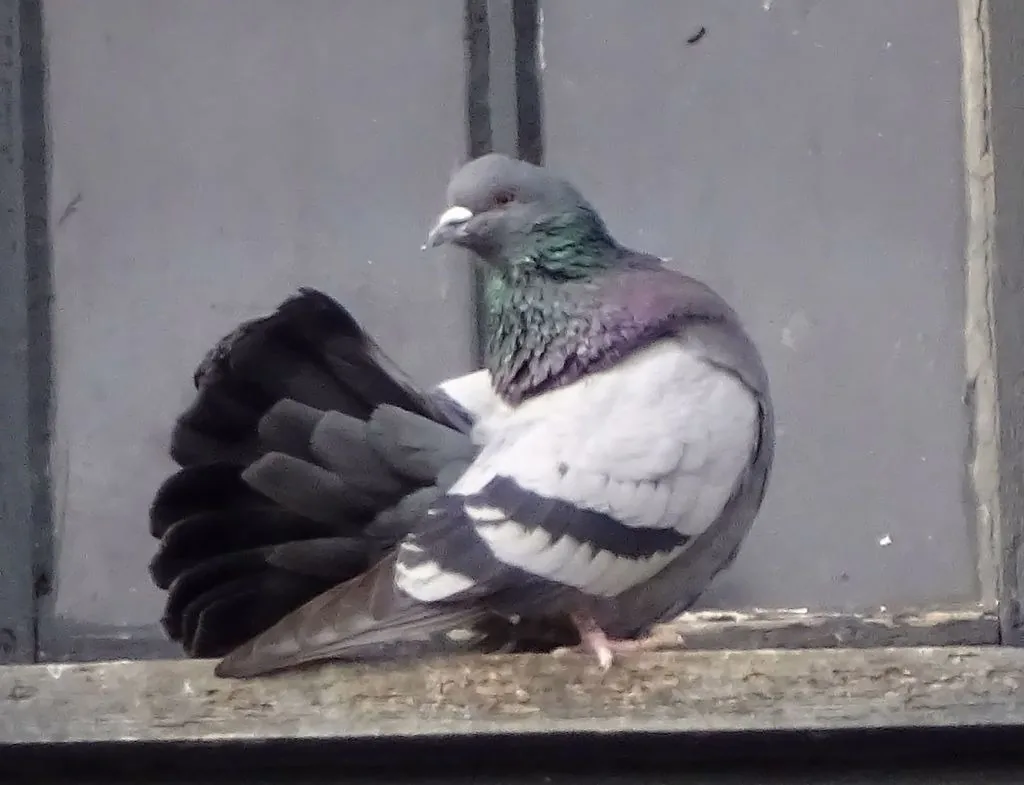
- About 12 inches long and 12 to 17 ounces, typically blue-gray with two black bars on each wing and a black tail band contrasting with a white rump.[1][6]
- Feet are red, and color forms range from all white to mottled brown to sooty black.[1][6]
- Wing tips touch on takeoff with a clicking sound, and the wings are held raised at an angle while gliding; the call is a soft, throaty cooing.[1]
- Nests are crude platforms of sticks, twigs and grass, often with hardened droppings, on sheltered ledges.[2][6]
Look-alikes
Where it lives
Found throughout the United States, including Hawaii, as well as southern Canada and Mexico.[1]
Biology and life cycle
Pairs are monogamous; females lay 1 or 2 eggs that hatch in about 18 days, and young leave the nest at 4 to 6 weeks.[2][6]
Pigeons breed year-round, raising most broods in spring and summer, and often lay new eggs before the previous young have left the nest.[2][6]
They eat mainly grain and seed, plus garbage, livestock feed and handouts, and need free-standing water daily.[2][6]
Urban pigeons seldom live more than 3 or 4 years, though captive birds can live 15 years.[2]
Damage and signs
- Droppings are acidic and can deface and speed the deterioration of building materials, including marble statues.[3][6]
- Built-up droppings can plug gutters and downspouts, causing water damage, and their weight can threaten ceilings.[3][6]
- Nests can block exhaust vents and may cause fires.[3]
- Flocks cause noise and foul sidewalks, cars and buildings, and they eat and contaminate livestock feed.[3][6]
Health risk
Pigeons can spread Newcastle disease and cryptococcosis, and soil enriched with bird droppings can grow the fungus that causes histoplasmosis; avoid contaminated areas or wear protection when cleaning up droppings.[3][6]
Control
Keep them out
Close openings to attics, lofts, vents and eaves with 1/4-inch hardware cloth, wire mesh or netting, and cap chimneys with stainless steel screens.[4][6]
Keep birds off ledges with spikes, coils, tight wires or electric ledge products, or by changing the ledge angle to 45 degrees or more.[4][6]
Hang netting under rafters or over ornamental architecture to block roosting and nesting; clear any debris that builds up on ledge products.[4][6]
Sanitation
Remove food and water: don't feed pigeons, keep trash in covered containers, clean up spilled grain, and fix leaks and pooled water.[6][4]
Traps and physical control
Remove nests and eggs repeatedly from spring through fall, wearing gloves and bagging the material, since pigeons quickly rebuild.[6]
Cage traps placed where pigeons roost or feed can reduce a flock; check them daily and don't relocate trapped birds, because pigeons home back.[6][4][5]
Pesticides
Sticky tactile repellents keep birds off ledges; apply them to tape or a removable surface rather than directly on the building, and follow the label.[6][4]
An oral fertility-control bait that stops pigeon eggs from hatching can shrink a flock slowly; it suits sites that don't need a quick reduction, and some states require a license.[6][4]
When to call a professional
Frightening baits containing 4-aminopyridine are restricted-use products that only certified applicators can buy and apply, following strict prebaiting procedures.[6][4]
What doesn't work well
Frightening devices such as distress calls, reflective tape and owl effigies rarely give long-term relief because birds grow used to devices that never change.[6]
There's no reliable evidence that ultrasonic devices work against birds.[6]
Releasing trapped pigeons elsewhere is impractical; they can return from 50 miles or more away.[5]
Legal status
Feral pigeons are not protected by federal law, and most states do not protect them, but check state and local laws before acting.[1][6]
Some cities are bird sanctuaries that protect all birds, and local ordinances may restrict methods such as shooting or pyrotechnics.[1][6]
Common questions
- Are pigeon droppings dangerous?
- They can be. Droppings can harbor disease organisms, and soil enriched with bird droppings can grow the fungus behind histoplasmosis, so avoid contact or wear protective gear when cleaning.[3][6]
- Can I just trap pigeons and release them somewhere else?
- That rarely works. Pigeons are strong homing birds that can fly back from 50 miles or more, or become a problem in another community.[5]
- Is it legal to get rid of pigeons?
- Feral pigeons aren't federally protected, and most states don't protect them, but check state and local laws and make sure they aren't protected native doves.[1][6]
Sources
- Internet Center for Wildlife Damage Management, “Pigeons: Identification.” icwdm.org/species/birds/pigeons/ (accessed 2026-10-06). Run by university wildlife damage specialists (maintained at the University of Wisconsin-Stevens Point); species modules are based on Prevention and Control of Wildlife Damage (University of Nebraska Cooperative Extension, 1994).
- Internet Center for Wildlife Damage Management, “Pigeon Biology.” icwdm.org/species/birds/pigeons/pigeon-biology/ (accessed 2026-10-06). Run by university wildlife damage specialists (maintained at the University of Wisconsin-Stevens Point); species modules are based on Prevention and Control of Wildlife Damage (University of Nebraska Cooperative Extension, 1994).
- Internet Center for Wildlife Damage Management, “Pigeon Damage Identification.” icwdm.org/species/birds/pigeons/pigeon-damage-identification/ (accessed 2026-10-06). Run by university wildlife damage specialists (maintained at the University of Wisconsin-Stevens Point); species modules are based on Prevention and Control of Wildlife Damage (University of Nebraska Cooperative Extension, 1994).
- Internet Center for Wildlife Damage Management, “Pigeon Damage Control and Prevention Methods.” icwdm.org/species/birds/pigeons/pigeon-damage-control-and-prevention-methods/ (accessed 2026-10-06). Run by university wildlife damage specialists (maintained at the University of Wisconsin-Stevens Point); species modules are based on Prevention and Control of Wildlife Damage (University of Nebraska Cooperative Extension, 1994).
- Internet Center for Wildlife Damage Management, “Pigeon Handling.” icwdm.org/species/birds/pigeons/pigeon-handling/ (accessed 2026-10-06). Run by university wildlife damage specialists (maintained at the University of Wisconsin-Stevens Point); species modules are based on Prevention and Control of Wildlife Damage (University of Nebraska Cooperative Extension, 1994).
- University of Nebraska-Lincoln Extension, “G2024: Urban Pest Birds: Controlling Damage.” extensionpubs.unl.edu/publication/g2024/html/view (accessed 2026-10-06)
- iNaturalist, “Columba livia taxon page (order and family).” www.inaturalist.org/taxa/3017 (accessed 2026-10-06)