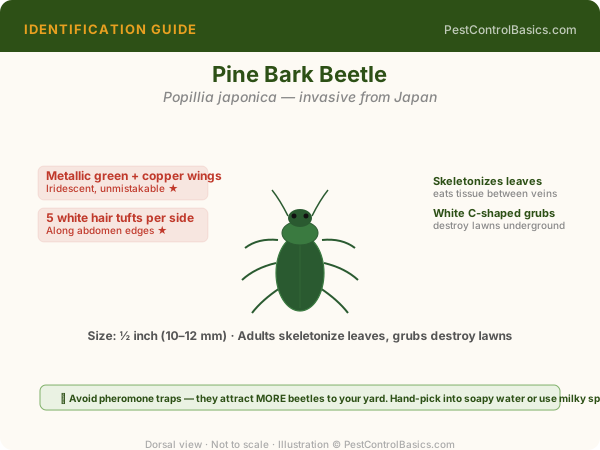
The pine bark beetle epidemic has killed billions of trees in the western US since 2000. Once a tree is successfully colonized by bark beetles, it cannot be saved — early detection is everything.
Bark BeetleDendroctonusPineWestern USPitch TubePreventive Only
🪲
Risk Level
Forest Pest
📐 FIELD GUIDE ILLUSTRATION
Original illustration by PestControlBasics.com. Use anatomical labels above to confirm your identification.
🔬
PestControlBasics Editorial Team
Reviewed by Derek Giordano · Updated 2026
🔍 Identification
Adults: 2-6mm depending on species; brown-black; cylindrical; found on bark surface during emergence flights. Pitch tubes: white-pink resinous masses on bark surface (pine's defense response to beetle boring — if active and sticky, tree is still fighting); boring dust (frass): fine yellowish-brown powder at trunk base and bark crevices — sign of active boring. Gallery patterns under bark are species-diagnostic.
🧬 Biology & Behavior
Two key species: western pine beetle (Dendroctonus brevicomis) attacks ponderosa pine; mountain pine beetle (D. ponderosae) attacks pines at higher elevations. Stressed trees are attacked first — drought, root damage, disease, overcrowding all increase susceptibility. Once 3+ beetles per square foot of bark have established, the tree's resin defense is overwhelmed — the tree cannot be saved. Trees that 'pitch out' invading beetles (active resin pitch tubes) may survive if pressure is light.
⚠️ Damage & Health Risk
Tree death within weeks to months of successful mass attack; massive landscape and forest losses; fire risk from standing dead timber; cascading ecological impacts from forest mortality.
🔧 DIY Treatment
Preventive carbaryl or permethrin bark spray on high-value trees BEFORE beetles arrive — applies to the bark surface to kill landing beetles. Tree vigor maintenance (irrigation during drought, fertilization) is the primary preventive approach. Remove and chip dead trees promptly — do not leave standing dead within 100 feet of living pines.
👷 When to Call a Pro
Licensed PCO with forestry experience for preventive bark spray programs on high-value trees; forestry consultant for landscape-scale assessment.
❓ FAQ
How do I know if bark beetles have killed my tree?
Within 2-3 weeks of successful mass attack: foliage begins turning from green to yellow-green to red over several months. At the bark: if pitch tubes are dried and brown (not active sticky resin), the tree lost the battle. Boring frass at the base confirms active beetles. A tree with 100% red foliage is dead — beetle flight has already occurred and risk of spread to adjacent trees is over.
Can I spray to kill bark beetles already inside a tree?
No — once beetles are under bark, no surface spray penetrates to kill them. Preventive bark spray before attack arrival is the only spray strategy that works. Trees already attacked cannot be saved by any spray treatment. Remove and chip infested trees to reduce the next generation of adults that would attack neighboring trees.
DG
Derek Giordano
Certified Pest Control Operator · Former Business Owner
Derek ran his own pest control company in Florida for several years, servicing thousands of regular customers. All content is based on hands-on field experience and current EPA & university extension guidelines.
Prevention strategies that actually reduce Pine Bark Beetle pressure
Most pest pressure traces back to one or two environmental conditions that are easier to fix than the infestation itself is to spray. For Pine Bark Beetle, the highest-leverage changes typically involve moisture management, food access, and exclusion at structural entry points. Reducing standing water within 20 feet of the foundation eliminates more pest problems than any single chemical application, and the effect persists year over year rather than requiring a rebuy every quarter.
Exclusion work is unglamorous but durable. A common entry-point audit covers door sweeps, weep holes, utility penetrations, dryer vents, soffit gaps, and the base of siding. Most homes have between five and fifteen openings larger than the minimum required for the target pest to enter, and sealing even half of them measurably reduces indoor sightings within one season. Stainless steel mesh, copper wool, and exterior-grade sealant cover most situations; expanding foam alone is not sufficient because rodents and some insects chew through it.
Storage practices matter too. Pantry pests, fabric pests, and overwintering insects all exploit cardboard, paper, and natural-fiber storage in basements and garages. Switching to sealed plastic bins for seasonal storage removes a significant amount of harborage that is otherwise impossible to spray effectively.
Confirming a Pine Bark Beetle infestation in the field
Misidentification is the most common reason home treatment fails for Pine Bark Beetle. Look-alike species often respond to completely different active ingredients, so a 30-second confirmation step before any spraying or baiting saves the most time over a season. The practical workflow begins with where you found the specimen — kitchen, bathroom, garden, attic — because habitat narrows the candidate list faster than morphology alone.
Specific cues for Pine Bark Beetle include body proportions, leg count, antenna shape, and any wing structure if present. Adults are usually the easiest stage to identify, but most real-world infestations show juveniles or evidence (frass, shed skins, webbing, damage patterns) more often than adults themselves. Photograph the specimen against a ruler or coin for scale, then compare against a regional reference rather than a global one — range maps from state Extension services beat generic online identification sites.
When two species look genuinely similar, the deciding factor is often where they congregate at dusk versus dawn, or whether they leave a visible trail. A test of three common DIY treatments — one bait, one residual spray, one mechanical barrier — applied in different areas can also confirm identity by which works.
Why timing changes everything with Pine Bark Beetle
The same product applied two weeks apart can produce a complete kill or near-zero effect depending on where the Pine Bark Beetle population sits in its life cycle. Egg-stage pests are nearly immune to contact sprays, so a perfectly applied treatment during a major hatch event will leave the next generation completely unaffected. The professional standard is two applications spaced 10 to 14 days apart for most household pests — the first kills the active adults, the second catches anything that emerges from eggs in the interim.
Temperature also drives treatment success. Most residual sprays lose efficacy above 90°F or below 50°F, and pyrethroid products in particular can repel rather than kill when applied during high heat. The best window is early morning when surface temperatures are still moderate and target pests are moving but not yet at peak activity. Indoor treatment is less weather-dependent but still benefits from being applied when household air movement is low — running ceiling fans during application redistributes droplets away from the intended surface.
Seasonal pressure for Pine Bark Beetle usually has two or three predictable peaks per year. A treatment calendar built around those peaks costs less and works better than reactive spraying after a problem is already established.
When to escalate Pine Bark Beetle control beyond DIY
Most Pine Bark Beetle situations are within the range of a careful homeowner, but a handful of scenarios genuinely warrant a licensed applicator. Multi-unit buildings are at the top of that list — shared walls, plumbing, and ductwork mean a localized treatment in one unit often just relocates the population to a neighbor. Any infestation that involves wall voids, attic insulation, or sub-slab plumbing is also harder to reach with consumer products and benefits from professional equipment and labeled product concentrations.
Health-sensitive situations are the second escalation trigger. Pregnancy, infants, immunocompromised residents, and pets with known sensitivities all narrow the available product list considerably. A licensed professional can apply restricted-use products and reduced-risk reformulations that achieve control with lower household exposure than over-the-counter alternatives. The cost difference is usually less than two seasons of DIY spending once the time investment is factored in.
The third escalation point is recurrence. If the same pest returns within six weeks of an apparently successful treatment, the source is usually structural or environmental rather than chemical, and a professional inspection often finds the cause faster than a second round of self-treatment.
Published: Jan 1, 2025 · Updated: Apr 7, 2026
Yellow jackets vs. paper wasps vs. hornets: what you're dealing with
Three commonly-confused wasp groups have meaningfully different behavior and require different management approaches. Paper wasps build open umbrella-shaped nests with visible cells, typically under eaves, in soffit corners, in shrubs, or under deck railings; colonies are smaller (typically 20-50 wasps), workers are less aggressive, and stings are typically defensive rather than offensive. Yellow jackets build enclosed papery nests, often underground in old rodent burrows or in wall voids, soffit cavities, and similar concealed locations; colonies are larger (often several hundred to several thousand), workers are aggressive particularly in late summer when populations peak and food sources change, and ground-nest disturbance produces serious sting events. Hornets (including bald-faced hornets, technically a yellow jacket species in the Vespidae family, and European hornets) build large enclosed aerial nests on tree branches or building exteriors. The identification matters because paper wasp nests can often be treated and removed by homeowners with caution, while yellow jacket and hornet nests are more dangerous and often warrant professional removal, particularly when nests are concealed in wall voids.
The role of caulk, sealant, and exclusion in long-term pest control
Sealing entry points is the most underrated pest control activity in residential settings, partly because it produces no immediate visible result and partly because it feels like home repair rather than pest control. The yield is substantial: a thoroughly sealed structure with appropriate exterior caulking, intact weatherstripping, sealed utility penetrations, and screen integrity has dramatically lower pest pressure than the same structure without those interventions. Specific high-yield targets include gaps around dryer vents, electrical and plumbing penetrations through exterior walls, gaps where siding meets foundation, mortar joints in older brick, weep holes in newer brick (which should be screened, not sealed), garage door bottom seals (where rodents commonly enter), and the gap above door thresholds where many ants and small insects pass. Materials matter: silicone-based caulk for moisture areas, polyurethane sealant for foundation cracks, copper mesh for rodent exclusion at utility penetrations (steel wool degrades), and 1/4-inch hardware cloth for larger openings. A weekend of methodical sealing in spring or fall — when activity is moderate and weather permits exterior work — produces lasting reduction that no single treatment matches.
Wasp nest removal: timing and the case for waiting
When a wasp nest appears on a property, the instinct is immediate removal, but timing and species considerations often justify a different approach. Paper wasps and many other social wasp species in temperate climates have annual colonies that die naturally at first hard frost; the queen overwinters separately and starts a new nest the following spring. A nest in a location that isn't a direct human conflict point (eave of a shed, branches of a far tree, post in a fence corner) can often simply be left until natural die-off, with the nest removed cosmetically in late fall after the colony has died. Nests in or near high-traffic areas — doorways, mailboxes, play structures, frequently-used outdoor seating — warrant removal for safety. Treatment timing within the season matters: evening application (when most workers have returned to the nest) maximizes effect, while daytime treatment leaves foragers that return to the nest later and produces incomplete results. Aerosol products labeled for wasp nests that produce a long-distance stream (rather than a foaming application) allow treatment from a safer distance.
Ground-nesting yellowjackets: a distinct problem requiring different handling
Yellowjacket species that nest in the ground present a substantially different management challenge from species that nest above ground. The nest entrance is often inconspicuous — a single small hole in turf, in a soil bank, or at the base of a retaining wall — and the nest itself can be quite large, with thousands of workers. The first sign of the nest is frequently a sting incident during mowing, landscape work, or recreational activity, because the nest is invisible until disturbed. Treatment of ground nests requires direct application of insecticide into the entrance, ideally at dusk or after dark when workers are inside, and follow-up to confirm activity has ceased. Pyrethroid dusts applied to the entrance are typically more effective than sprays, because the dust persists and is tracked into the nest by returning foragers. Sealing the entrance after dusting is sometimes recommended but should only be done after activity has confirmed ceased, because sealing a still-active nest can cause workers to emerge through alternate exits. For homeowners without experience, professional treatment of ground nests is often the right call given the population size and the consequences of incomplete treatment.
When neighborhood-level coordination matters for treatment
Some pests are house-scale problems and some are neighborhood-scale problems, and treating a neighborhood-scale problem as if it were house-scale leads to a familiar frustration: treatment works, then activity returns within weeks because the source was never inside your property. German cockroach problems in multi-unit buildings are the canonical example — treating one unit while the rest of the building is untreated produces temporary relief at best. Rodent infestations frequently span multiple adjacent properties, especially row houses, condo complexes, and dense suburban developments with shared boundary fencing or shared utility easements. Mosquito problems are obviously neighborhood-scale because adult mosquitoes don't respect property lines. The practical implication is that for these pests, isolated treatment is not just incomplete but in some cases economically wasteful. Coordinating with neighbors, talking to HOA or property management about whole-building or whole-block treatment, and identifying the actual sources rather than the symptom locations is what produces durable results. This is uncomfortable work in some neighborhoods, but no amount of treatment intensity in a single unit substitutes for it.
Paper wasp tolerance: when not to treat
Paper wasps are widely treated reflexively, but the cost-benefit assessment for treatment is often less favorable than homeowners assume. Paper wasps are valuable predators of caterpillars and other garden pests, they're typically non-aggressive unless the nest is disturbed within a few feet, and most nests in residential settings are in locations where they pose minimal risk to occupants. A nest under an eave on the unused side of the house is qualitatively different from a nest at the front door or near a children's play area. The right question to ask before treatment is whether anyone is actually going to be within the nest's defensive range during the rest of the season, and what the cost of accidental disturbance would be. For nests in low-traffic areas, leaving them alone often produces fewer wasp encounters across the season than treatment does, because the resident colony actively excludes other wasps and the natural cycle leads to nest abandonment by fall. For nests in genuinely high-conflict locations, prompt treatment is warranted, but the default of treating every visible nest underestimates the ecological role and overestimates the actual risk in most situations.
🗺️ US Distribution — Pine Bark Beetle
Common Occasional Not Present
States Present
49
Occasional
2
Primary Region
All agricultural regions
📊 Source: University extension services, USDA, CDC vector data, and published entomological surveys.