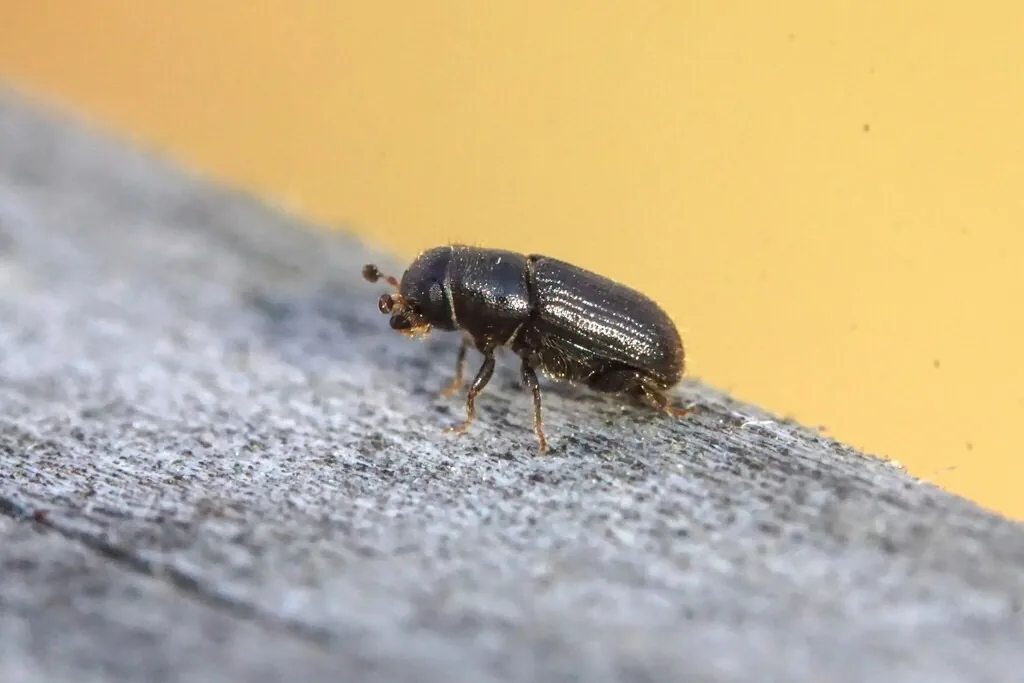
How to identify it
- Southern pine beetle adults are only 2 to 4 mm long, cylindrical and brown to black, with a rounded rear end and a head visible from above.[1]
- Ips engravers are dark reddish brown to almost black, and the rear of the wing covers looks cut off at an angle and hollowed, with four to six small spines on each edge.[2]
- Eastern six-spined engravers are about 3/16 inch long; the five-spined and southern pine engravers are about 1/8 inch.[2]
- Attacked pines show pitch tubes, popcorn-size lumps of resin on the bark, and reddish-brown boring dust on the bark.[1][2]
- Under the bark, southern pine beetle galleries wind in S or zigzag shapes, while Ips engravers make Y- or H-shaped egg galleries.[1][2]
Look-alikes
| Look-alike | How to tell them apart |
|---|---|
| Black turpentine beetle | Belongs to the same genus as the southern pine beetle but is more than twice as large.[1] |
| Secondary bark and wood-boring beetles | Nearly every dead pine in the Southeast gets colonized by beetles, but most are secondary species that don't attack nearby healthy trees; peeling the bark to check the gallery pattern is needed for a diagnosis.[1] |
Where it lives
The southern pine beetle ranges across the southern and southeastern United States and has spread into the Northeast since 2014 with warmer winters; in North Carolina, all native pines are susceptible to Ips engravers.[1][2]
Biology and life cycle
Southern pine beetle females pick the host tree and release a pheromone that draws in more beetles of both sexes, and this mass attack is what kills the tree.[1]
Southern pine beetle larvae feed on a fungus the female carries into the bark, so their own tunnels are very short.[1]
Ips males bore into the bark and make a small chamber, where one to four females join them; each female then cuts egg galleries in the inner bark.[2]
Ips engravers prefer fallen trees and logging slash but attack apparently healthy pines after drought or injury; in hot weather a generation can take as little as 3 weeks.[2]
Southern pine beetle outbreaks mostly start in dense, overstocked pine stands, often beginning in a lightning-struck tree and spreading to healthy neighbors over a few weeks.[1]
Damage and signs
- Beetle tunnels can girdle a pine, and spots or groups of trees are often killed together.[1][2]
- Needles in the crown turn from green to yellow to red before going brown; by the time the crown is red, the beetles have usually already left.[1][2]
- Ips-infested trees usually carry blue-stain fungi that are themselves usually fatal to pines.[2]
- The southern pine beetle attacks any pine in its range; loblolly stands have the most outbreaks, while slash and longleaf pines are more resistant.[1]
Health risk
Pine bark beetles harm trees, not people; the problem is dying pines and the loss of nearby trees as an infestation spreads.[1][2]
Control
Prevention
Thin crowded pines, keep about 25 feet between mature pines in urban yards, and plant a mix of tree species.[1]
Avoid wounding pines and compacting the soil during construction, and quickly remove pines badly damaged by lightning or equipment.[1]
Sanitation
For engravers, cut down infested trees, remove their bark, and burn or bury the slash.[2]
Traps and physical control
For an active southern pine beetle spot, remove infested pines plus a buffer strip of green trees ahead of the spread; trees the beetles have already left can stay, since they harbor natural enemies.[1]
Pesticides
Insecticides only prevent attacks; they can't save a colonized pine. Sprays of bifenthrin or permethrin, or injections of emamectin benzoate, are options only for high-value trees under imminent threat.[1][2]
When to call a professional
Spraying the leader and upper crown where engravers often attack is hard with homeowner equipment, so a tree professional is usually needed.[2]
Common questions
- Can I save a pine that already has bark beetles?
- Usually not. Once southern pine beetles have colonized a tree it can't survive, and by the time engravers are discovered the tree is very likely doomed.[1][2]
- Does every dead pine with beetles mean my other pines are at risk?
- No. Most beetles in dead pines are secondary species that don't attack healthy trees; correct identification matters before removing trees.[1]
- Are white pitch tubes different from red ones?
- Color isn't diagnostic. Southern pine beetle pitch tubes can be white or red, and the bark must be peeled to see the tunnel pattern.[1]
Sources
- University of Florida IFAS Extension, “EENY-176: The Southern Pine Beetle, Dendroctonus frontalis (Featured Creatures).” edis.ifas.ufl.edu/publication/IN333 (accessed 2026-10-06)
- NC State Extension, “Pine Engraver Beetles (PDIC Factsheets, reviewed May 2024).” content.ces.ncsu.edu/pine-engraver-beetles (accessed 2026-10-06)
- iNaturalist, “Dendroctonus frontalis taxon page (order and family).” www.inaturalist.org/taxa/218219 (accessed 2026-10-06)