How to identify it
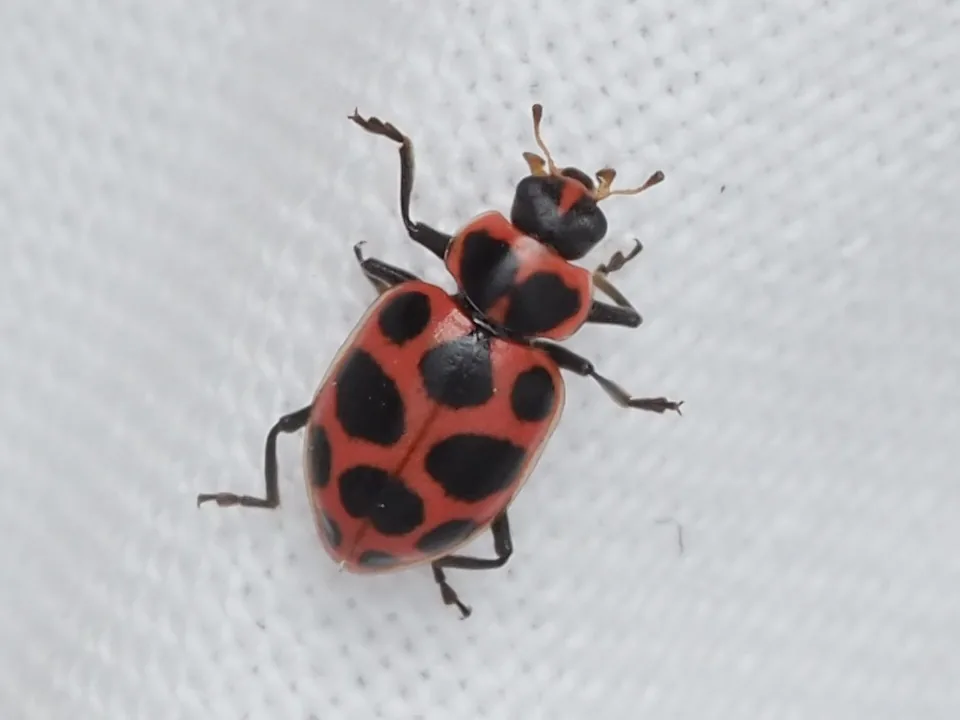
- Adults are pink to red, about 1/5 to 1/4 inch (5 to 6 mm) long and more elongate than round, with six black spots on each wing cover.[1][2]
- Two large black marks sit on the pink or yellowish area behind the head.[1][2]
- Larvae are blackish with orange or yellow patches; pupae are black and orange and glued openly to plants.[1]
- Eggs are football shaped, orange to yellow, and stand on end in small groups.[1]
Where it lives
A North American native, it's found through much of the Northeast, the South and the Midwest. The subspecies C. maculata strenua is the one in California and the Southwest.[2][1]
Biology and life cycle
A female lays 200 to more than 1,000 eggs over a life of one to three months.[1][2]
Adults winter in large clusters under leaf litter and stones along hedgerows and field edges, then disperse in spring, often on foot.[2][1]
Egg to adult takes three to four weeks in warm weather, with two to five generations a year.[1][2]
Damage and signs
Health risk
Neither Cornell nor UC IPM lists any concern for people; both describe it as a predator that also eats pollen.[2][1]
Control
Prevention
Skip broad-spectrum, persistent insecticides; they're toxic to the natural enemies you want to keep.[1]
Biological control
Early-flowering plants with lots of pollen, dandelions for example, feed dispersing adults in late spring before aphids build up.[2]
Keep ants in check, since they attack lady beetles and other natural enemies.[1]
Common questions
- Why are there pink ladybugs in my garden?
- It's likely the native pink spotted lady beetle, which is most common on low plants such as vegetables and garden ornamentals.[1]
- Does it eat my plants?
- No. It eats aphids and other small prey, and the plant food it takes is pollen.[2][1]
- Where do they go in winter?
- Adults gather in large groups under leaf litter or stones along hedgerows and field borders.[2]
Sources
- University of California Statewide IPM Program, “Pink Spotted Lady Beetle (Natural Enemies Gallery).” ipm.ucanr.edu/natural-enemies/pink-spotted-lady-beetle/ (accessed 2026-10-06)
- Cornell University College of Agriculture and Life Sciences, “Biological Control: A Guide to Natural Enemies in North America: Coleomegilla maculata (Pink Spotted Lady Beetle).” biocontrol.entomology.cornell.edu/predators/Coleomegilla.php (accessed 2026-10-06)
- iNaturalist, “Coleomegilla maculata taxon page (order and family).” www.inaturalist.org/taxa/126267 (accessed 2026-10-06)