How to identify it
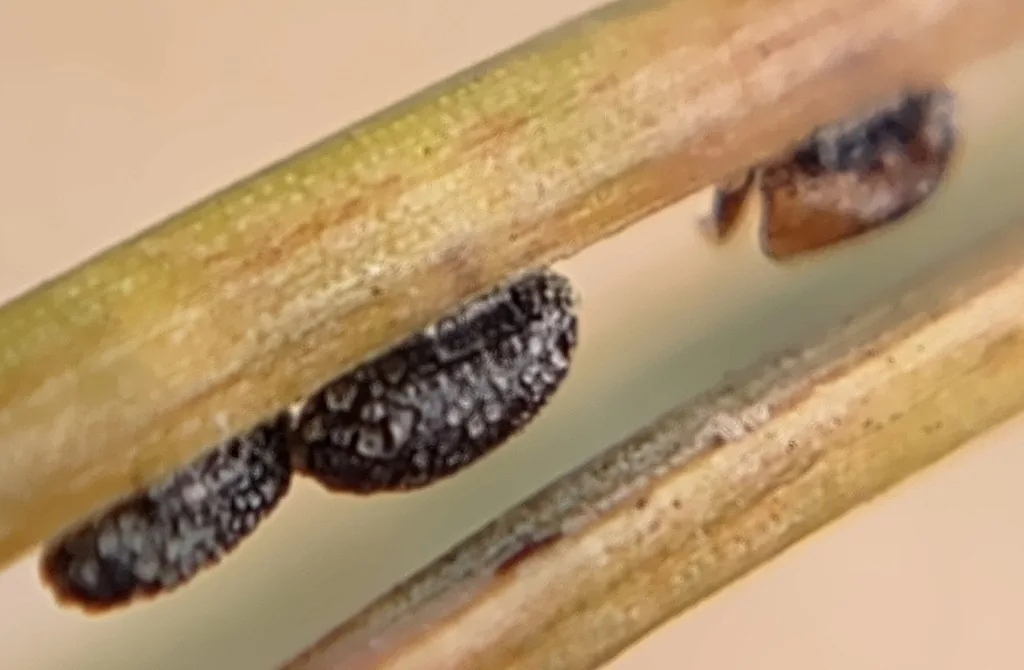
- Overwintering females on the needles are legless and look like small black beans; Arizona puts the insects at about 0.5 mm.[1][2]
- Egg masses are covered by white, cottony wax around the root collar, in branch crotches and under larger branches.[1]
- Older needles yellow, die and drop, giving trees a tufted look.[1][2]
Where it lives
It feeds on pinyon, singleleaf pinyon and foxtail pines in the southwestern United States, in natural stands and ornamental plantings.[2]
Biology and life cycle
Development resumes in spring, mating occurs in early April, and newly hatched nymphs settle on the previous year's needles.[1]
Second-stage nymphs form in late summer and overwinter on the needles; there is one generation a year.[1]
Damage and signs
- Repeated colonization weakens and often kills small trees and can leave larger trees open to pinyon Ips (Ips confusus).[2]
Health risk
Control
Prevention
To keep pinyons healthy, avoid wounding trees, choose an appropriate site, water properly and give trees adequate space.[1]
Common questions
- Why is my pinyon pine thin with tufts of needles at the tips?
- A common cause is pinyon needle scale feeding on older needles.[1][2]
- What do pinyon needle scales look like?
- Overwintering females look like tiny black beans on the needles.[1]
- Can pinyon needle scale kill trees?
- It often kills small trees after repeated attacks and can predispose larger ones to Ips beetles.[2]
Sources
- Colorado State University Extension, “Pinyon Pine Diseases and Insects.” extension.colostate.edu/resource/pinyon-pine-diseases-and-insects/ (accessed 2026-10-15)
- University of Arizona Cooperative Extension, “Pinyon Needle Scale (AZ1315, December 2011).” extension.arizona.edu/publication/pinyon-needle-scale (accessed 2026-10-15)
- iNaturalist, “Matsucoccus acalyptus taxon page (order and family).” www.inaturalist.org/taxa/484384 (accessed 2026-10-06)