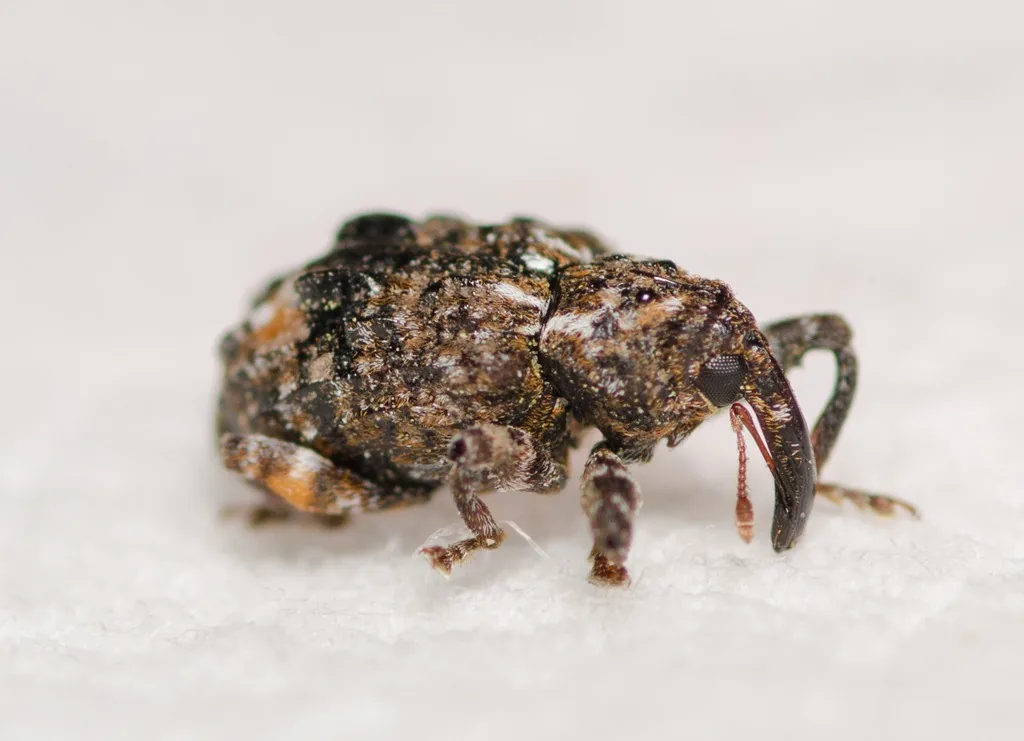
How to identify it
- Adults are dark brown snout beetles about 3/16 to 1/4 inch long, with a snout about one-third the length of the body.[1][2][3]
- The wing covers have four humps and patches of grayish white.[1][2]
- Larvae are legless, C-shaped, grayish-white grubs with a small brown head, about 1/3 inch long when grown, found inside fruit.[1][2][3]
- The telltale sign is a small crescent-shaped cut beside the egg-laying hole on young fruit; feeding by adults leaves small round holes.[2][3]
Look-alikes
| Look-alike | How to tell them apart |
|---|---|
| Codling moth larva | Codling moth larvae are white to pinkish caterpillars with a dark brown head that tunnel to the core and leave reddish-brown frass, unlike the legless curculio grub.[4][1] |
Where it lives
A native pest found in most states east of the Rocky Mountains, throughout the peach-growing areas of the United States.[1][3]
Biology and life cycle
Adults spend the winter mostly in forest leaf litter or soil near orchards, and move into fruit trees in early spring to feed, mate and lay eggs.[1][2][3]
A female slits the skin of a young fruit and lays an egg in the hole; the developing fruit protects it.[1][2]
Eggs hatch in 2 to 12 days, and grubs feed inside the fruit for about two to three weeks before leaving to pupate in the soil.[1][2]
Northern populations have one generation a year, while a southern strain has two; Illinois has two.[3][2]
New adults emerge in summer, feed on fruit for a time, then seek winter shelter in late summer or early fall.[1][2]
Damage and signs
- Infested young fruit usually falls to the ground around the time of the natural June drop.[1][2][3]
- When an egg fails to hatch, the crescent scar remains on the fruit at harvest and lowers its quality.[1][2]
- Adults also feed on fruit in spring and late summer, leaving scars and small holes.[3][2]
- Hosts include apples, peaches, plums, pears, cherries, apricots and wild fruit trees, and trees at the edge of woods are often hit first.[1][2][3]
Health risk
The harm is to the crop: both adults and grubs injure fruit, and infested fruit is unfit to eat or sell.[3]
Control
Prevention
Watch young fruit from bloom until about two weeks after petal fall for fresh crescent scars; attacks on apple begin once fruit reaches about 1/4 inch.[1][2]
Sanitation
In small plantings, pick up and destroy dropped fruit to remove grubs before they pupate.[2][3]
Remove wild or untended fruit trees nearby, and prune in the dormant season to keep the canopy open for better spray coverage.[2]
Traps and physical control
Beating sheets and baited trunk traps can show whether adults are active.[3]
Pesticides
Kaolin clay, applied from petal fall and renewed weekly, forms a white film that deters egg-laying and is accepted for organic growing.[2][1]
Insecticides go on only after bloom is completely finished to protect pollinators; follow your state's tree fruit guide and the product label.[2][1]
Common questions
- What are the half-moon scars on my apples?
- They are plum curculio egg-laying scars. The female cuts a small crescent-shaped flap in the skin and lays an egg beside it.[2][3]
- Why are my small apples or peaches falling off early?
- Plum curculio grubs feeding inside young fruit cause it to drop, usually around the time of June drop.[1][2][3]
- Can I spray during bloom?
- No. Wait until bloom is completely finished to avoid exposing pollinators.[2]
Sources
- University of New Hampshire Extension, “Plum Curculio [fact sheet].” extension.unh.edu/resource/plum-curculio-fact-sheet (accessed 2026-10-06)
- UMass Amherst Extension Fruit Program, “Apple IPM: Plum Curculio (March 2020).” www.umass.edu/agriculture-food-environment/fruit/fact-sheets/apple-ipm-plum-curculio (accessed 2026-10-06)
- University of Illinois Extension, “Life Cycle and Biology of Plum Curculio (2023).” extension.illinois.edu/sites/default/files/plum_curcurlio_insect_fact_sheet_nov._23.pdf (accessed 2026-10-06)
- University of California Statewide IPM Program, “Codling Moth (Pest Notes, Home and Landscape).” ipm.ucanr.edu/home-and-landscape/codling-moth/ (accessed 2026-10-06)
- iNaturalist, “Conotrachelus nenuphar taxon page (order and family).” www.inaturalist.org/taxa/217517 (accessed 2026-10-06)