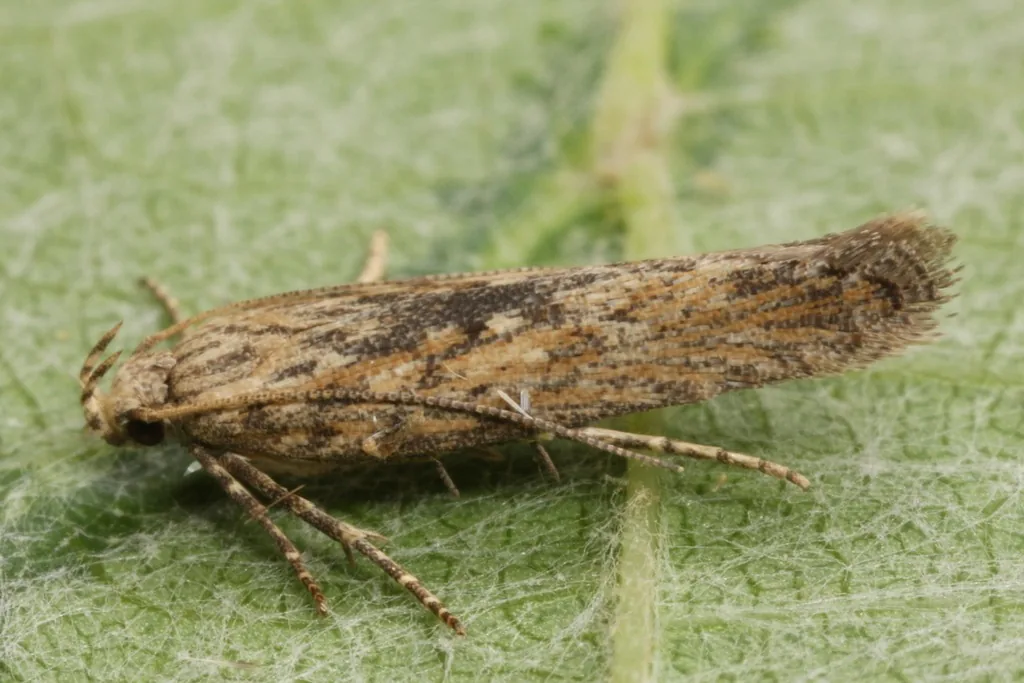
How to identify it
Look-alikes
| Look-alike | How to tell them apart |
|---|---|
| Tomato pinworm | Pinworms are gray to yellowish with red or purple around each segment, lack the dark head, and attack only tomatoes.[1] |
Where it lives
UC IPM covers it as a garden pest of potatoes, tomatoes, eggplant and peppers in California.[1]
Biology and life cycle
Moths lay eggs on tubers, foliage, plant debris or soil and crawl through soil cracks to reach tubers.[1]
Larvae tunnel into fruit, stalks or leaves.[1]
Damage and signs
- In tomatoes they bore into fruit and kill stem tips; in potatoes they tunnel through tubers, stalks and leaves.[1]
Health risk
It feeds on plants and tubers; UC IPM mentions no risk to people.[1]
Control
Prevention
Don't plant tomatoes, eggplant or peppers near infested potatoes or right after a potato crop.[1]
Keep them out
Keep potatoes deeply hilled, don't let the soil crack, and use sprinklers to keep the surface sealed.[1]
Sanitation
Harvest promptly and destroy infested tubers, or store them below 52 degrees F to stop development.[1]
Common questions
Sources
- University of California Statewide IPM Program, “Potato Tuberworm (Pests in Gardens and Landscapes).” ipm.ucanr.edu/PMG/GARDEN/VEGES/PESTS/pottuberwrm.html (accessed 2026-10-06)
- iNaturalist, “Phthorimaea operculella taxon page (order and family).” www.inaturalist.org/taxa/395129 (accessed 2026-10-06)