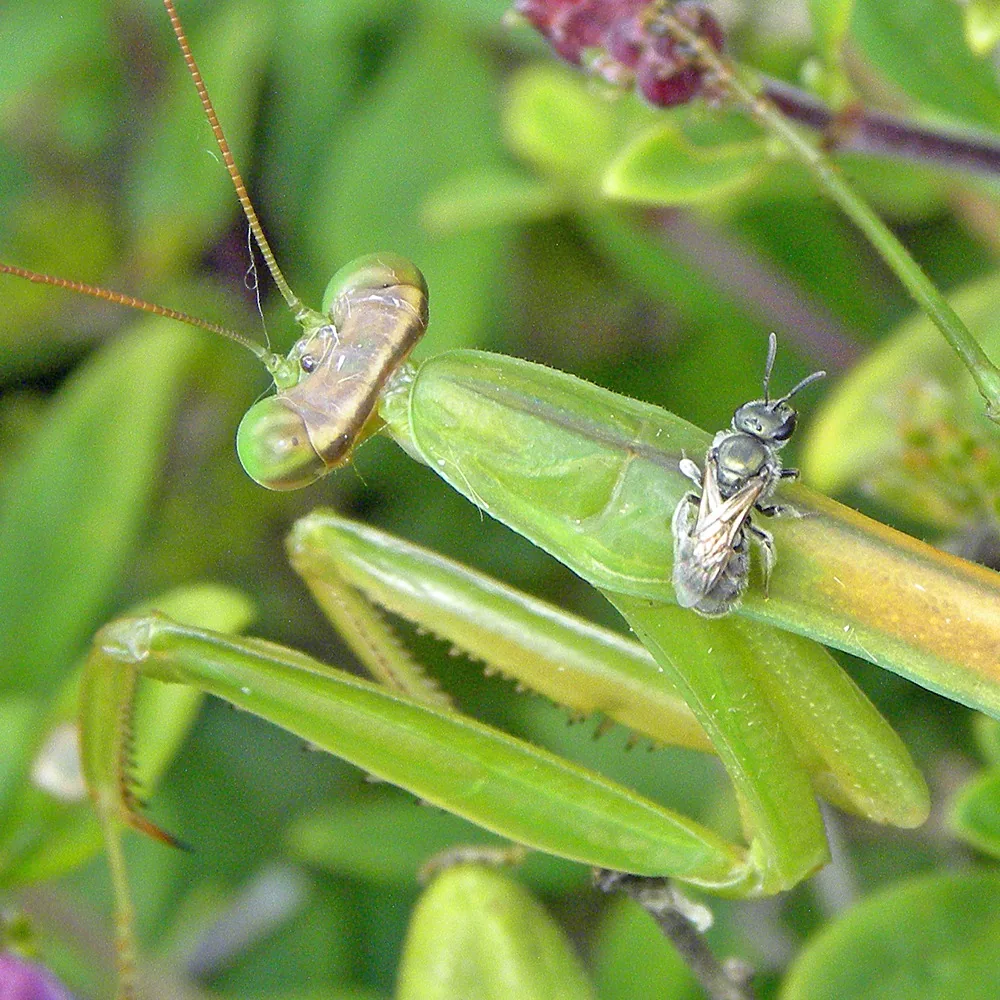
How to identify it
- Adults are generally 2 to 5 inches long, elongate, and brown, green or yellowish; one species can show all three colors.[1]
- At rest the enlarged, spiny front legs are held up in front of the head, giving the praying look.[1][2]
- The triangular head has large, bulging eyes and can turn about 180 degrees.[1][2]
- The introduced Chinese mantid is the largest common species, 3 to 5 inches long; the native Carolina mantid is about 2 to 2 1/2 inches.[2][4]
- Egg cases start as pale froth that hardens into a brown, papery mass on twigs, stems, fences, posts or house siding.[1][3]
Look-alikes
| Look-alike | How to tell them apart |
|---|---|
| European mantid | This introduced species is pale green and about 3 inches long, with a bull's-eye spot on the inside of each front leg.[2][4] |
| Carolina mantid egg case | It's tan, 1/2 to 3/4 inch long and rectangular with a pale central band; a Chinese mantid case is light brown, 1 to 1 1/4 inches long and half-dome shaped.[3] |
Where it lives
European and Chinese mantids were introduced in the late 1800s and are now common in places like Ohio; the native Carolina mantid ranges from New York to Florida and west to Utah, Arizona and Texas.[4]
Biology and life cycle
After mating, a female lays eggs in a foam that hardens into an egg case holding up to 400 eggs.[4][2]
Mantids overwinter as eggs. Nymphs hatch in spring, and 50 to 200 can emerge from one case.[3][1]
Nymphs look like small wingless adults and molt about six or seven times; there is one generation a year.[1][4]
Hungry nymphs eat their siblings, which keeps mantid numbers in an area low.[2]
Females sometimes eat males during mating, though this doesn't happen in most matings.[1][4]
Damage and signs
- Mantids don't feed on plants. They eat butterflies, caterpillars, crickets, flies, grasshoppers, moths, wasps and even honey bees at hive entrances.[3]
Health risk
Although they are large predatory insects, mantids do not bite humans.[4]
Control
Prevention
No control is needed. Mantids feed on pests and beneficials alike, and releasing them does no harm to the garden.[4]
Biological control
Buying egg cases for pest control isn't recommended: mantids don't kill enough pests to prevent plant damage.[3]
Adding many egg cases may not raise numbers either, because mantids move off to find cover and food.[2]
To keep resident mantids, limit pesticides and leave some vegetation for cover; Bt and insecticidal soap affect them far less than broad-spectrum sprays.[2]
Common questions
- What is the hard tan foam on my shrub?
- It's almost certainly a mantid egg case. The eggs overwinter inside and nymphs hatch in spring.[3][1]
- What happens if I bring an egg case indoors?
- Warmth makes nymphs hatch in about four to six weeks, even in midwinter, and unfed nymphs start eating each other.[3][2]
- Do praying mantids bite people?
- No. Ohio State Extension notes that mantids do not bite humans.[4]
Sources
- University of California Statewide IPM Program, “Mantids (Natural Enemies Gallery).” ipm.ucanr.edu/natural-enemies/mantids/ (accessed 2026-10-06)
- University of Kentucky Entomology Extension, “Praying Mantids, ENTFACT-418.” entomology.mgcafe.uky.edu/ef418 (accessed 2026-10-06)
- Kansas State University Research and Extension, “Praying Mantids, MF3593 (December 2021).” bookstore.ksre.ksu.edu/pubs/MF3593.pdf (accessed 2026-10-06)
- Ohio State University Extension, “Ohio's Natural Enemies: Mantids, ENT-67.” ohioline.osu.edu/factsheet/ent-67 (accessed 2026-10-06)
- iNaturalist, “Tenodera sinensis taxon page (order and family).” www.inaturalist.org/taxa/71034 (accessed 2026-10-06)