How to identify it
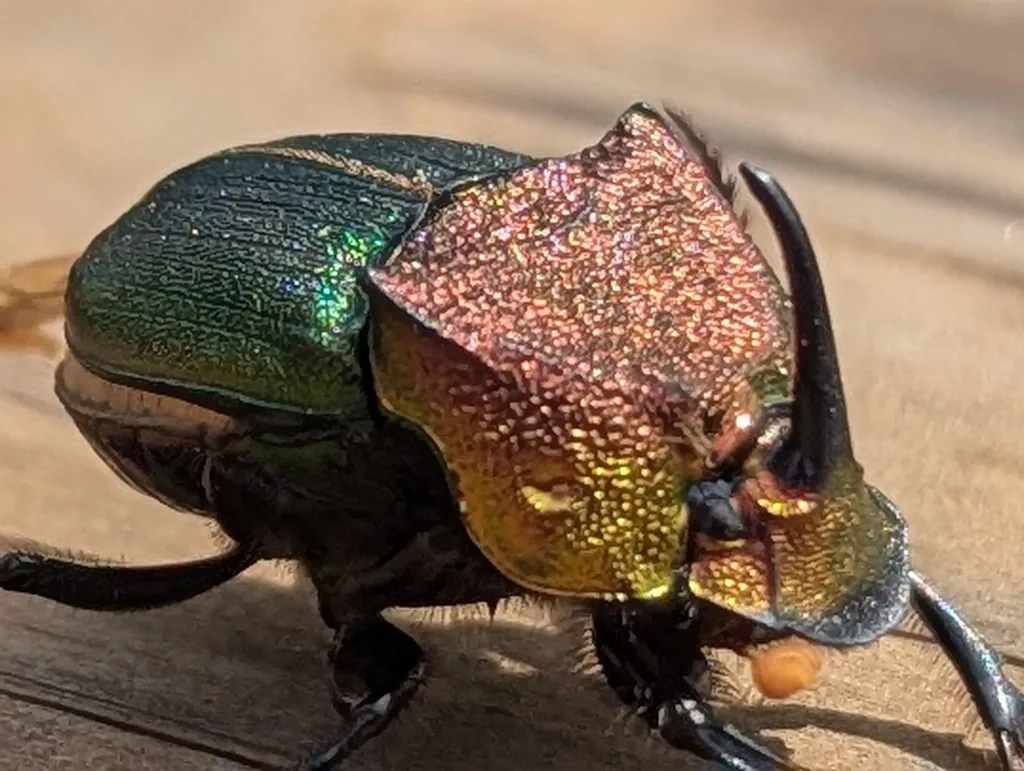
- Adults are about 1/2 to 7/8 inch long and bulky, with bright metallic green or green and blue wing covers and iridescent red and gold reflections on the thorax.[1][2]
- Males have a horn on the head that curves back over the thorax.[1][2]
- Larvae are soft, C-shaped grubs with a hardened head that develop inside dung balls.[2]
Where it lives
It is native to the eastern United States, from Massachusetts to South Dakota and south to Texas and Florida.[2]
Biology and life cycle
A pair digs a tunnel under a dung pat, and the female forms a brood ball of dung, pushes it down the tunnel and lays an egg on it.[1][2]
The larva develops inside the ball; north of Florida, larvae overwinter below the frost line, and egg to adult takes two to six months in the lab.[2]
Damage and signs
Health risk
None to people or pets; it can carry a stomach worm that infects pigs that eat the beetles.[2]
Control
Prevention
No control is needed, since the rainbow scarab is beneficial.[1]
Common questions
Sources
- NC State Extension, “Rainbow Scarab.” content.ces.ncsu.edu/rainbow-scarab-1 (accessed 2026-10-15)
- University of Florida IFAS Extension (Featured Creatures), “Rainbow Scarab, Phanaeus vindex (EENY-567).” ask.ifas.ufl.edu/publication/IN1003 (accessed 2026-10-15)
- iNaturalist, “Phanaeus vindex taxon page (order and family).” www.inaturalist.org/taxa/83929 (accessed 2026-10-06)