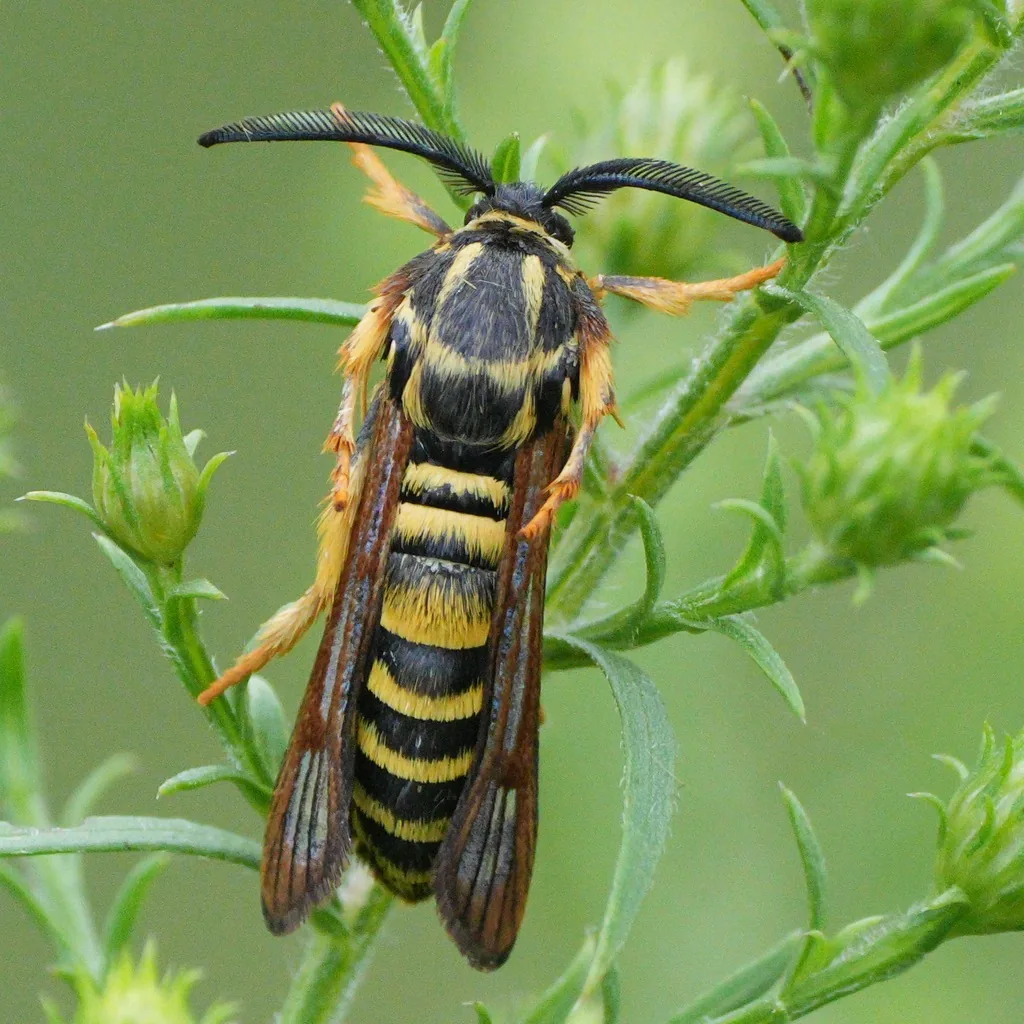
How to identify it
Look-alikes
| Look-alike | How to tell them apart |
|---|---|
| Yellowjackets | Yellowjackets have few hairs and no scales; the moth has visible scales.[1] |
Where it lives
It's a common pest of blackberries and raspberries throughout Kentucky.[1]
Biology and life cycle
Moths fly from July through September and lay eggs singly under leaves.[1]
In Kentucky larvae probably need two years to develop, tunneling in canes and roots.[1]
Damage and signs
- Canes die early, grow spindly and have smaller leaves.[1]
Health risk
It feeds on plants; UK Extension mentions no risk to people.[1]
Control
Sanitation
Remove wild brambles near the planting, and dig out and destroy infested canes and crowns.[1]
Biological control
Soil drenches with insect-killing Hb nematodes have succeeded against crown borers in trials.[1]
Common questions
Sources
- University of Kentucky Entomology (ENTFACT), “Raspberry Crown Borer (ENTFACT-226).” entomology.mgcafe.uky.edu/ef226 (accessed 2026-10-06)
- iNaturalist, “Pennisetia marginatum taxon page (order and family).” www.inaturalist.org/taxa/477881 (accessed 2026-10-06)