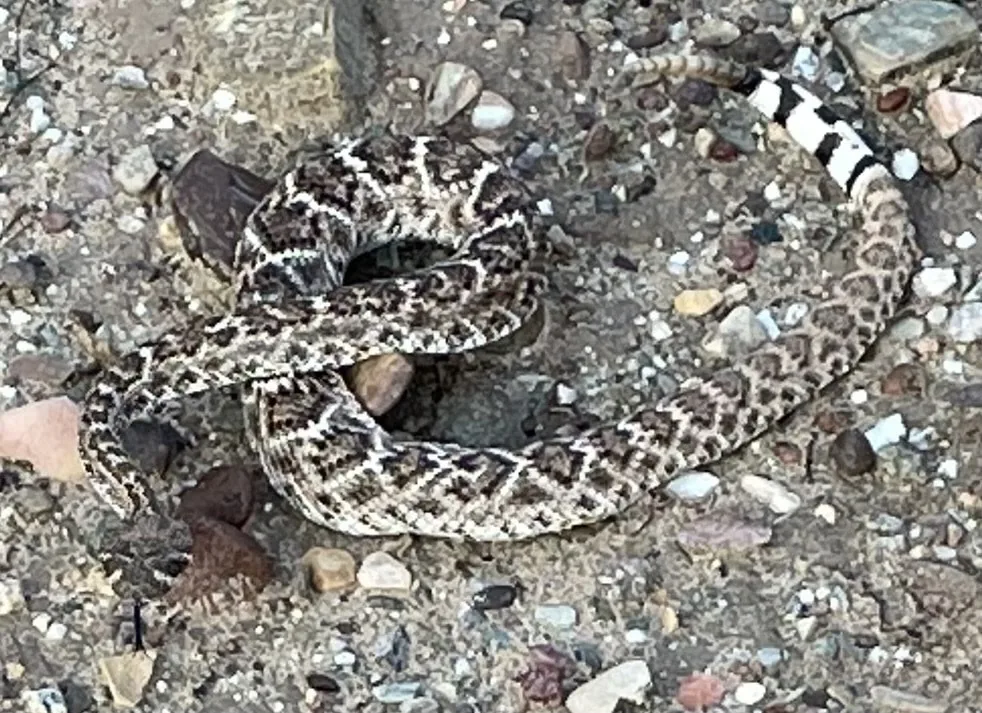
How to identify it
- A broad, triangular head and, on most species, a rattle of interlocking horny segments at the tail tip.[2]
- A broken-off or missing rattle does not rule out a rattlesnake, since rattles can shorten or break away entirely.[2]
- Like other pit vipers, a deep heat-sensing pit on each side of the head between the eye and nostril, and vertical pupils.[4][2]
- The western diamondback has brown diamond-shaped markings down the back and black and white rings on the tail; it averages 3 1/2 to 4 1/2 feet and can reach 7 feet.[3]
- Young rattlesnakes are born with only a small button on the tail, and a new rattle segment forms each time the skin is shed.[2]
Look-alikes
| Look-alike | How to tell them apart |
|---|---|
| Gopher snake and bullsnake | The harmless gopher snake can shape its head into a triangle to mimic a rattlesnake but never has a rattle, and bullsnakes may hiss in a way that sounds like rattling.[2][4] |
| Copperhead | Copperheads are smaller pit vipers, usually 1 1/2 to 3 feet long, with hourglass-shaped bands and no rattle.[1][3] |
| Other tail-shaking snakes | Many harmless snakes shake their tails, which can sound like a rattle in dry leaves, so listen for the sound only as a warning to back away.[4] |
Where it lives
Rattlesnakes are native to the U.S., with nine species in California and ten in Texas. The western diamondback is the most common venomous snake in Texas, found in all but the easternmost part, and reaches extreme southeastern California.[2][3][4]
Biology and life cycle
Adults eat mainly rodents, while young rattlesnakes eat mostly lizards and young rodents; they wait in ambush and strike prey with venom.[2]
When inactive they hide in rock crevices, under surface objects, beneath dense plants and in rodent burrows, which they use but cannot dig.[2]
Rattlesnakes give birth to live young, often in late summer or early fall, and the young are as venomous as adults.[2][5]
In colder areas they spend winter in rock crevices or dens, sometimes several months at a time, and they slow down below about 50 degrees F.[2][5]
In summer they may seek cool, damp places such as under buildings, in basements and around pools, fountains and fishponds.[2]
They are good swimmers and climbers, and can strike a third or more of their body length from any position.[2][1]
Damage and signs
- Rattlesnakes do not damage buildings or gardens; the danger is a defensive bite to a person, pet or farm animal.[6][2]
- About 1,000 rattlesnake bites are reported in the U.S. each year, and usually fewer than 4 are fatal, but bites can cause severe pain and tissue loss.[2]
- More than half of venomous bites happen when someone bothers, handles or harasses a snake.[2]
- Hands, feet and ankles are the most common bite sites.[2]
- Dogs and other domestic animals can be badly hurt, especially when bitten on the nose or face, and need a veterinarian immediately.[2][6]
Health risk
CDC lists puncture marks, bleeding, redness, swelling, bruising or blistering, and severe pain as signs of a bite, sometimes followed by nausea, vomiting or trouble seeing or breathing. Even a dead rattlesnake can bite by reflex.[1][2]
Control
Prevention
Wear boots and long pants where snakes live, never go barefoot where you cannot see your feet, and look before picking up rocks, wood or debris.[1][2]
Teach children to leave snakes alone and to tell an adult, and check around stumps or logs before sitting down.[2]
Keep them out
Seal cracks and openings into buildings, check crawl space doors and gaps under garage doors, and close up pool and spa pump enclosures.[2][7]
Protect a children's play area with a snake-proof fence of 1/4-inch galvanized hardware cloth, 36 inches tall, buried 4 to 6 inches and angled outward.[7][2]
Sanitation
Clear heavy brush, tall grass, rocks, logs, lumber piles and other cover, and keep weeds mowed short or removed.[2][7]
Control ground squirrels, mice and rats, which draw rattlesnakes, then fill and firmly pack old rodent burrows.[2][7]
When to call a professional
A snake left alone will usually move on; if you want it removed, call a professional who specializes in snake removal rather than trying it yourself.[2]
If someone is bitten: what CDC says to do
Get emergency medical attention as soon as possible so antivenom can be started if needed and irreversible damage stopped.[1]
Take a photo of the snake from a safe distance if you can, to help identify it.[1]
Stay calm and apply first aid while waiting for transport: lie or sit down with the bite in a neutral position of comfort.[1]
Take off rings and watches before swelling starts, wash the bite with soap and water, and cover it with a clean, dry dressing.[1]
What CDC says not to do
Never pick up or try to trap the snake, and never handle a venomous snake, even a dead one or a severed head.[1]
Do not wait for symptoms; get medical help right away.[1]
Do not use a tourniquet, electric shock or folk therapies, and never cut or slash the wound.[1]
Do not try to suck out venom, apply ice or soak the wound in water.[1]
Do not drink alcohol as a painkiller or take pain relievers.[1]
Legal status
Snakes are protected nongame wildlife in most states, and some species are on state or federal threatened and endangered lists.[4]
Rules differ by state: California lets residents take most rattlesnakes on private land but bars killing the red diamond rattlesnake.[2]
UC IPM does not generally recommend killing rattlesnakes, since attempts to kill them sometimes end in a bite; Texas Parks and Wildlife asks people not to kill snakes at all.[2][3]
What doesn't work
Sulfur, mothballs and horsehair ropes do not repel rattlesnakes, and no plant repels snakes.[2]
Commercial snake repellents have not been proven to work well enough to recommend.[2][7]
Bringing in kingsnakes is not recommended; predators eat too few rattlesnakes to make a difference around a home.[2]
Snakebite kits do not work and can cause more harm.[2]
Common questions
- Can a rattlesnake bite without injecting venom?
- Yes. Dry bites happen, and ICWDM says over half of rattlesnake bites lack venom, but you cannot tell at first, so get medical care right away.[2][6][1]
- Is a snake without a rattle safe?
- Not necessarily. Rattles can break off, and newborn rattlesnakes have only a button, so treat any thick-bodied snake with a triangular head with caution.[2]
- My dog was bitten by a rattlesnake. What should I do?
- Take the dog to a veterinarian immediately. Bites to pets, often on the face or nose, can cause severe injury.[2][6]
Sources
- U.S. Centers for Disease Control and Prevention, NIOSH, “Venomous Snakes at Work (reviewed September 23, 2026).” www.cdc.gov/niosh/outdoor-workers/about/venomous-snakes.html (accessed 2026-10-06)
- University of California Statewide IPM Program, “Rattlesnakes (Pest Notes, Home and Landscape).” ipm.ucanr.edu/home-and-landscape/rattlesnakes/ (accessed 2026-10-06)
- Texas Parks and Wildlife Department, “Hunter Education: Snakes.” tpwd.texas.gov/education/hunter-education/online-course/preparation-and-survival/snakes (accessed 2026-10-06)
- Internet Center for Wildlife Damage Management, “Snakes: Identification.” icwdm.org/species/reptiles/snakes/ (accessed 2026-10-06). Run by university wildlife damage specialists (maintained at the University of Wisconsin-Stevens Point); species modules are based on Prevention and Control of Wildlife Damage (University of Nebraska Cooperative Extension, 1994).
- Internet Center for Wildlife Damage Management, “Snake Biology.” icwdm.org/species/reptiles/snakes/snake-biology/ (accessed 2026-10-06). Run by university wildlife damage specialists (maintained at the University of Wisconsin-Stevens Point); species modules are based on Prevention and Control of Wildlife Damage (University of Nebraska Cooperative Extension, 1994).
- Internet Center for Wildlife Damage Management, “Snake Damage Identification.” icwdm.org/species/reptiles/snakes/snake-damage-identification/ (accessed 2026-10-06). Run by university wildlife damage specialists (maintained at the University of Wisconsin-Stevens Point); species modules are based on Prevention and Control of Wildlife Damage (University of Nebraska Cooperative Extension, 1994).
- Internet Center for Wildlife Damage Management, “Snake Damage Prevention and Control Methods.” icwdm.org/species/reptiles/snakes/snake-damage-prevention-and-control-methods/ (accessed 2026-10-06). Run by university wildlife damage specialists (maintained at the University of Wisconsin-Stevens Point); species modules are based on Prevention and Control of Wildlife Damage (University of Nebraska Cooperative Extension, 1994).
- iNaturalist, “Crotalus atrox taxon page (order and family).” www.inaturalist.org/taxa/30764 (accessed 2026-10-06)