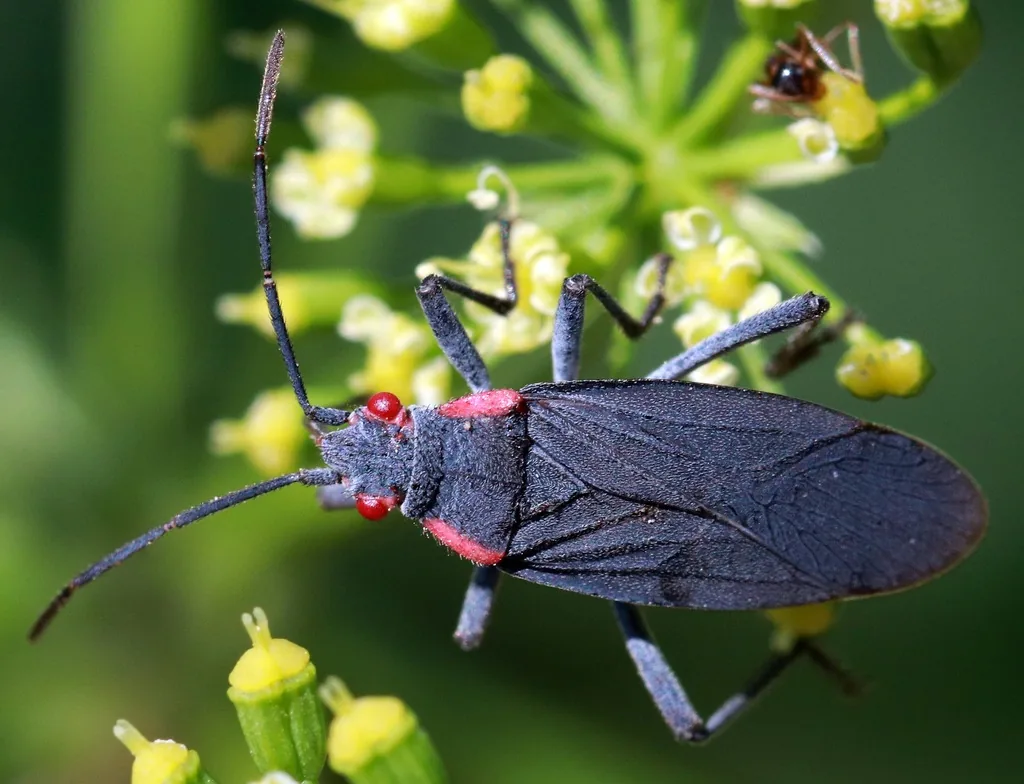
How to identify it
Look-alikes
| Look-alike | How to tell them apart |
|---|---|
| Boxelder bug | A different species in the same family that also gathers in large numbers in late summer and fall.[1] |
Where it lives
It's reported from southeastern states west to Texas and California, several central states, and Hawaii; in Florida it's mainly on the peninsula.[1]
Biology and life cycle
It prefers balloonvine but feeds heavily on goldenrain tree seeds, earning the name goldenrain tree bug.[1]
In Florida it's collected every month, peaking in May.[1]
Damage and signs
- Children playing on infested lawns can get their clothes stained red by crushed bugs.[1]
Health risk
UF/IFAS mentions no health risk; the main complaint is red stains on clothes from crushed bugs.[1]
Control
Sanitation
Rake up the fallen seeds they feed on in lawns and play areas.[1]
Traps and physical control
A small group on a plant can be hand-collected; usually no control is needed.[1]
Common questions
Sources
- University of Florida IFAS Extension (Featured Creatures), “Scentless Plant Bugs, Jadera spp. (EENY-130).” edis.ifas.ufl.edu/publication/IN287 (accessed 2026-10-06)
- iNaturalist, “Jadera haematoloma taxon page (order and family).” www.inaturalist.org/taxa/127669 (accessed 2026-10-06)