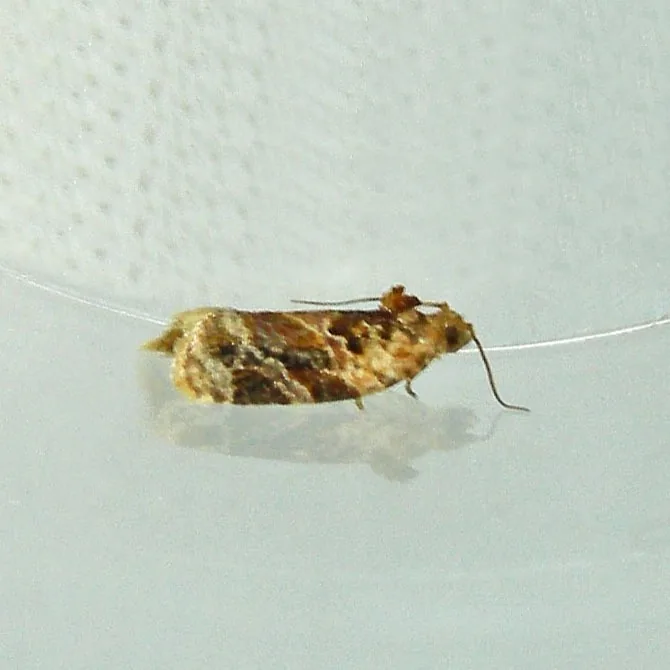
How to identify it
Look-alikes
Where it lives
In Kentucky it is one of three leafrollers that commonly attack fruit trees and some landscape ornamentals.[1]
Biology and life cycle
It overwinters as a pupa in ground debris; adults lay egg masses on the undersides of larger limbs in early spring.[1]
Eggs hatch about bloom, larvae fold or roll leaves with webbing, and there are two to four generations a year.[1]
Damage and signs
- Larvae attach a leaf to the fruit surface and feed on the skin and flesh beneath it.[1]
Health risk
It feeds on plants; UK Extension mentions no risk to people.[1]
Control
Prevention
Use pheromone traps from pink through September to time scouting, and act at about 4 larvae per 100 leaves or fruit clusters.[1]
Biological control
In backyard apples, Bacillus thuringiensis sprays work best while larvae are small, before they web leaves together.[1]
Common questions
Sources
- University of Kentucky Entomology (ENTFACT), “Leafrollers (ENTFACT-216).” entomology.mgcafe.uky.edu/ef216 (accessed 2026-10-06)
- iNaturalist, “Argyrotaenia velutinana taxon page (order and family).” www.inaturalist.org/taxa/208118 (accessed 2026-10-06)