How to identify it
- Adults are about 1/16 inch (1.2 mm) long, dark brown to black, with dark wings and antennae banded pale and dark.[1][2]
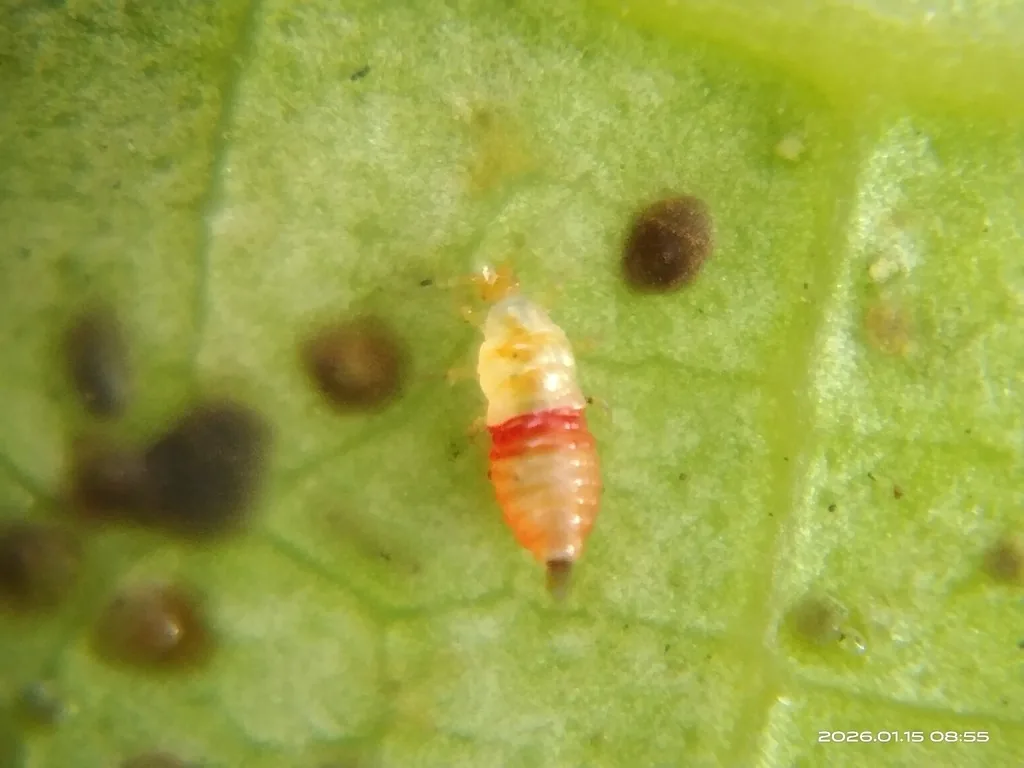
- Immature stages are pale with a bright red band across the middle.[1][2]
- Leaves show small pale spots above, with thrips and tiny dark drops of excrement below; heavy feeding russets, silvers and kills leaves.[1]
Where it lives
A tropical-subtropical species, it is found in Florida from Key West to Baker County but mostly from the Orlando area south, and in Hawaii.[2]
Biology and life cycle
Females insert tiny kidney-shaped eggs into leaves and fruit and cover each with a small dark blister.[1]
All stages are usually present together, mostly on the inner parts of host plants.[1]
Damage and signs
Health risk
Control
Prevention
Check the inner foliage and leaf undersides of susceptible plants for pale spotting, excrement and red-banded young.[1]
Common questions
- What are the tiny insects with a red band on my mango leaves?
- Likely young redbanded thrips.[1][2]
- Why are my avocado leaves silvery with black specks?
- Redbanded thrips feeding bleaches leaves and leaves dark drops of excrement.[1]
- Where do redbanded thrips occur in the US?
- Mainly central and south Florida, and Hawaii.[2]
Sources
- NC State Extension, “Redbanded Thrips on Ornamental Plants.” content.ces.ncsu.edu/redbanded-thrips-on-ornamental-plants (accessed 2026-10-15)
- University of Florida IFAS Extension (Featured Creatures), “Redbanded Thrips, Selenothrips rubrocinctus (EENY-099).” ask.ifas.ufl.edu/publication/IN256 (accessed 2026-10-15)
- iNaturalist, “Selenothrips rubrocinctus taxon page (order and family).” www.inaturalist.org/taxa/271215 (accessed 2026-10-06)