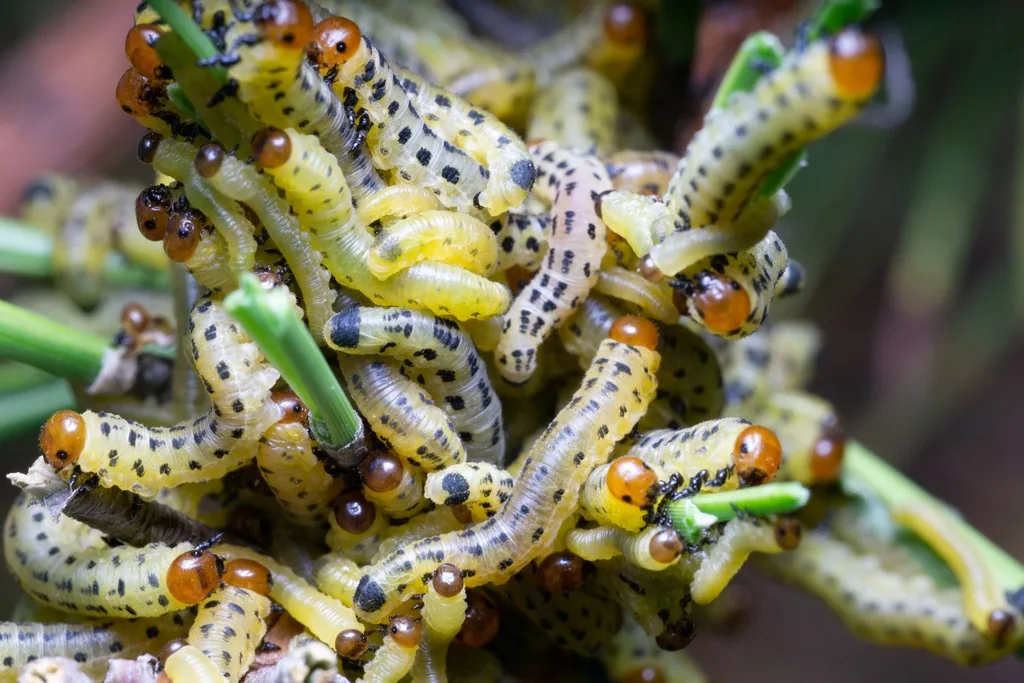
How to identify it
Where it lives
It is a native pest of ornamental and forest pines; NC State reports four or five generations a year in North Carolina.[1][2]
Biology and life cycle
Females lay about 100 to 120 eggs in the needles of a single twig.[1][2]
Mature larvae drop to the soil and spin brown, papery cocoons about 1/2 inch long; prepupae overwinter in the litter, and some wait two or more years before developing.[1][2]
Damage and signs
Health risk
Control
Traps and physical control
When only a few colonies are on small ornamental pines, pick or shake them off and crush them.[1]
Pesticides
They are not particularly resistant to insecticides; products labeled for caterpillars in the landscape give good control.[1]
Common questions
- What are the groups of larvae eating my pine needles?
- Often redheaded pine sawfly larvae, which feed in groups.[1][2]
- Can redheaded pine sawflies kill a pine?
- They can kill small trees; large pines are usually just defoliated.[1]
- How do I control a few colonies?
- Pick or shake them off small pines and crush them.[1]
Sources
- NC State Extension, “Redheaded Pine Sawfly (PDIC Factsheet).” content.ces.ncsu.edu/redheaded-pine-sawfly (accessed 2026-10-15)
- UMass Extension Landscape, Nursery and Urban Forestry Program (Landscape Insect & Mite Guide), “Neodiprion lecontei (Redheaded Pine Sawfly).” www.umass.edu/agriculture-food-environment/landscape/publications-resources/insect-mite-guide/neodiprion-lecontei (accessed 2026-10-15)
- iNaturalist, “Neodiprion lecontei taxon page (order and family).” www.inaturalist.org/taxa/135292 (accessed 2026-10-06)