How to identify it
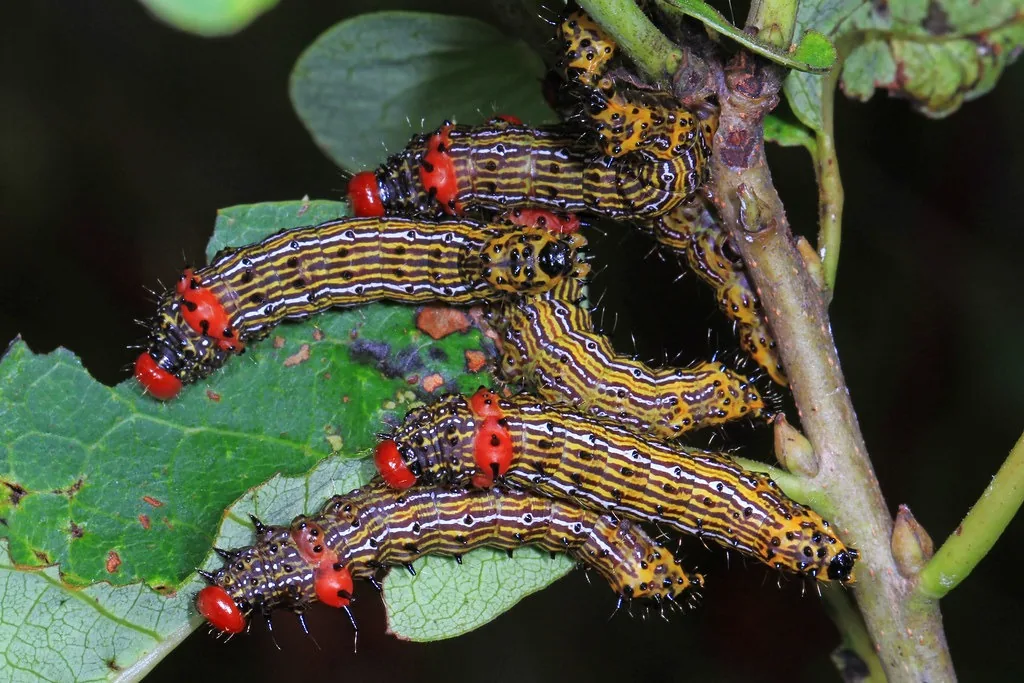
- Older caterpillars are 1 to 1-1/2 inches long, yellowish orange with black and white lengthwise stripes and a red head.[1]
- A reddish hump with two black spines rises on the first abdominal segment, and rows of dark bristly bumps run along the body.[1]
- Larger caterpillars often hold the rear end raised.[1]
- Eggs are cream to yellow spheres laid in groups of 25 to 100 under leaves.[1]
Where it lives
It occurs through much of the United States; in California, high populations are mostly in the Central Valley.[1]
Biology and life cycle
Moths emerge in April and May; caterpillars pass through five instars.[1]
In autumn, grown caterpillars spin cocoons in topsoil or litter and overwinter as prepupae.[1]
There are two or more generations a year in California's Central Valley.[1]
Damage and signs
Health risk
It feeds on tree leaves; UC IPM mentions no risk to people from the caterpillar.[1]
Control
Traps and physical control
Check lower leaves weekly in April and May, and prune out shoots with egg masses or young caterpillar groups.[1]
Biological control
Parasitic wasps such as Cotesia schizurae and Hyposoter fugitivus often prevent outbreaks; if parasitism is common, no further action is needed.[1]
Avoid long-lasting carbamate, organophosphate and pyrethroid sprays, and plant nectar flowers near problem trees.[1]
Common questions
Sources
- University of California Statewide IPM Program, “Pest Notes: Redhumped Caterpillar (Publication 7474).” ipm.ucanr.edu/PMG/PESTNOTES/pn7474.html (accessed 2026-10-06)
- iNaturalist, “Oedemasia concinna taxon page (order and family).” www.inaturalist.org/taxa/1391456 (accessed 2026-10-06)