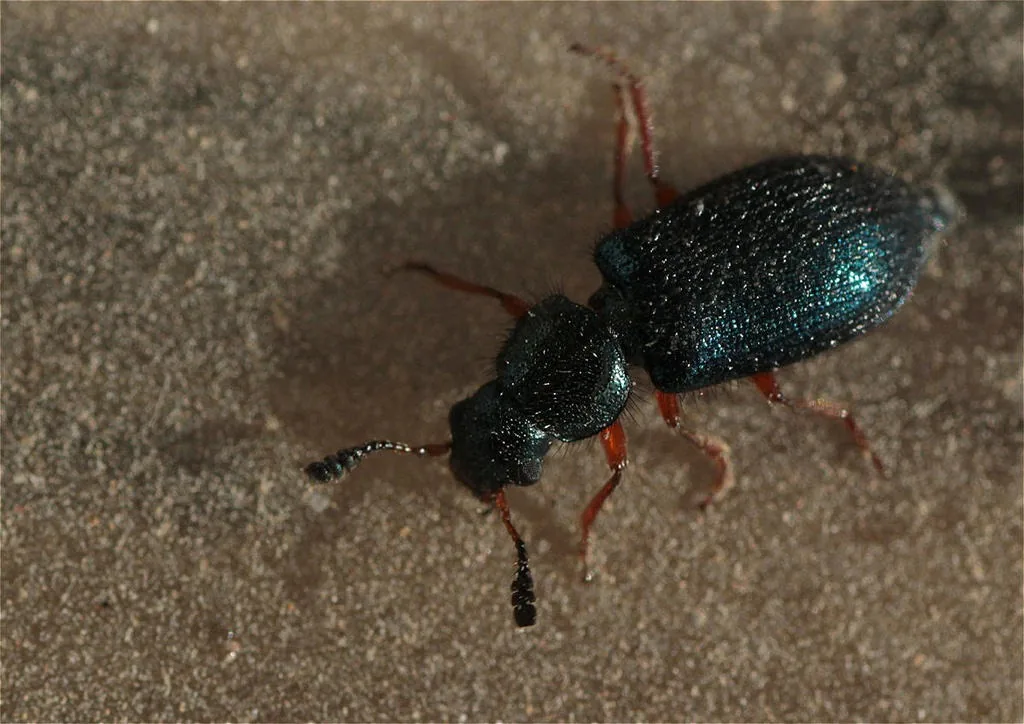
How to identify it
Look-alikes
Where it lives
It's found worldwide.[1]
Biology and life cycle
Eggs are laid in clusters in dry cracks near food, and larvae avoid light.[1]
Adults fly and take off readily when disturbed.[1]
Damage and signs
- Larvae infest cheese and dry-cured ham, and the beetle has become a more common pest in U.S. dog food plants.[1]
Health risk
It damages stored foods; UF/IFAS mentions no risk to people.[1]
Control
Sanitation
Manage it like other stored product pests with an integrated approach, finding where the product became infested.[1]
Common questions
Sources
- University of Florida IFAS Extension (Featured Creatures), “Redlegged Ham Beetle, Necrobia rufipes (EENY-811).” edis.ifas.ufl.edu/publication/IN1426 (accessed 2026-10-06)
- iNaturalist, “Necrobia rufipes taxon page (order and family).” www.inaturalist.org/taxa/176817 (accessed 2026-10-06)