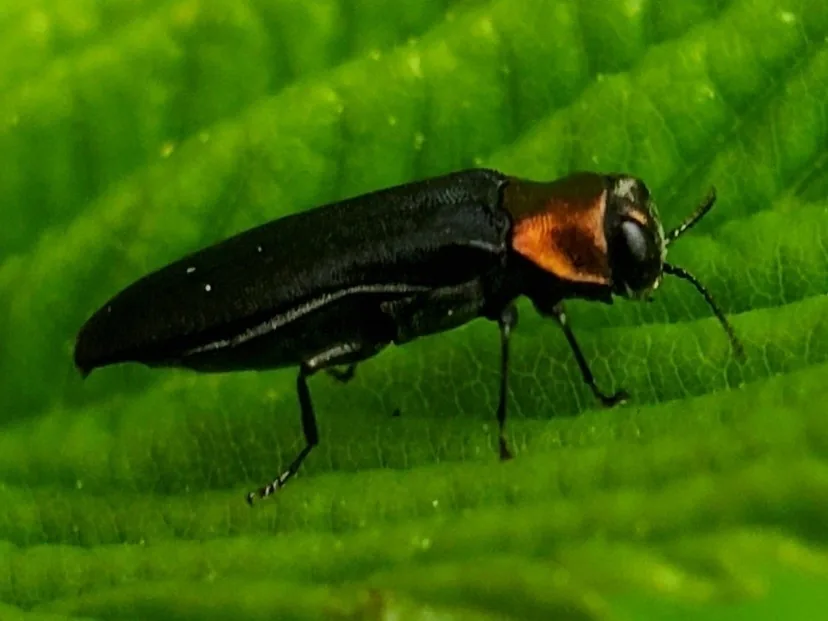
How to identify it
Where it lives
It can be a serious pest of raspberries and blackberries throughout Kentucky.[1]
Biology and life cycle
Larvae overwinter in canes and adults emerge in early to mid-June.[1]
Larvae tunnel in a spiral around the cane and then up into the pith.[1]
Damage and signs
- Infested canes die or become too weak to carry a crop, and girdled canes suffer more winter injury.[1]
Health risk
It feeds on plants; UK Extension mentions no risk to people.[1]
Control
Sanitation
During winter pruning, cut out galled canes and destroy them before bud swell, along with nearby sources.[1]
Pesticides
If pruning doesn't control heavy infestations, two sprays 7 to 12 days apart timed to adult emergence help.[1]
Common questions
Sources
- University of Kentucky Entomology (ENTFACT), “Rednecked and Raspberry Cane Borers (ENTFACT-209).” entomology.mgcafe.uky.edu/ef209 (accessed 2026-10-06)
- iNaturalist, “Agrilus ruficollis taxon page (order and family).” www.inaturalist.org/taxa/130012 (accessed 2026-10-06)