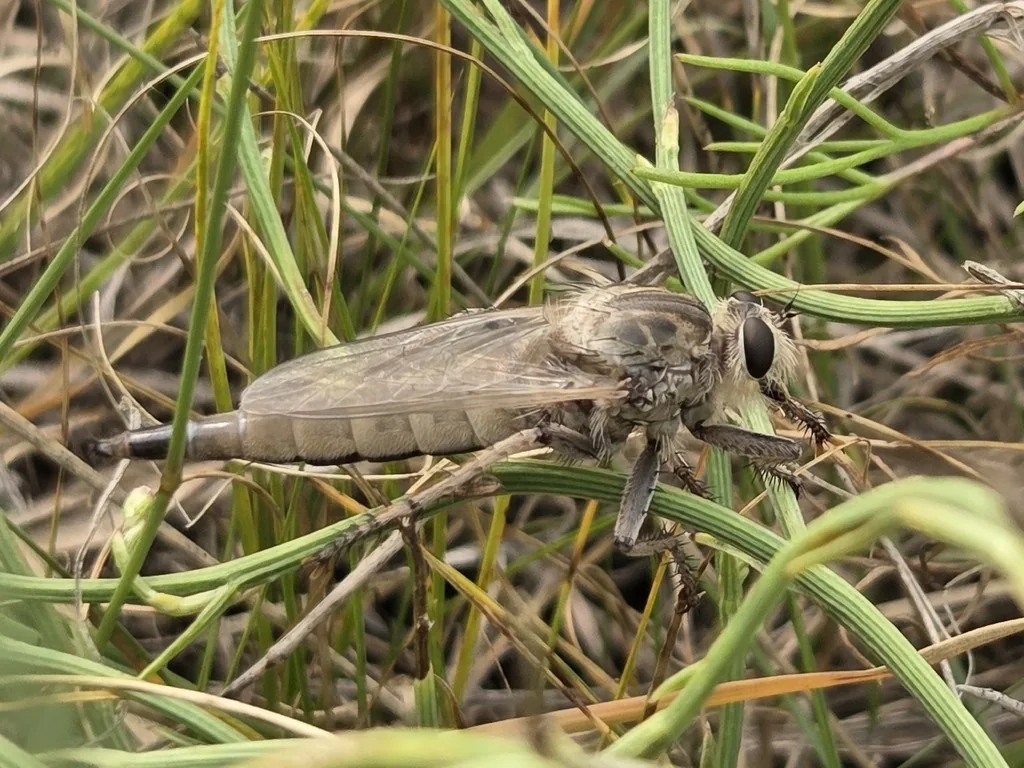
How to identify it
- Adults are bristly or hairy flies with a long, slender, tapering abdomen; many look humpbacked and most are gray, brown or black.[2][1]
- All robber flies have a distinctive dip on top of the head between their large, prominent eyes.[1][3]
- They have long, strong, bristly legs for grabbing prey; most are about 1/3 to 2/3 inch long, though some reach 2 inches.[1][3]
- Some species are stout and hairy and closely mimic bumble bees.[2][4]
Look-alikes
| Look-alike | How to tell them apart |
|---|---|
| Bumble bees | Bee-mimicking robber flies can be told apart because, as true flies, they have only one pair of wings.[3][4] |
| Bee flies | Stout, yellow-haired flies often seen hovering or resting on flowers, with wings frequently marked by dark patterns and held outstretched.[3] |
Where it lives
Nearly 1,000 species live in North America. They are most common in open, sunny and semi-arid habitats, especially dry, sandy areas, and are scarce deep in woodlands.[2][1]
Biology and life cycle
Adults wait on a perch and seize prey in flight, injecting saliva that quickly paralyzes and digests the victim; they then suck out the liquid meal.[1][4]
They take bees, wasps, dragonflies, grasshoppers, beetles, butterflies and other flies, and some species specialize in grasshoppers.[2][3]
Proctacanthus milbertii, sometimes called the Missouri bee killer, actually eats mostly grasshoppers and moths; honey bees make up only about 4% of its diet.[2]
Larvae live in soil or decaying wood and feed on insect eggs, white grubs and other soft-bodied insects. Development takes one to three years.[2][1]
Adults live about three months and are seen through the summer; males are territorial.[2]
Damage and signs
Health risk
Robber flies are not considered a health threat, but adults handled improperly, especially larger species, can inflict a painful bite.[2][3]
Control
Prevention
No control is needed; they are considered beneficial predators of many pest insects.[3][2]
Traps and physical control
Avoid handling robber flies with bare hands, since larger species can bite when handled carelessly.[2][3]
Biological control
To encourage them, plant nectar flowers such as goldenrod, since adults need sugar as well as protein before laying eggs.[2]
Common questions
- Do robber flies bite people?
- Only if mishandled. Larger species can give a painful bite when someone grabs them carelessly.[2][3]
- Are robber flies good to have in the garden?
- Mostly yes. They eat many pest insects, and their larvae may help reduce white grubs, wireworms and grasshopper eggs, though adults also take some bees.[2][3]
- Why does a robber fly look like a bumble bee?
- Some species, such as Laphria, mimic bumble bees so predators mistake them for something that can sting.[4][2]
Sources
- University of Florida/IFAS Extension, Featured Creatures, “Robber Flies, Asilidae (EENY-281, revised September 2024).” edis.ifas.ufl.edu/publication/IN557 (accessed 2026-10-06)
- University of Wisconsin-Madison Division of Extension, Wisconsin Horticulture, “Robber Flies, Asilidae (reviewed February 2025).” hort.extension.wisc.edu/articles/robber-flies-asilidae/ (accessed 2026-10-06)
- Texas A&M AgriLife Extension Service, Department of Entomology, “Robber fly (Field Guide to Common Texas Insects).” texasinsects.tamu.edu/robber-fly/ (accessed 2026-10-06)
- Mississippi Entomological Museum, Mississippi State University, “The Robber Flies, Order Diptera, Family Asilidae (fact sheet 36, September 2023).” mississippientomologicalmuseum.org.msstate.edu/MIMS/FactSheets/36_Asilidae.pdf (accessed 2026-10-06)
- iNaturalist, “Proctacanthus milbertii taxon page (order and family).” www.inaturalist.org/taxa/61644 (accessed 2026-10-06)